
Chief Engineer
Tuesday October 17th 2006, Author: James Boyd, Location: none selected

While the design team at Alinghi is led by Grant Simmer, who famously was part of the winged keel Australia II winning crew in 1983, a man who reluctantly admits his involvement with the America's Cup goes back even further is Chief Engineer, Dirk Kramers. The US-based Dutchman once upon a time was mast designer for the Courageous campaign in 1977 and has since been involved with many of the top Cup teams including America3 and Young America before being signing up as one of the early recruits for the then fledgling Alinghi team in 2000.
Kramers and his engineering team, including Kurt Jordan, Aaron Perry and Brett Ellis, work out of the open plan design office at the Alinghi base in Valencia, although Kramers is soon to decamp temporarily with the team to Dubai, where they will spend the winter months training. Working alongside the engineers in the 16 or so strong design group are the 'hydro' team, the yacht designers such as Rolf Vrolijk, Manolo Ruiz de Elvira, head of CFD Michel Richelsen and fellow CFD guru Jim Bungener. They focus on the hull shape and the appendages, while Vrolijk and Kramers keep an eye on the big picture, such as the general layout of the boat. Then there are mast designers like Kirst Feddersen, sail designers like Luc Dubois, Patrick Mazuay and Mike Schreiber plus a whole roster of computer/performance monitoring specialists.

Left to right: Dirk Kramers, Rolf Vrolijk, Luc Dubois and Manolo Ruiz de Elvira.
The computer boffinry within group has expanded since the last Cup cycle and Kramers reckons they now have as many software engineers as they have 'real' engineers. But the result is that they are able not only to record real data, load cases from pretty much any aspect of the boat - the sails, mast, hull, appendages, even crew performance - but significantly, they can now integrate it all together. "15 years ago you had one gadget that would make you go faster, another gadget which will make you go faster, etc and now we are able to figure out what the interaction between all the gadgets really is," says Kramers."'You don’t want that gadget because that gadget counteracts this one, etc' So it is much better integratation and the tools are much better of tying it all together."
As ever, the design process is heading in the direction of that ultimate holy grail - being able to perfectly model every aspect of an America's Cup boat in the virtual world. While previously teams worked with separate weather or structural or hydrodynamic models, now these are all tied together. "It is just a slow development," continues Kramers. "There are no big steps that you make. You started a project on the last Cup and you weren’t able to implement it there, so you just follow into it with this Cup. So that’s great. If a team can continue like that through several campaigns, it makes it that much stronger. Before there was no continuity."
This is now the fifth America's Cup to be held in the present style of boat, even if the rule has been slightly modified this time round with one tonne (or 4%) shaved from the displacement and a little more downwind sail area. In design terms Kramer says they are at "the thin end of the funnel". "It gets more difficult as the class gets older. It gets so refined and all the performance differences we’re looking for are so small so the focus changes and it gets harder to make big leaps. You are always trying to come up with new ideas and every time you stub your toe and get another rule which prevents you from doing that."
From the engineering standpoint, Kramers says that from generation to generation of Cup boat everything has got lighter and lighter, but surprisingly less complex. "As far as numbers of bits of rigging and so on it has been getting simpler and more and more refined. That is mostly a function of having better tools and knowing our loads better."
They are constantly examining new materials they might use, be it fibres, resins or metals and Alinghi work closely with the Ecole Polytechnique Fédérale de Lausanne university, who carry out most of the materials development work as well as CFD. While Michel Richelson has some serious computing horsepower at his disposal within the Alinghi base to run CFD models night and day, the computing horsepower is greater still in Lausanne.

At present the team are heavily immersed in a testing cycle with the first of their two new boats, SUI91, with the second due for launch at the team's builder, Decision in Switzerland in March. With the boats now skirted, obviously teams have been concentrating more on developing their appendage packages in recent months.
While the challengers have been regularly racing each other off Valencia since the end of this year's Acts, Alinghi have not been able to join in. It should be remembered that in the America's Cup the job of the challengers is to come up with the most likely candidate (ie the winner of the Louis Vuitton Cup challenger selection series) with which to topple the defender and while Alinghi previously have been training against other teams, since the Acts, the challengers have been closed ranks, not wanting to give Bertarelli's team any further assistance.
2006 has been the year that teams have been taking to the water in their new Version 5 boats. Of the ones so far launched Kramers reckons Emirates Team New Zealand's NZL 84 has been the most extreme. "It is the most radical in terms of shape, the bow. It is very slab-sided, it is a very boxy looking boat. It is extreme in cross-sectional shape. As far as its gross dimensions it doesn’t seem to be that extreme. They seem to be able to make it go fast. Their new boat is coming out in a couple of weeks and it will be interesting to see what that is like and I’m sure it won’t be any slower than 84."
Luna Rossa is in Kramers' opinion the best looking of the new boats, even if it wasn't a star performer in this year's Acts. "You can’t read too much into this year’s results. Everybody has a different pace they do things at. Usually you do your boat development and radical things early on and you learn from that and at some point you have to switch over to sailing and team development. If 85% of our time we spend testing that doesn’t help the helmsman get any better at starting, so at some point you have to start working on that as well because you can’t have weaknesses in any of the spots."
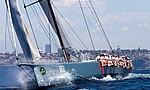
Meanwhile Alinghi are in an envious position. While the challengers were trying out their new hardware in the Acts this year, so Alinghi continued to race SUI75, their second 2003 generation boat. SUI75 was uprated to Version 5, but impressively proved still to be on the pace against the brand new boats. Assuming SUI91 is yet another leap ahead one wonders what chance the defenders have. This is where of course America's Cup politics come into play and at Alinghi they will be very aware of the psychological higher ground this has given them over the defenders.
With such a potential advantage surely there must be some desire to hold back on revealing their technology on the race course? "When you show up on the start line you want to win," retorts Kramers. "There is no sandbagging as they used to say. But would we race other teams in our brand new boat? You’d think about that twice."
For a design team with so many sky-high IQs, squeezing another thousanth of a percent performance increase out of a Cup yacht, a job many have been doing for 15 years or so now, must seem like drudgey in the extreme. Kramer does not seem a man bored by this, but admits that the most enthused discussions in the Alinghi design offhce tend to be about the more extreme development classes.
"In the office we talk about boats all day long. And then occasionally we talk about 'real boats': Moths or A-Class cats! In Switzerland we had this road show in Geneva and there was a guy out there with a foiling Moth. Jordi Calafat and Pete Evans went out on it and that’s all they have been talking about since they came back!" Back at home in Rhode Island, Kramers is good friends with C-Class guru and Cogito skipper Steve Clarke.
Obviously it is sad that these development classes have no relevance to America's Cup design and there is a whole philosophical debate to be had over whether match racing in fast boats is good for the Cup. "I think you could do it," Kramers gives his view. "It would be completely different. You always think about match racing the way it is now, boats bow to stern, dial-ups, leebowing, etc. If you go into catamarans you could never have a leebow. It would be a completely different thing. It would be just as tactical, but it would be a completely different sport. There are not enough people who truly understand all the ins and outs of the racing now. Especialy in the America’s Cup - you watch the start and you ask who crossed the line first? This guy did, but we know the wind is going right, so this is why the other guy is on the right..." Perhaps this is one of the problems with getting the public interested in the America's Cup - it is all too much about subtle nuance and not enough crash and burn.
But then the racing itself is only a part of the America's Cup jamboree. As Kramers puts it: "The Cup in itself is not just a sailing sport. It is more a game. Management, finance, PR, boat building, designing – it is just that the final exam happens to be a sail boat race. "
Most Read
Most Commented
Comments
Businesses
Pro businesses
Editor's choice
Member blogs
-
 Ned Collier Wakefield: MOD70 round BarbadosWell that was intense. 12 hard fought for seconds for the win. In idyllic conditions, Tony Lawsons MOD ...
 -
 Mini Transat leg 2 reportThe second leg of the Mini Transat started on 31st October, just over a month after ...
 -
Leg 1 reportI’ve been working towards the Mini Transat now for three years. In 2013 I was part ...
Business blogs
-
 The Island Sailing Club in Cowes, Isle of Wight, is delighted that Prince Michael of Kent ...
 -
Peta Stuart-Hunt chats with the 25 year-old British solo sailor Lizzy Foreman before she sets sail ...
-
The 2015 Student Yachting World Cup (SYWoC), an ISAF-recognised event hosted and run by students for ...
Editor's Choice
All time favourites...
-
 Three legs down into Ian Walker’s
 -
 Winning all but two races at
 -
 For the first time in its
Latest Comments
Add a comment - Members log in