
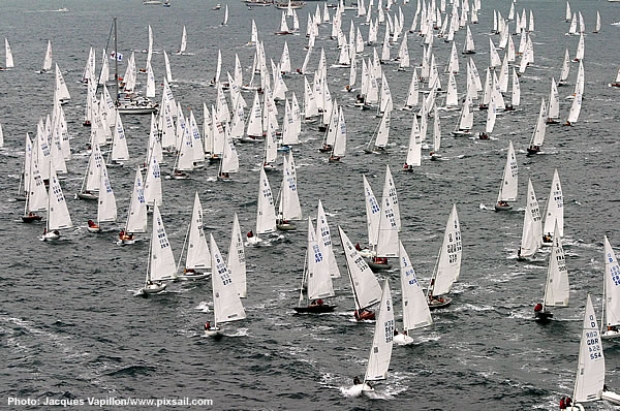
78 and still going strong
Thursday August 31st 2006, Author: Toby Heppell, Location: United Kingdom
First seen in 1928 the Dragon is no new boat, but a lifetime of refinement and slow development combined with stunning good looks and a largely well-heeled and enthusiastic ownership, including a smattering of European royalty has insured this class has remained hugely popular, attracting many top sailors to come back to sail the boat time and again.
One such sailor, and now Dragon builder, is Dane Poul-Richard Hoj-Jensen - the man behind Petticrows boat building yard in Burnham, UK. Hoj-Jensen had his first taste of Dragon sailing in 1969 when the boat was still an Olympic class. He qualified for and sailed in the Olympics in 1972, however, this was to be the Dragon’s last Olympics as it was promptly replaced by the Soling. He started sailing the new Olympic class boat but continued to sail Dragons on the side while winning two Gold medals in the Soling at the 1976 and 1980 Olympic Games.
Following this 12 year long, highly successful sailing career in the Soling, Hoj-Jensen returned to Dragon sailing in a much more down to earth way. At this time he began to get involved in selling Dragons, being first asked to be a dealer for Petticrows, before being asked to become a partner in the company. This handing of responsibility to sailors has continued recently as half of the company has been sold to Tim Taviner who originally made Finns with Devoti. Taviner will be taking over much of the management of the company to ensure the future of the boat yard.

Hoj-Jensen believes strongly the reason the Dragon class has survived so well is because it has developed, albeit at a slow pace, over the years. “I think what started the boat up and brought it to so many different people in so many different countries was definitely its Olympic background. Of course after the Olympics the boat would have stopped being sailed unless they decided to develop it and allow builders to make it in glass fibre. So the class took the decision to do that which meant they were able to build some cheaper boats.” The class allowing glass hulls and aluminium masts to be used prevented boats from getting increasingly expensive – something which post-Olympics would almost certainly have caused its extinction.
This change to glass fibre has not been handled in exactly the way Hoj-Jensen would have wished. In order for the class to keep the old wooden boats competitive the new, naturally lighter, fibreglass ones had to be built heavy, or with correctors in them. Hoj-Jenssen argues, not only would a lighter boat increase the performance but also would make the boat easier to get from event to event. ”I tried to talk to the class about ten years ago because I think a long way in the future it will become harder and harder to tow the boat in Europe because it is 1700kg. The class was not keen to and maybe it will not be a problem. We will have to see,” he says.
The change from wood to glass fibre does not mean builders are not allowed to build the boats from wood any longer, just that they are allowed to build them in glass fibre if they want. Typically most new Dragons ordered are built from glass fibre but some people still like the idea of a wooden boat. “We have built 23 wooden boats, in fact we built one last year. The thing is now it is getting more and more complicated to get the wood we need to build them,” comments Hoj-Jensen. Originally Dragons were planked – there is still a German builder who makes them this way – now the wooden Dragons built by Petticrows are made from cold moulded mahogany, an expensive material and process but one which produces beautiful boats. “There is no performance reason to have a wooden boat - the glass fibre is just as quick - but if you love it and you really want it then it is nice to have a wooden one. It takes a lot of time to build them in wood and obviously we still have to build them to the rules and build them down to weight, which is where the time is,” he continues.
The Dragon is an expensive boat to buy whether it is in fibre glass or not. Although they can turn out one boat a week at Petticrows a brand new base model Dragon will still cost £38,800. The Wooden boats cost significantly more money due to both the material cost and the amount of labour involved – it takes Petticrows an entire year to build a wooden boat – they come in at just under £100,000 but are, we have to say very beautiful indeed.

With its long history of development it is not surprising the Dragon continues to change even to this day. Dragon builders have been given permission recently to vacuum mould their boat leading to better working conditions and hopefully better quality end product. Big decisions like this can often be a long slightly tedious affair. For instance Petticrows have been working on a resin they would like to use for the vacuuming of their hulls recently but have been waiting for permission from the class association “We have spent two years working out how to do it but then we have been waiting eight years for permission from the class and now everyone is happy. It can be a problem sometimes because the class can be a little bit conservative on the one hand. On the other hand maybe that is good because everything is discussed fully before it actually happens,” comments Hoj-Jensen.
It is not just building techniques being developed in the class; the hull shapes as well as deck layouts are also being constantly modified. ”We have made four different designs in my time,” explains Hoj-Jensen. “Some years ago we decided to focus more on the downwind performance because we stopped doing triangles and started doing windward-leeward courses. At that time we were all so close upwind we thought, we will have to try and do something downwind. We decided to make the boat more flat on the bottom and more round in the front. That was about six or seven years ago.” Interestingly much of the hull shape development goes on in the wooden boats where the design is easier to modify which in turn helps builders to take this knowledge over to the glass fibre ones. Hoj-Jensen says many of the people who buy wooden boats understand this and are happy to be a part of the class’ development and future.
In addition to these fairly major hull modifications there are other more minor differences taking place all the time. “On the latest boat the combing is rounded so you are sitting better and the main traveller beam is made in glass fibre now and integrated with the deck. This means it is not a fitting anymore and is a part of the deck, so it can be weighed in as a part of the boat and does not need to be taken off before weighing.”
However, not all of these new ideas and modifications stay on the boat as some are deemed to be bad ideas and others no longer necessary. Hoj-Jensen says there is a Dragon they built where the class was planning on changing the rules making it illegal to make a new boat without 2300 litres of buoyancy in the tanks. They began building boats with the necessarily large side tanks then the class decided builders could add foam buoyancy in the bow to make up the missing buoyancy. Obviously as a result of this the tanks were changed back to their normal state.

Much of this development done by Petticrows is to make the boat easier to sail for a wider group of people. As well as making Dragon hulls they make masts, available in a variety of sizes and styles. This leaves the sailor with many options at their disposal, so a light team can buy a flexible mast and a heavy team a stiff one. Also they are working on a rig without adjustable jumpers for crews who do not always have the same front man, and whoo need a simpler set-up.
The idea of technology and set up over physical ability is perhaps something with a long history in the class. “I would say you do not need to be an Olympic sailor to sail a Dragon, if you have a good crew on the boat then you can manage very well. It is still so much a keelboat unlike an Etchells or a Soling where you have to be much fitter. You do not really have to be that fit to sail a Dragon - you should be fit but you do not have to be,” says Hoj-Jensen. He suggests this is the reason so many Royals sail the boat, they are able to get in one with a good crew and sail well even when they can’t sail everyday like a professional.
Certainly the Dragon is a beautiful boat and it is not going anywhere in the near future. It is always interesting in a class like this to watch the battle between innovators like Hoj-Jensen and more conservative class members actually turn out the perfect compromise. A boat that is classically beautiful, hard to sail really well with a wealth of sailing talent heavily involved - this is clearly a class here to stay.

Most Read
Most Commented
Comments
Businesses

Pro businesses
Editor's choice
Member blogs
-
 Ned Collier Wakefield: MOD70 round BarbadosWell that was intense. 12 hard fought for seconds for the win. In idyllic conditions, Tony Lawsons MOD ...
 -
 Mini Transat leg 2 reportThe second leg of the Mini Transat started on 31st October, just over a month after ...
 -
Leg 1 reportI’ve been working towards the Mini Transat now for three years. In 2013 I was part ...
Business blogs
-
 The Island Sailing Club in Cowes, Isle of Wight, is delighted that Prince Michael of Kent ...
 -
Peta Stuart-Hunt chats with the 25 year-old British solo sailor Lizzy Foreman before she sets sail ...
-
The 2015 Student Yachting World Cup (SYWoC), an ISAF-recognised event hosted and run by students for ...
Editor's Choice
All time favourites...
-
 Three legs down into Ian Walker’s
 -
 Winning all but two races at
 -
 For the first time in its
Latest Comments
Add a comment - Members log in