
Inside the Glove
Friday July 21st 2006, Author: James Boyd, Location: United Kingdom
As we have seen recently at the Rolex Commodores' Cup and this week in Cork, Ireland has gone new custom-built race boat crazy this year. Over the last 18 months these have including Eamon Conneely's TP52
Siemens (ex-
Patches), Ger O'Rourke's canting keel Cookson 50
Chieftain, Colm Barrington's Ker 50
Magic Glove, Tim Costello's Mills 40
Tiamat, David Dwyer's Mills 39
marinerscove.ie, Conor and Denise Phelan's Ker 37
Jump Juice, Eamonn Rohan's Corby 35s
Blondie and
Antix. In the UK in comparison we've had John Shepherd's Ker 46
Fair Do's VII and Ian Maclean's Ker 36
Software Mistress.
Theories about why the sudden upsurge in Irish grand prix racing is taking place range from a booming economy to peer pressure among owners, perhaps i all reality it is a bit of both. Whatever the reason it is excellent news for keelboat racing and one hopes this trend will be picked up in the UK as well.
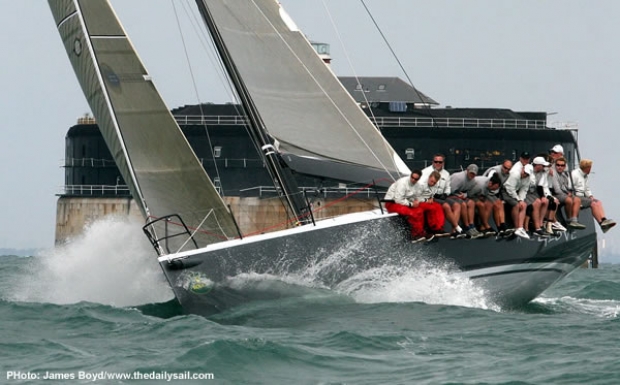
Of the new launches this year the most talked about is Colm Barrington's new silver hulled Ker 50, Magic Glove. She was built as Barrington's previous Flying Glove was, down in South Africa using a carbon foam cored laminate by the same team led by Tony Evans that built Team Shosholoza's new boat. While mentioning her Rolex Commodores' Cup result is unlikely to illicit a polite response from her owner, this week at Cork Barrington is making up for it having scored the impressive tally of five bullets and a second place discard in his silver streak.
Magic Glove is one of three new IRC custom boats Jason Ker and his team have designed that have been launched this year the others being another 50, Snow Lion and the 37 Jump Juice. Fair Do's VII was also launched this year but is a previous generation design, her launch held up when her initial builder, Bizarre Yachts in Lymington went bust. Snow Lion was built by New England Boatworks in Rhode Island for American owner Larry Huntington and while similar to Magic Glove is designed more for short handed and offshore racing. She recently won class 9 in the St David's Lighthouse Divisio under IRC in the centennial Newport-Bermuda race by a healthy margin and is expected to compete in next year's transatlantic race.
In comparison to Ker's last 50 footer Aera, the new boats have been more cruiser racer orientated and have a modified hull shape and a pronounced spoon bow (curved forefoot), he says. "We did some CFD work and some tank testing to verify we were making progress forwards.". The tank work, the costs split between the owners of the three new boats, was carried out using one third scale models at the facility in Bulgaria where Ker has also been carrying out runs for the Team Shosholoza Cup boats.

From his position as Principle Designer for the South African team, Ker has been able to transfer some of his new found Cup design know-how to his latest IRC designs. Most apparent is the trim tab on the trailing edge of the keel found on Magic Glove and Jump Juice but not on Snow Lion. "Offshore it is definitely not worth having the trim tab so Snow Lion had hers locked off for the Bermuda Race. It is of no benefit at all if you’re running but it is good for races where you have a decent amount of upwind racing. It is nice to have height and speed off the line and upwind generally. In most types of racing you will always give away downwind competitiveness for upwind competitiveness," says Ker.The trim tab has this effect and is a useful tactical weapon, although Ker acknowledges that it takes some getting used to, a sentiment echoed by many of the crews struggling with them at the Rolex Commodores' Cup. "You have to be set up right to get the full benefit out of it," the designer warns.
While trim tabs on Cup boats are operated by a wheel within the main steering wheels, on the new Ker boats it is simply moved by a continuous line, the two ends of which emerge just forward of the backstay and pull the tab in different directions. Aside from the method of control the gear is exactly the same, although scaled down, to what is used on Cup boats: the lines control a worm drive with a lock and leave, non-return-type gearing enabling the tab to altered by up to +/- 7°, its aspect shown on one of the B&G displays. "Normally the tactician or someone else at the back of the boat controls the trim tab and obviously it needs to be controlled in the tacks and then sometimes small adjusts need to be made when you are sailing along in a straight line," says Ker.
The tab itself is around 250mm across, representing around 35% of the keel, and does not taper top to bottom. While a fractional amount of tab is used to keep the foil asymmetric downwind and reaching, upwind it is full on in anything above 14 knots of wind when boat speed is around 8.3-8.4 knots. Less tab is used at speeds below this and when the boat is tacked.
The effect on the water is unusual. "We are getting used to it You can see the difference as we can hold off the TP52s no problem," says Magic Glove boat captain James Hynes. "It is strange to see it because we are sailing bow down the whole time, while they are pointing up but we all come out on the same angle. So we’re just going fast and we never pinch so we’re never out of the groove and it just drive, drive, drive...."
Ker estimates that there is a 1.5% penalty for using the trim tab under IRC but he thinks it worthwhile. "It depends a lot on the type of boat. Some boats don’t benefit nearly as much from a trim tab as others." Essentially it works better on boats that are wider at the transom or ones where the hull shape are affected by moving sideways.
As to the rounded spoon bow Ker says there are pluses and minuses to this. "It gives you a bit of reserve buoyancy above the water line, so at speed you pick up that extra length. When you are heeled most of these modern boat shapes go bow down but with this when it goes bow down it picks up extra length so there is a subtle benefit there. Also if you have a vertical stem that comes down into the water and you go bow down you can have balance issues. So if you cut away the forefoot slightly you reduce those issues."
Compared to their previous generation of boats like Fair Do's VII, there are minor differences in that the ratio of the bulb weight to the overall displacement. As a rule Ker says they used to keep this below 50% but thinks that for this year this constraint has been removed from the IRC rule and so they have gone slightly over this ratio mainly by reducing hull weight.
Having had a look around Magic Glove, she is a good looking boat, with her smart metallic silver paint job and her rounded cabin top and the effort the team that put her together went to, to ensure the deck gear was all black or dark grey and that the maximum amount of cordage was run below deck Wally-style.
Compared to Flying Glove, the new 50 has a pedestal in the cockpit and also has an unusual main halyard arrangement where the dead end feeds down to the mast step below deck and then is threaded up to the cockpit where it can be ground from the pedestal. In practise to ease luff tension they ease the tack rather than the halyard.
The boat has a bowsprit rather than a pole, on the basis that the boat being 50ft long it should be developing enough apparent wind that running square would rarely happen.
Above decks her rig is effectively a scaled up version of Flying Glove's but with an AC-style hydraulic outhaul where the car on top of the boom is push directly by the ram rather the ram pulling a conventional rope attached to the clew.
In terms of their general philosophy Ker says they have tried to make sure the new boats are as nice to sail as possible and that they haven't go out on a limb to try and beat the rule. This results in longevity and a better resale value.
Looking forwards Ker expects to soon be touting plans for a new semi-production 39ft racer cruiser to his design, built probably in Eastern Europe and finished in the UK. This is the same size as Barrington's previous boat Flying Glove and is a 'sweet' size as items like the interior, engine and deck gear weighs as much as it does on a 37 footer, reckons Ker. The result will be a boat that is almost as competitive as a custom built one, but at a very much more competitive price and this Ker feels will appeal more to British owners.
"Class 1 this year - that is where things start hotting up," says Ker, adding: "With all the Irish guys coming into people currently in Beneteau 40.7s and Primas, hopefully they’ll see these new custom boats and say ‘that looks more fun’ and will start thinking of changing up to maybe not a custom boat but a production boat of a similar type."

Most Read
Most Commented
Comments
Businesses

Pro businesses
-
Italy
-
United Kingdom
-
France
-
Editor's choice
Member blogs
-
 Ned Collier Wakefield: MOD70 round BarbadosWell that was intense. 12 hard fought for seconds for the win. In idyllic conditions, Tony Lawsons MOD ...
 -
 Mini Transat leg 2 reportThe second leg of the Mini Transat started on 31st October, just over a month after ...
 -
Leg 1 reportI’ve been working towards the Mini Transat now for three years. In 2013 I was part ...
Business blogs
-
 The Island Sailing Club in Cowes, Isle of Wight, is delighted that Prince Michael of Kent ...
 -
Peta Stuart-Hunt chats with the 25 year-old British solo sailor Lizzy Foreman before she sets sail ...
-
The 2015 Student Yachting World Cup (SYWoC), an ISAF-recognised event hosted and run by students for ...
Editor's Choice
All time favourites...
-
 Three legs down into Ian Walker’s
 -
 Winning all but two races at
 -
 For the first time in its
Latest Comments
Add a comment - Members log in