
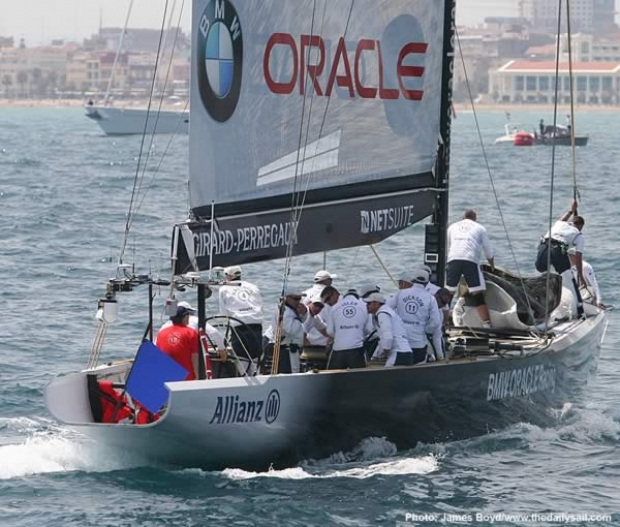
What lies beneath...
Wednesday May 17th 2006, Author: James Boyd, Location: United Kingdom


Now that skirting has been re-introduced for the America's Cup teams so the conjecture and conspiracy theories have returned with a vengeance over what lies hidden beneath...
Certainly the most theorising has gone on about BMW Oracle Racing's Act 10 winner USA-87. This came about following her impressive launch when protruding through a 'water screen' and engulfed in smoke came a bowsprit. Cup boats usually don't have bowsprits.

However this was not the talk of the Valencia tecchie tupperware parties so much as the location of the mast - roughly a 1m further forwards than on other boats it was surmised. This could only indicate some form of unconventional appendage package hidden beneath the new girl's skirt, so the discussion went, an argument line fuelled further by the presence of Ian Burns and Bruce Farr in the BMW Oracle design team both of whom have previous with such things. In fact the mast being further forward in the boat may be an illusion as the reason for the bowsprit is believed to be due to the foredeck of USA-87 being shorter. This is best illustrated by location of the forestay chainplate, closer to the bow than on other Cup boats.
Other experts we spoke to such as Terry Hutchinson and Dee Smith both of whom have raced against USA-87 this week seemed sceptical over there being anything unconventional in her appendage package.
But why spoil a good story? What is undeniable is that on the water this week USA-87 has proved to have the turning circle of a London taxi and she also has the strange ability to stop dead in the water almost as if a handbrake had been applied. Both these are useful weapon's in Dickson's pre-start armoury. The boat also at times shows the unusual sideways sliding 'shopping trolley' movement of a boat hiding more than one steering appendage beneath the water.
 In interviews with those involved with the America's Cup we have learned the hard way that you get laughed at if you ask direct questions such as 'what appendage package do you have?' Nonetheless we sit down with America's Cup legend Ian 'Fresh' Burns, BMW Oracle Racing's Design Co-ordinator to talk around this particular question.
Unusual appendage configurations are nothing new in the America's Cup. Having a trim tab on the keel foil is now almost standard-fit on Cup boats and was a device developed by Dick Carter and first seen in the Cup on the Olin Stephen's designed 12m and 1967 and 1970 winner Intrepid where it was used originally as a device to help the transition from long keels to fin keels. As everyone was going appendage crazy following Australia II's successful wing keeled challenge in 1983, so Tom Blackaller campaigned a boat, US-61 four years later with a forward steerable rudder/canard, a la CBTF system.
Such appendage whackiness has not been limited to 12 metres. Come the advent of the new America's Cup Class in 1992 so no less than four boats in that contest had some form of twin keel appendage arrangement. The most successful of these was the Farr-designed NZL-20. 'The little red skiff', as she was known, made it through to the finals of the Louis Vuitton Cup winning four straight races off Il Moro de Venezia V, before she was nailed by Paul Cayard in the protest room for use of a bowsprit (sound familiar?) NZL-20 was fitted with a 'tandem keel' where two keel fins support the fore and aft ends of the bulb. These foils also used to steer the boat i place of a conventional spade rudder. On NZL-20 the foils were steered from separate wheels on deck operated by David Barnes and Rod Davis. (Subsequently David Barnes went on to become General Manager of GBR Challenge where he persuaded the powers that be that GBR-78 should have a similar tandem keel set-up).
"A lot of people were stunned by how well that boat sailed at certain times," recalls Ian Burns of NZL-20. "At other times it struggled a little bit but there were a lot of other peculiarities about that boat - its displacement, length and sail area - that I think left a lot of questions in people’s minds about the ultimate potential of that configuration. It makes for quite a steering and structural challenge but gives you total controllability of the boat if you can get them both pointed in the right direction at the right time."

In 1992 Burns was involved with Iain Murray's Spirit of Australia campaign on AUS-21, another tandem keel yacht. With that campaign Burns remembers that half way through the Louis Vuitton Cup they got serious with diamond saw and carbon fibre cutting out the middle section of their boat to fit a new forward keel foil that could be steered. "Making such dramatic changes in the middle of a regatta your chances of getting things wound up are pretty slim," continues Burns. "That was classic small, one boat program stuff. It was pretty a low budget, under staffed, under funded campaign, but it was an interesting project and a lot of people involved with that project saw there was some merit with it."
The advantages of the tandem keel is that it provides a better support structure for the keel bulb and also it is less draggy as the combined foil area is smaller, the sections working closer to the optimum. ".In theory there are pretty good gains," says Burns. "There are also some gains in not having the main lifting body right under the middle of the trough of the wave the boat makes going through the water so combine those two things, there is potential for it to be quite an exciting package. The main challenge is to try and get the foil systems to work - to point in the right direction. If you want to turn there is twice the problem we now have with only one control surface that steers the boat." However the engineering challenge is made all the harder as in addition to having to hold a 20 tonne load, the foils are also steerable.
So does USA-87 have something similar - a tandem keel or a steerable forward canard? Has the resale value of GBR -78 just gone up? We may have to wait until the boats are de-skirted prior to Act 12 next year to find out...
In part two of our interview tomorrow Ian Burns discusses jumper-less rigs, bow profiles, the constraints of Version 5 of the America's Cup Class rule and how to manage a design team including both Bruce Farr and Juan Kouyoumdjian...


Most Read
Most Commented
Comments
Businesses
Pro businesses
-
Italy
-
United Kingdom
-
United Kingdom
-
Editor's choice
Member blogs
-
 Ned Collier Wakefield: MOD70 round BarbadosWell that was intense. 12 hard fought for seconds for the win. In idyllic conditions, Tony Lawsons MOD ...
 -
 Mini Transat leg 2 reportThe second leg of the Mini Transat started on 31st October, just over a month after ...
 -
Leg 1 reportI’ve been working towards the Mini Transat now for three years. In 2013 I was part ...
Business blogs
-
 The Island Sailing Club in Cowes, Isle of Wight, is delighted that Prince Michael of Kent ...
 -
Peta Stuart-Hunt chats with the 25 year-old British solo sailor Lizzy Foreman before she sets sail ...
-
The 2015 Student Yachting World Cup (SYWoC), an ISAF-recognised event hosted and run by students for ...
Editor's Choice
All time favourites...
-
 Three legs down into Ian Walker’s
 -
 Winning all but two races at
 -
 For the first time in its
Latest Comments
Add a comment - Members log in