
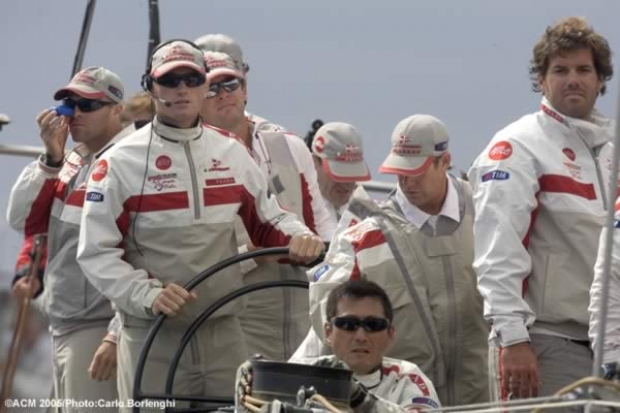
The unstoppable Aussie
Wednesday April 19th 2006, Author: James Boyd, Location: none selected
If one were to define the term 'on a roll', then at present Australian James Spithill would be it. Aged just 26, Spithill is now well into his third America's Cup campaign, this time as principle helmsman for Luna Rossa. The Italian A team challenge is one of the big four in the Cup and with the exception of Emirates Team New Zealand is the oldest challenger, with what many believe to be big prospects in store for them. In addition to his regular job in Valencia, Spithill is also the current Match Race World Champion and Melges 24 World Champion.
"We've won the last six or seven events in a row - a few match race events, Bermuda, Brazil, Trieste, the Worlds and then we won another Melges regatta before the Worlds, the Atlantic East Coast Championship just up the coast from Florida, so it has been a good 9-12 months," admits Spithill modestly.
He attributes his present spate of successes to being comfortable with the people he has around him. "That just gives you self-confidence. I am really happy with the group and it says a lot to the level that is in there - I have been pushed really hard by Francesco and Philippe [Presti]. So it is fantastic."
Luna Rossa was obviously born of the ashes of the last two Prada campaigns. This time there is also a strong element of former OneWorld crewmen in the team as well as a few other fresh faces. "Philippe [Presti] has come in," says Spithill. "Andy Horton and a heap of new people and the guys I came here with from OneWorld. So it is interesting to hear what they have all got to say."
One interesting aspect of the team is that both Prada and OneWorld failed to perform as well as was expected in the 2003 Cup cycle and one wonders how well the lessons have been learned from these campaigns. "I think having made those mistakes you certainly don’t want to make them again," says Spithill. "At OneWorld we had a huge problem with funding when the stock market crashed - that is what really hurt us. When we came to race we were ready to race and we went undefeated in the first round, but we just didn’t have any of that R&D stuff which needed to be done the year before because we were trying to keep our head above water. That is the beauty of having Francesco and the guys from Prada last time and from the One World team and the other teams who have supplemented in. You have all got the different lessons that you have learned."
The sailing team has changed little over the last year with a squad capable of manning two Cup boats. This includes three helmsmen - aside from Spithill there is team head Francesco de Angelis and Frenchman Philippe Presti. "We rotate a fair bit on a day to day basis, because we have such a strong group at the back," says Spithill. "It also gives us an opportunity for one of us to sail with the other person and see a different style because we are all different and it is great to see something else and learn from it. So we mix it up and our in house racing is extremely close. We used the last year for everyone to get to know each other and we are still doing that having brought Philippe into the mix and Andy [Horton] has been a really positive step."

In terms of the division of labour between Spithill and de Angelis, the Italian is very much still the boss of the campaign, although not principle helmsman as he was for the last two Prada campaigns. "We really share the load on the sailing team," advises Spithill. "There is a group of us who makes decisions. There are no egos or primadonnas, because that’s how we’ve based the personnel we’ve signed on. We don't want any of that. Everyone comes from different cultures and experiences, there is so much good stuff out there."
Recently the Italian team were the first to launch their new Version 5 America's Cup yacht, ITA 86 in Valencia. In line with present Cup thinking that the new version of the ACC rule will make boats more similar not less, ITA 86 is thought to be a fairly middle of the road, conservative design.
Thus there was some shock when their next door neighbours at BMW Oracle Racing unveiled their new USA 87 with a mast well forward indicating some sort of forward appendage. "Obviously we didn’t think we would see any radical things, but then we looked at BMW Oracle Racing and there is something radical there, which I think it is great for the sport – something different," says Spithill. "A lot of guys have said that in a straight line some sort of configuration like that is faster, but then it is a case of can you get off the start line and can you get around the corners. A lot of guys have tried it. In a straight line it has proved to be extremely fast. Spithill believes that with the ACC box rules having got smaller for the hull, most of the development work this time around will take place aloft in the rig and sails.
As ever the hardest part of the Cup design process is making the call on how to optimise it to be competitive in the expected conditions. "You can design the best all-round boat, but you are never going to beat a guy who’s targeted his boat for 12 knots if you are racing in 12 knots. So that is the game and having the different pieces and the different set-ups, so when you race that person if you feel you are a little weak in heavy air then maybe you throw a long bulb on to get a VGC gain. So it is a full on game of trade-offs."
These days such trade-offs make tiny performance differences - Spithill talks about chasing tenths of knots, as such gains in such a heavily researched well resourced environment as the Cup are considered big jumps.
So how is he finding sailing conditions off Valencia? "The winters can be quite different. Offshore days can be quite tricky but when the sea breeze is in it is a pretty nice wind here and you can get some really nice testing heading out off the course. And we certainly haven’t seen it as a one way track. In the racing window there is a lot of opportunity for passing which makes it great and it is going to be really open. I think it is going to be a good venue."
 While Spithill says the Version 5 boats are definitely a bit more lively with their added canvas downwind and fractionally lighter displacement, the big question as he sees it is where will the class go after the 32nd America's Cup. "I’d like to see them either go bigger and get a little more powerful," he says. "You have got to have that 'wow' factor for spectators. I wouldn’t rule out swing keel. I guess the big thing is keeping the cost down which is a fair enough thing, if you want to have a lot of teams represented. The more changes you make the more cost it is going to be so you have got to balance it out and that is the tricky thing. But I think there has to be at least one major change for this class next time."
As part of the sailing team Spithill says they take a collective approach these type of decisions. "Gone are the days when you tell the designer what you want and he produces the lines for the boat builder and off you go. You are really involved in every stage because you are just playing the trade off game with what you think."
With the first Act of 2006 starting in a little over one month in Valencia so the team have been frantically trying work up their new boat. As ever Emirates Team New Zealand, BMW Oracle Racing and Alinghi are seen as the main competition, but some of the B-teams cannot be discounted. "You just don’t know. There are so many other teams like the Spanish and the Swedes who produce a boat that comes out and is more than competitive," admits Spithill.
For 2006 there is much fighting talk of some teams keeping their powder dry and not using their brand new Version 5 boats, particularly the defenders, Alinghi. Spithill reckons that this is not as likely to happen as pundits might think. "I’d be surprised. I just see it as a good opportunity. I think teams are going to line up anyway with their new boats and I think there is a lot to learn. I don’t see why they wouldn’t use them. Maybe they wouldn’t have them ready for the first Act but if it was ready for the second Act why wouldn’t they wouldn’t want to get out there and win? It would be pretty disappointing if they didn’t."
Beyond this season there is the political question of when teams will launch their second boats. "We’re still going through it right now. The Kiwis, us and Oracle were pretty similar in our timing for the first one so it will be quite interesting to see when they will bring out the next one and a lot of that will depend upon how much we learn off the first one," says Spithill.
One of the most impressive parts of the Luna Rossa campaign this time around is there fabulous new base in Valencia. While the new homes of many of the teams have modern functional exteriors, Luna Rossa have been showing their Italian flair by cladding their base using their old sails. At night time internal lights gives the building a unique glow.
While the building is an exceptional piece of architecture it is also highly functional. "We have a great facility," says Spithill. "We have a great boat shed for all the shore guys and the loft is all finished. Operationally it makes you pretty efficient, with the two travel lifts, etc. That’s what is comes down to. We have just over a year and a bit until the Cup and now we are just trying to get as much time as you can so any saving you can make we have tried to incorporate that into the design of this building."
With the Cup cycle now hotting up the opportunity for Spithill to spend time away from Valencia will become increasingly limited. Sadly this is likely to mean he will be unable to defend his Melges 24 title. What was the attraction of the American sports boat in any case? "You just don’t get a whole lot of opportunities to do fleet racing with this game," Spithill explains. "I just wanted to really learn more on my technical side, the whole set-up of the boat, making the boat go fast, because that is what we do here all the time - we are just in the boat speed game. And on the match race circuit everything is standard - which is great because you draw for boats, you don’t change the rig, all you touch is how you sheet the sails and you might touch the runner. So with the Melges it was a great opportunity to go into a high level class, but we really did start from scratch. We did a lot of work with Dave Ullman and Brian Porter and his team, and it was like a scaled-down Cup program - taking a small group of five of us."
The Worlds in Key Largo held last December were also off season at a time when the sailing team had time off.
His opportunity to defend the World Match Race title also looks set to evaporate following the merger between ISAF and the Swedish Match Tour, into the new World Match Racing Tour. "We were told it was a single event and we had planned on doing it and now we are told it may be the Tour which automatically makes it a three horse race," complains Spithill. "If that happens we’ll be pretty disappointed because you always want a chance to defend your title or at least to plan to."
Most Read
Most Commented
Comments
Businesses

Pro businesses
-
France
-
United Kingdom
-
Italy
-
France
Editor's choice
Member blogs
-
 Ned Collier Wakefield: MOD70 round BarbadosWell that was intense. 12 hard fought for seconds for the win. In idyllic conditions, Tony Lawsons MOD ...
 -
 Mini Transat leg 2 reportThe second leg of the Mini Transat started on 31st October, just over a month after ...
 -
Leg 1 reportI’ve been working towards the Mini Transat now for three years. In 2013 I was part ...
Business blogs
-
 The Island Sailing Club in Cowes, Isle of Wight, is delighted that Prince Michael of Kent ...
 -
Peta Stuart-Hunt chats with the 25 year-old British solo sailor Lizzy Foreman before she sets sail ...
-
The 2015 Student Yachting World Cup (SYWoC), an ISAF-recognised event hosted and run by students for ...
Editor's Choice
All time favourites...
-
 Three legs down into Ian Walker’s
 -
 Winning all but two races at
 -
 For the first time in its
Latest Comments
Add a comment - Members log in