
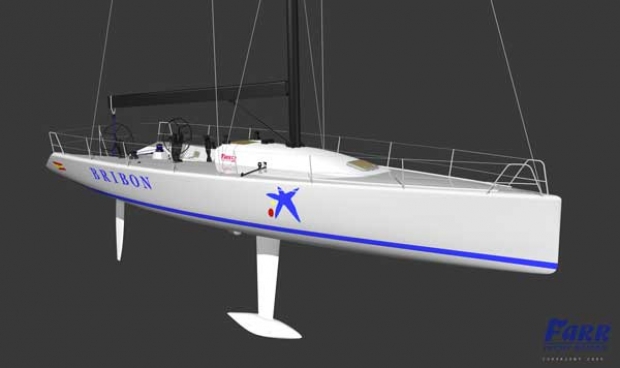
12 new TP52s for this seasons
Thursday March 31st 2005, Author: James Boyd, Location: United Kingdom
| Boat | Owner | Nat | Designer | Builder | Launch |
| Transpac 52s | |||||
| Braveheart | Charles Burnett III | USA | Bakewell-White | Lloyd Stevenson | |
| Flash | Mark Jones | USA | Alan Andrews | Westerly Marine | |
| Rosebud | Roger Sturgeon | USA | Reichel Pugh | Westerly Marine | |
| Lightwave | David Ford | USA | Laurie Davidson | Cookson | |
| Yassou | Jim Demetriades | USA | Nelson Marek | Goetz | |
| Beau Geste | Karl Kwok | HK | Farr Yacht Design | Southern Ocean Marine | Spring 2003 |
| Bright Star | Richard Breeden | USA | Farr Yacht Design | Goetz | Spring 2004 |
| Bambakou 52 | John Coumantaros | USA | Farr Yacht Design | Goetz | Spring 2004 |
| Sjambok | Michael Brennan | USA | Farr Yacht Design | Goetz | Spring 2004 |
| Trader | Fred Detwiler | USA | Jim Donovan | ML Boat Works | Summer 2004 |
| Patches | Eamoon Coneely | IRE | Reichel Pugh | Green Marine | Spring 2005 |
| Cristabella | John Cook | GBR | Judel/Vrolijk | Green Marine/Neville Hutton | Spring 2005 |
| Caixa Galicia | Vincente Tirado | SPA | Farr Yacht Design | Cookson | Spring 2005 |
| Bribon | Jose Cusi / H.M. Juan Carlos | SPA | Farr Yacht Design | Cookson | Spring 2005 |
| Sirius | Spanish Navy | SPA | Farr Yacht Design | Cookson | Spring 2005 |
| Atalanti | George Andreadis | GRE | Farr Yacht Design | Goetz | Spring 2005 |
| Orlanda | Alessandro Pirera | ITA | Bottin & Carkeek | Latini Marine | Spring 2005 |
| Pisco Sour | Vasco Vascotto | ITA | Bottin & Carkeek | Longitude | Spring 2005 |
| Quantum Racing | Doug de Vos | USA | Reichel Pugh | Barcos Deportivos, Spain | Spring 2005 |
| Pegasus 52 | Philippe Kahn | USA | Farr Yacht Design | Goetz | Summer 2005 |
| World Force | Aitor Ruiz/Eugenio Jaudenes | SPA | J. Jaudenes/Theys | Richie Faulkner | Summer 2005 |
| Team Balearia | Toño Gorestegui | SPA | Bottin & Carkeek | Summer 2005 | |
| John Kilroy | USA | Autumn 2005 | |||
| Marco Birch | USA | Autumn 2005 | |||
| Mean Machine | Peter de Ridder | NED | Judel/Vrolijk | Hakes Marine | Autumn 2005 |
| Rush | Thomas Stark | USA | Farr Yacht Design | Cookson | Autumn 2005 |
| Sotto Voce | Arien van Vemde | NED | Judel/Vrolijk | Hakes Marine | Autumn 2005 |
| Fram | H.M. King Harald | NOR | Farr Yacht Design | Goetz | Spring 2006 |
| Team Astro | Rainer Wilhelm | AUST | Luca Brenta | Spring 2006 | |
| Stuart Robinson | GBR |
As mentioned in our update on the class yesterday, at present twelve new TP52s are due for launch in time for this season, with seven more due for launch this autumn or in 2006 plus several others in the pipeline. Designer Juan Kouyoumdjian for example tells us that he is currently talking to five clients about a series of boats to be build by Killian Bushe at the same yard in Holland where the second ABN AMRO VO70 is at present under construction. Watch this space... Considering that launching a fully tooled up carbon/Nomex TP52 gets you little change from 1 million Euros (plus running costs for a fully pro crew) - this is an impressive investment in yachting hardware and personnel.
Of the 12 new boats due to race this year, a majority are going to join the Mediterranean circuit, while two - Thomas Stark's new Rush and the latest Pegasus of Philippe Kahn - are going to join the US fleet.
As ever Farr Yacht Design are the most prolific in the class and have been behind half of these 12 with four - Rush following the three Spanish boats, including the latest Bribon of Jose Cusi and the King Juan-Carlos of Spain - under construction at Cookson in New Zealand and two more - the new Pegasus and latest Atalanti for Greek owner George Andreadis - at Goetz in the US.
"There has been a great explosion of interest in these boats," says Jim Schmicher, Senior Naval Architect at Farr Yacht Design. "If you’d asked me last spring if I thought we’d have six of these boats building now, I would have said 'no'. But the interest of the people in Spain - I think there there is a lot of pent up desire to get into a different style of boat. We are still talking to four or five potential clients for 2006 - which bodes well for the class and I think there will be many more - maybe twice that many".
According to Schmicher all of the Cookson boats are the same save for some detail work specified by their owners or skippers while the hulls on the Goetz boats are the same, but they have different appendage packages due to their intended race programs - Pegasus' first race will be the Transpac while Atalanti will be heading for the Med.
Compared to last year's models built for racing in the States, the latest generation Farr boats have been optimised for slightly lower down the wind range. "This means they will be narrower on the waterline and have a smaller footprint upright for sailing in lighter winds. But they still have the ability for reaching and when they get going fast to transition to a powerful boat with good effective length," explains Schmicker.
Saying this Schmicker doesn't think there will be a difference between US and Med boats destined to race around the buoys or in long inshores. "If you came to the US and were doing buoy racing at Key West or Newport, then guess what - your Med boat wouldn’t be wildly different because the average wind strength in Key West is 12 knots and in Newport it is about the same. So you’d probably have a boat that is a little bit focussed on lighter wind, but over a two mile beat the difference - it’s probably half a boat length..."
The principle difference between TP52s, as demonstrated by the Goetz boats, will be between those looking to race inshore and those going seriously offshore or oceanic as in the case of Pegasus.
"If you were always doing buoy races you would have a particular set of appendages, tailored for having enough lateral area to get upwind well and they would have features of the bulb designed to go upwind that would reduce drag," Schmicker explains. "The other extreme is if you are doing an offshore race with lots of reaching and running and then you don’t need lateral area so you’d have a fairly small fin and you have a bulb tailored to very low drag. Those are your two extremes so if you have some combination of offshore and inshore then you might go somewhere in between. But for a Mediterranean boat doing buoy racing and a Newport boat doing buoy racing, then - voila - you have the same keel."
TP52 racing in the Med is supposed to comprise 75% round the cans and 25% or so 'offshore' although these are more accurately long inshores. Thus Farr have optimised their Med boats with 80% focus on windward-leeward racing. But the track record of TP52s in the States shows that their owners prefer to compete in more truly 'offshore' events such as the Chicago-Macinak, Bermuda Race and Pineapple Cup and boats designed now for these races Schmicker says would probably have a more powerful hull shape. However he hopes with the latest boats they have reached a compromise. "Your Med boat is - to use a loose term - is a 'smaller' boat whereas your boat for stronger wind speeds and more offshore would be a 'bigger' boat, but we have designed ours so that you can get across that transition between a smaller boat upright in lighter air and the boat that has got plenty of effective length and powerful counter and enough volume to keep the bow up when you are going fast."
The pillow fight
One of the most interesting aspects of the TP52 is that it is cranking up a wholescale battle of the design offices, the likes of which we haven't seen since the heyday of IOR or IMS. Although there is not much leeway under the TP52 class rules, even boats optimised for the same set of weather conditions - such as the Med circuit - will of course vary between design houses.
While designers such as Alan Andrews, Brett Bakewell-White, Nelson-Marek and Laurie Davidson penned the first generation TP52s, so in addition to Farr we now have Reichel-Pugh, Judel-Vrolijk and Botin & Carkeek, the latter trying to make the transition after their success in the IMS500 class (read October's interview with Shaun Carkeek here).
Judel/Vrolijk for example have created John Cook's new Cristabella currently having its hull completed by Green Marine shortly before being passed on to Neville Hutton in Lymington to be completed.
"It is doing you normal homework: Trying to optimise within the box for the conditions, mainly trying to find out what the parameter effects are on the performance profiles of the boats," explains Rolf Vrolijk of the design process. "That is the basic study you have to do, that is why you can target your boat for particular conditions or not."
Although the Med boats typically will sail in 8-10 knots of breeze Vrolijk doesn't feel that boats will be pushed only into that area of the box. "I don’t think anyone is going to put a boat in a corner, unless you really want one for a particular event, but I don’t expect that. So you have to go for your own derivation of what you expect from the season and what the competition will be like, how big the groups are and where you can make the gains to be successful over the season. And there is also interaction and discussion with the teams and the crew and they participate in the final decision." This will become even more the case for the 2006 season in the Med when many more events are to be held compared to this year when the class is still getting on its feet.
As to the differences between the boats Vrolijk says that this will principally focus on waterline beam (as the centre of gravity is fixed) and volume distribution along the length of the hull. "It is the normal parameter game. It will depend a lot upon how strong you want the boat to be upwind or not."
Regarding the relative performances on the water of the TP52 compared to the Spanish fleet's IMS500 predecessor Vrolijk expects the new boats to be 20 seconds or more faster in breeze of 8-10 knots of more, whereas the IMS boats will be better in the light. However under IMS they will be close up to 8 knots and in anything over this the IMS500 should be faster. "The Transpacs are longer on the waterline than the 57s, so they have a higher speed potential and once you get up to 15-20 knots then they start surfing because of the length and the weight."
Where the biggest gains and loses will be made, Vrolijk predicts, will be on the crew work, making the most of the far larger accelerations teams will experience aboard the new lighter more powerful generation of boat. "They are more manoeuvrable but the difference is that the Deltas will be bigger because the crew work and the acceleration will make bigger differences than with the IMS boats. That’s what you saw in San Francisco [at the Rolex Big Boat Series last year] where there were minutes of difference between sisterships even and reaching also - and they were the same boats. So it won’t be closer racing. The acceleration will be a very important part for these boats, so getting the right tune and angles, etc. Crew work will be more important, trimming will be critical and sail choice. It will be quite professional. But it is a good development…"
The new Cristabella is due for launch in Spain on 17 June and after a warm-up event in Castillione, she will join the TP52 circuit at its second event in Valencia the week following the America's Cup Acts at the end of June. Compared to the Cristabella team's previous crew they have had to hire more hands and will be sailing with 14 (most teams are expected to sail with 15) including new recruit 'big' George Skuados and Luke McCarthy who takes over from Simon Fisher as navigator.
Aside from Cristabella, Judel-Vrolijk are also designing Peter de Ridder's latest Mean Machine and the new Soto Voce for Dutch owner Arien van Vemde. They are both due to start construction at Hakes Marine in New Zealand in August.
Following their experience designing the first generation TP52 Rosebud, heavily and enthusiastically campaigned by owner Roger Sturgeon, Reichel Pugh have two of the most interesting new TP52 campaigns on the stocks.
The first of two boats they are due to launch this year will be Patches of Irish owner Eamon Conneely (see our interview with him tomorrow) that will be skippered by former GBR Challenge helm and skipper Ian Walker with a mixed Anglo-Irish crew including many ex-GBR Challenge and Team GBR Olympic squad personnel. Built by Green Marine the boat is due for launch less than a month from now.
Reichel-Pugh's second boat is also unusual in being the latest racing boat of Doug de Vos, who's family are known for their series of Windquests. However on this occasion the boat is being called Quantum Racing. Of note with this campaign is that having been sidelined for this America's Cup cycle, on the helm will be none other than Russell Coutts.
In addition to the new Orlando for Italian former IMS500 owner Alessandro Pirera, and another syndicate owned boat driven by Vasco Vascottto (read our interview with Vasco here), Botin & Carkeek have a third TP52 due for launch this year for the Spanish Team Baleria, who campaigned a 41 footer in the IMS600 class last year.

Aside from Patches and Cristabella, also under construction in the UK is another Spanish boat called Work Force, being put together at present by Richie Faulkner in Hamble, who built Peter Morton's Mandrake. Work Force is unusual in having been designed by two young ex-Southampton University trained naval architects Javier Jaudenes and Lieven Theys. Jaudenes' father used to campaign the Corel 45 Las Casera. This boat is also of course destined for the Med circuit.
In addition to John Cook, the TP52 class is soon to get its second British owner in the form of Stuart Robinson who over the last seasons has been campaigning his Swan 70 Stay Calm in Europe and the Caribbean.
Most Read
Most Commented
Comments
Businesses


Pro businesses
-
Italy
-
France
-
United Kingdom
-
United Kingdom
Editor's choice
Member blogs
-
 Ned Collier Wakefield: MOD70 round BarbadosWell that was intense. 12 hard fought for seconds for the win. In idyllic conditions, Tony Lawsons MOD ...
 -
 Mini Transat leg 2 reportThe second leg of the Mini Transat started on 31st October, just over a month after ...
 -
Leg 1 reportI’ve been working towards the Mini Transat now for three years. In 2013 I was part ...
Business blogs
-
 The Island Sailing Club in Cowes, Isle of Wight, is delighted that Prince Michael of Kent ...
 -
Peta Stuart-Hunt chats with the 25 year-old British solo sailor Lizzy Foreman before she sets sail ...
-
The 2015 Student Yachting World Cup (SYWoC), an ISAF-recognised event hosted and run by students for ...
Editor's Choice
All time favourites...
-
 Three legs down into Ian Walker’s
 -
 Winning all but two races at
 -
 For the first time in its
Latest Comments
Add a comment - Members log in