
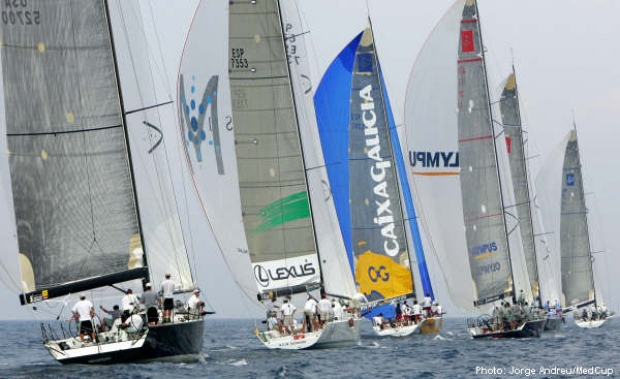
Inside the Spanish keel boat scene
Wednesday June 29th 2005, Author: James Boyd, Location: none selected
While Acts 4 and 5 of the 32nd America's Cup may be done and dusted here in Valencia boats loaded with equally accomplished sailors from Coutts and Cayard to mere World Champions and Olympic medallists take to the water today in round two of the Breitling MedCup for the TP52s. After two days this event will meld with Valencia's annual Trofeo SM la Reina regatta starting on Friday.
Here nine TP52s are competing, including two new additions, John Cook's new Cristabella and Aifos, the new Spanish navy boat. More on these in due course, but the reason for this article is to explain why Spain has developed the world's biggest professional keelboat circuit. The man providing the answers is Robert Hopkins, an American from Massachusetts now living in the Canaries who has been part of the Spanish IMS circuit for ten years and who for the past five has been navigator alongside tactician Dee Smith on board Vicente Tirado's Caixa Galicias.
Having campaigned one of the top IMS 500s up until last year, the latest Caixa Galicia is of course a TP52, one of three Farr designs built for Spanish owners to date by Mick Cookson in New Zealand. Hopkins went through the normal dinghy sailing route in the States - 420, 470, 505, Flying Dutchman - and has been involved with four America's Cup campaigns starting with Peter de Savary's Victory in 1983, Stars & Stripes in 1987, Il Moro and then PACT 95. In these he served in a variety of roles including navigator, design team co-ordinator and coach, the latter role being the one for which he is best known. Aside from his role with Caixa Galicia he is also presently a coach for the Italian America's Cup challenger Luna Rossa and was head coach for the US Olympic team in 1984 and 1992.
The Spanish profesisonal keelboat racing scene has come a long way over the last 10 years says Hopkins. "When I arrived in 1995 the sponsors might pay for a suit of sails on some boats and there were a couple fully professional. Now there are lots that are fully professional - there is one more success story after another, supporting the fact this is a good investment." Today the top teams tend to have one sponsor and perhaps a clothing sponsor and will build a new boat every third year.
"What really drives it is the Copa del Rey, the King's Cup. There's a King Cup in every sport. There's one in soccer, basketball, etc. The one for sailing happens in the first week of August when everyone is on vacation, so a lot of people can go and see it. And TVE, the national TV station, runs a daily report right from the site and it is the event for the week."
Of course behind the Copa del Rey is King Juan Carlos himself who is regularly to be seen at the helm of Jose Cusi' Bribon, the latest being one of the Cookson/Farr TP52 trio. The King's presence on the IMS circuit and now the TP52s, along with several other members of the Spanish royal family spurs massive press interest in Spain - in probably much the same way as it did in the UK when King George V used to campaign Britannia. With press interest comes the ability for teams to raise sponsorship.
"The King is the spark, the focal point that gives everyone the confidence that if they sail well there will be repercussions in the press," maintains Hopkins. "It is what makes it all work. There is a mixture of popular press and the kind of institutional VIP kind of treatment that you would see at a golf tournament or something."
It was the King who was the catalyst for getting Spanish owners to move away from IMS and into TP52s, but the class was chosen largely from endorsement by respected owners in America such as Bright Star's Richard Breeden. "One of the attractive things about this was that there was a set of internationally recognised American owners who unanimously reported that it was a great boat and a great class," says Hopkins.
The King's involvement was also the reason why the change over has happened with impressive speed. The decision to move only occurred last August and just 10 months later nine full-on TP52s are competing, with more expected in time for August's Copa del Rey. "It is a great service that we have a guy who says 'this is what we're going to do' and everyone has the confidence that it is going to happen. It is just a unique situation in the world," says Hopkins.

Aside from the King's direction many of those in the top IMS 500s felt they had reached the end of the road with the class. "We pressed the IMS rule very very hard," continues Hopkins. "Basically the two real problems with it are that it encourages a low performance boat, because it has to accept us who are building expensive carbon boats and people who show up with their Swans and it is ambitious enough to try to score a race between a 35 footer and 57 footer and in that end that is just unacceptible. So we selected a boat that kept the design part of the game in there but allowed us to sail in real time. Sailing in real time is easier for the press to understand and easier for the sailors too."
The success of the IMS500s and now the TP52s in Spain has attracted more international owners. Cristabella's British owner John Cook, for example, is now into his fourth season on the circuit. "He figures it costs less to buy super saver tickets and come down here with a crew for a three day weekend than it is to sail out of Cowes. Literally. The weather is more reliable. The regatta organisation is excellent. The circuit is stable," says Hopkins. Cook is expected to be joined soon by Stuart Robertson, currently the owner of the Swan 70 Stay Calm, Britain's second TP52 owner.
Looking at the TP52s here in Valencia the differences between boats in this, the first generation of Med boats, are small and one wonders why they didn't opt for a state of the art purpose-built one design. "I think the owners here do enjoy the part of the game which is designing the boat - so why take that away?" argues Hopkins. "There are differences. If you walk the docks and see the flare in the topsides. They are all the same width at deck, but they have different beam waterlines. It turns out that the trade-off between stability with a wide boat and drag is pretty flat, so it is a happy rule. You can make boats that look different, but go the same."
Hopkins compares the TP52 to the Star, one of the world's most successful tight box rule classes, which does allow different hull shapes, but where performance on the water is more down to the skill and preparedness of the crew.
One difference between the IMS 500 circuit and the TP52 is that class rules dictate that one quarter of regatta points are scored in coastal races. "I guess that is good," continues Hopkins. "It avoids the boats typeforming into upwind-downwind pigs, which is what happens. If that works, then good, but I think with even a quarter of the points going that way you should still optimise for upwind and downwind because a large part of a coastal race is upwind and downwind too. We had one race in Punta Ala which was a mile beat, a 12 mile reach, a 12 mile reach and a mile run. So it was a one mile race upwind and that is hard to avoid. So far I haven't seen the excitement of having even more coastal races than before - at least when we do them they are not as boring as they used to be."
This is due to the substantially increased performance of the new boats over their predecessors. According the Hopkins the new 52 footers go upwind as fast as the old 57s and are a little faster in under 7 knots of wind. The moment they are cracked off they are much much faster.
Aside from this they are much nicer boats to sail, this is partly due to their having a dramatically improved power to weight ratio. "The feeling is way different. In the end you have tonnes and tonnes less lead so when you are sailing, the helm and the boat is much more responsive. On the 57 we were carrying 7 tonnes of lead inside the boat just as ballast. There is a band of only 300kg or something between minimum and maximum displacement in this class, so they are all pretty similar - same sail area, same displacement, length, draft. Make the cord narrower on the keel you are going slide more, so you have to be careful with that - you have less drag but you'll have a harder time starting. In the IMS you are given too much credit so the keels are too big and in the America's Cup Class you are allowed a trim tab so you can dial out the leeway. But these..."
The rigs are also usefully tweaky. "You can adjust the forestay as you are sailing along no problem. You can pump up the forestay against a full backstay load sailing upwind, although you have to know when to pump it. You have to have your mast tuned and be happy with your mainsail."
The teams are also having to learn the new art of reaching. "We used to never have any sails for anything other than VMG sailing, so we're learning about all that," says Hopkins. "A little problem is that in the Med there is never any wind, so the boats are designed to go 25 knots and so far that hasn't really happened at least in a race."
In terms of cost there seems to be little difference between the IMS 500s and the TP52s. Boats cost in the order of 1 million Euros to build depending upon where in the world they are constructed and by whom. In terms of operating costs the annual figure varies between 300-700,000 Euros. This latter figure is high due to the number of pro-crew (in Europe boats tend to be sailed by 16, while 15 sail them in the US), shipping them around, housing and feeding them, the large number of sails teams get through and that there need to funds in place to tweak the boats dramatically at times if they are under-performing. With just one regatta down for example and already one of the TP52s here is on to its second keel.
Looking at the class internationally differences between the largely pro-driver European boats and the owner-driver Americans seem to have ironed themselves out. TP52 regattas in Europe have overall results and within them a 'Corinthian class' for owner-drivers. Hopkins says it is a good addition but it worked fine before. "In the IMS fleet it was a mixture of owners and professionals. For example His Majesty has been steering the boat. No one gave him his own trophy. He'd win it on his own merit every four or five years."
While US boats are sailed by more amateur sailors, Hopkins maintains that this is also deceptive. "What the Americans have that you don't see as much in Europe is a huge labour pool of amateur sailors - in that they haven't been paid to sail competitively in the last 24 months - who are world class. They might be a house builder or a dentist, but they are also Olympic medallists and guys who are former pros. So there is not much of a gulf, because the professional market in the US is a lot smaller than here."
Equally despite US owners looking to do more serious offshore events from the Pineapple Cup to the Transpac, Chicago-Mac, Newport-Bermuda, etc the difference between US and Med TP52s seems to be smaller than was feared - the Farr-designed Esmerelda, built for a Japanese owner to campaign in the US last year, is here as John Coumantaros' latest Bambakou and is not expected to be off the pace.
One problem that does still remain is over the prospect of a world championship; a Europe versus USA showdown. The principle reason for this is that the Spanish boats have domestic sponsors. "Most of the Spanish companies that are sponsoring Spanish boats don't have enough of an international presence to justify shipping off to the US and racing there," says Hopkins. "So that remains to be seen whether a Worlds held in the US would work. I think the owners in the US would come here. Why not? It's a great circuit. Maybe the Worlds held in Europe would sucessful."
The only way a world championship would work in the States would be if it were held during the winter months. "We are hoping to talk our guys into it," says Hopkins.
Most Read
Most Commented
Comments
Businesses


Pro businesses
-
-
France
-
United Kingdom
-
United Kingdom
Editor's choice
Member blogs
-
 Ned Collier Wakefield: MOD70 round BarbadosWell that was intense. 12 hard fought for seconds for the win. In idyllic conditions, Tony Lawsons MOD ...
 -
 Mini Transat leg 2 reportThe second leg of the Mini Transat started on 31st October, just over a month after ...
 -
Leg 1 reportI’ve been working towards the Mini Transat now for three years. In 2013 I was part ...
Business blogs
-
 The Island Sailing Club in Cowes, Isle of Wight, is delighted that Prince Michael of Kent ...
 -
Peta Stuart-Hunt chats with the 25 year-old British solo sailor Lizzy Foreman before she sets sail ...
-
The 2015 Student Yachting World Cup (SYWoC), an ISAF-recognised event hosted and run by students for ...
Editor's Choice
All time favourites...
-
 Three legs down into Ian Walker’s
 -
 Winning all but two races at
 -
 For the first time in its
Latest Comments
Add a comment - Members log in