
Long uphill struggle
Thursday September 22nd 2005, Author: James Boyd, Location: United Kingdom
For Jason Ker and his design group at Team Shosholoza, the 2005 season so far has been a frustrating one. The South African America's Cup challenge made the bold move of being the first to launch a brand new Version 5 boat this year and despite lacking experience and time on the water compared to their competitors, great things were expected from the fledgling team.
Unfortunately the team have been severely wrong-footed as they struggle to overcome problems relating not to the South Africa-built hull of RSA 83, but with their new Italian-built Version 5 mast.
While a majority of carbon fibre America's Cup spars are built in two halves (length-wise) in a female mould and then joined together, the Team Shosholoza spar was designed to be built in one piece. The first occasion the manufacturer attempted this the mould exploded. The second time the mast appeared to come out of the mould okay, but soon after the team arrived in Valencia and stepped the new spar it became apparent that there were major structural issues with it. Hurriedly prior to the Valencia Acts they acquired a Version 4 spar from Alinghi and once those Acts had finished they attempted to repair the newly built spar. However during training the new mast came toppling down. For Trapani, as with Malmo, Shosholoza have reverted to the Alinghi Version 4 mast.
"We have new sails for the old mast and we are learning how to deal with it’s flexibility," says Jason Ker. "It is disappointing for us, but it is part of our learning as a team about how to get on top of problems like this: if you can’t make the start line you can’t win the race."
A new carbon fibre version 5 mast, is currently under construction for the team at Formula Spars in Lymington. Formula Spars recently built the masts for the Ericsson VO70 but haven't built an America's Cup mast since 1992. "They have done a good job with Ericsson," says Ker. "And our design is for a one piece construction, so it would be quite difficult to change back to a two piece construction which is what some of the alternative manufacturers provide."
While Formula Spars also build the mast in one piece the significant difference is that they compress the laminate using their 40m long autoclave rather than an internal pressure bag. "It is a much more reliable process and the heat is applied reliably," says Ker.
The new mast is scheduled to be with the team by the end of October and they will then spend the southern hemisphere summer months in Cape Town testing and tuning it.
While it is frustrating that they are unable to realise the full potential of their new boat - the Version 4 mast is engineered for a boat one ton heavier - Ker says that they are otherwise pleased with the potential RSA 83 is showing. "We have some good speed at times and we can see lots and lots of places where we can improve things. It is mainly in the rig - the design and trim of the sails are the biggest things we can do right now. But we are at least starting to know the direction to point the boat in terms of getting accurate polars for the guys to sail to. Hopefully we’ll continue to improve and do better again in Trapani."
Ker sees the greatest performance increase in the next generation of Cup boats coming from the rigs and in particular the sails, but warns that to be competitive in the America's Cup requires every aspect of the design, construction and sailing side to be optimised. So far this season Alinghi's second 2003 generation boat, SUI 75, is proving almost impossible to beat on the race course and this is a good example of a team ticking all the boxes. "There is nothing unusual about the boat - it is just a nicely executed design," says Ker of 75. "Hull, rig, sails, appendages, the way it is sailed, the way it is trimmed, the way the sails are designed - the whole package is fast. It is not just one element that is fast. We have to improve our whole package and we have got a long way to go."
While Shosholoza were the first to build a Version 5 boat, most teams are building their first new boat over the course of this coming winter but it remains to be seen whether the bigger teams in particular will feel the need actually to race their new boats in the 2006 season, if their previous boat is still competitive.
In addition to the rule change to Version 5, another significant difference with the new boats is that they will be optimised for conditions found off Valencia, rather than the brisker conditions generally found in Auckland. "In Act 5, the wind hardly went over 10 knots for the whole regatta," says Ker. "So you need to be competitive in the light but then you also get 18-20 knots sometimes, so you need to be able to hold your own in those conditions too. That is going to be a difficult balance in terms of deciding how powerful to make the boat." Ker admits that when they designed RSA 83 they hadn't carried out a full weather study and this may well affect the design of their second boat.
With box rules, such as that governing the America's Cup Class, usually after a couple of seasons designers find which side of the box is fast and then the class effectively becomes an expensive one design. Yet 15 years on from the creation of the present America's Cup Class there is still great variety in every aspect of the boats (as our photo gallery from Malmo illustrated).
Ker says that with the ACC rule there are 11 key parameters, from Bmax to the position of Bmax to section shape, bow and transom profiles, etc that define the boat and if you vary those just by steps of five - the result is 50 million different permutations. Yet, perhaps due to the heavy displacement of the boats and the huge power generated by their rigs the performance difference between the boats is not as great as one might expect. "You can see boats like K-Challenge [formerly NZL60, Team New Zealand's 2000 Cup winner] which is a wider 2000 generation boat sailing upwind against Mascalzone [the former 2003 generation Team Dennis Conner boats] the narrowest boat in the fleet by far and the differences are not very big. So quite different boats can virtually have the same characteristics," he says.
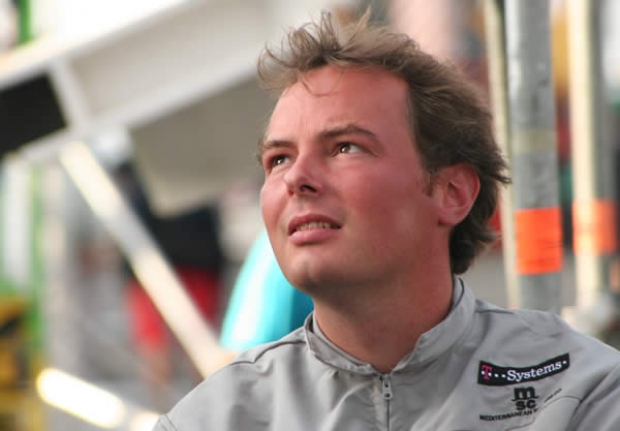
One gets the impression in the America's Cup that the large teams such as BMW Oracle Racing have almost unlimited resource compared to the smaller teams such as Shosholoza. Ker says that on the design side at least the divide is not as great as people might expect. "I think fundamentally we have the same tools, they just have more of them and the ability to customise the technology more. We have to buy off the shelf a little more than they do. We are using some pretty smart people. There are five people in our campaign with PhDs. We basically have a very smart group of guys and they are the top their fields and are using the best technology they can get hold of. We don’t feel we are suffering on that side of things." Principle sponsor T Systems are providing the Shosholoza with access to 'a cluster' (some high power computing) and have already been supporting the design team with computers and IT back-up.
In terms of physical testing, Shosholoza is using a tank test facility in Bulgaria, where Ker says they can do as much testing as they want to. However they will not be carrying out much wind tunnel work. "We are relying a lot on CFD for the aerodynamic side of thing and also the hull."
While the winter months will be a profitable time for the team as they train with their new boat and their new Version 5 spar, Ker thinks it will take the team the whole period until the Valencia Acts next year to get the boat fully sorted and the team competitive.
Most Read
Most Commented
Comments
Businesses

Pro businesses
-
-
United Kingdom
-
United Kingdom
-
Netherlands
Editor's choice
Member blogs
-
 Ned Collier Wakefield: MOD70 round BarbadosWell that was intense. 12 hard fought for seconds for the win. In idyllic conditions, Tony Lawsons MOD ...
 -
 Mini Transat leg 2 reportThe second leg of the Mini Transat started on 31st October, just over a month after ...
 -
Leg 1 reportI’ve been working towards the Mini Transat now for three years. In 2013 I was part ...
Business blogs
-
 The Island Sailing Club in Cowes, Isle of Wight, is delighted that Prince Michael of Kent ...
 -
Peta Stuart-Hunt chats with the 25 year-old British solo sailor Lizzy Foreman before she sets sail ...
-
The 2015 Student Yachting World Cup (SYWoC), an ISAF-recognised event hosted and run by students for ...
Editor's Choice
All time favourites...
-
 Three legs down into Ian Walker’s
 -
 Winning all but two races at
 -
 For the first time in its
Latest Comments
Add a comment - Members log in