
Breaking new ground
Thursday October 27th 2005, Author: Juan Kouyoumdjian, Location: United Kingdom
Most of the times we face a new project I have the challenge of designing a boat that complies with some specific rules. At that early stage of the design process comes the first question, what do the rules say? It is very important to understand the rules’ permissions and constraints before the design starts in order to ensure a fast boat that at the same time meets the class requirements. In our case we normally do a brainstorming session where everyone in the office meet to discuss the rule, determine which areas need to be clarified with the Chief Measurer and come up with ideas for the design.
We ask interpretations from the Chief Measurer for those areas of the rule that are not clear to us. These interpretations help in shedding some light in those grey areas of the rule. Despite having interpretations the objectivity needed for making classes fair and enticing to the owners is reached by following the rules as per what is written in them. Otherwise it would be very difficult for any designer facing the task of creating a boat for that class and it would be more a case of a Guide rather than a Rule. Any measurement decision not based on what is written in the rule would provide subjectivity to the measuring process and would be detrimental to the class. In this sense, the Transpac 52 Box Rule is open in such a way that allows developments in hull shapes, rigging and appendages.
With this in mind, some months ago we were confronted with the task of creating a design under the TP52 Rule. Despite the constraining fact that in order to get a TP52 certificate the boats first need to get an IMS certificate, there is a lot of development potential in this class. For this case we came out of our brainstorming session with lots of ideas, some of them had to be discarded because they did not meet the rule requirements, and some others needed an interpretation from the measurer. We kept three concepts that are important to address the issues of power, stability and manoeuvrability and that as far as we know are different than the rest of the existing fleet.
The first concept is related to the power moving the boat. The TP52 rule has no restrictions on the shape of the main sail; it has no maximum girths as we can see in other classes. It does however limit the area of the main sail and provides a formula for calculating it. It also limits its P and headboard.In addition there are limitations to the rigging, runners are forbidden and a backstay is mandatory.
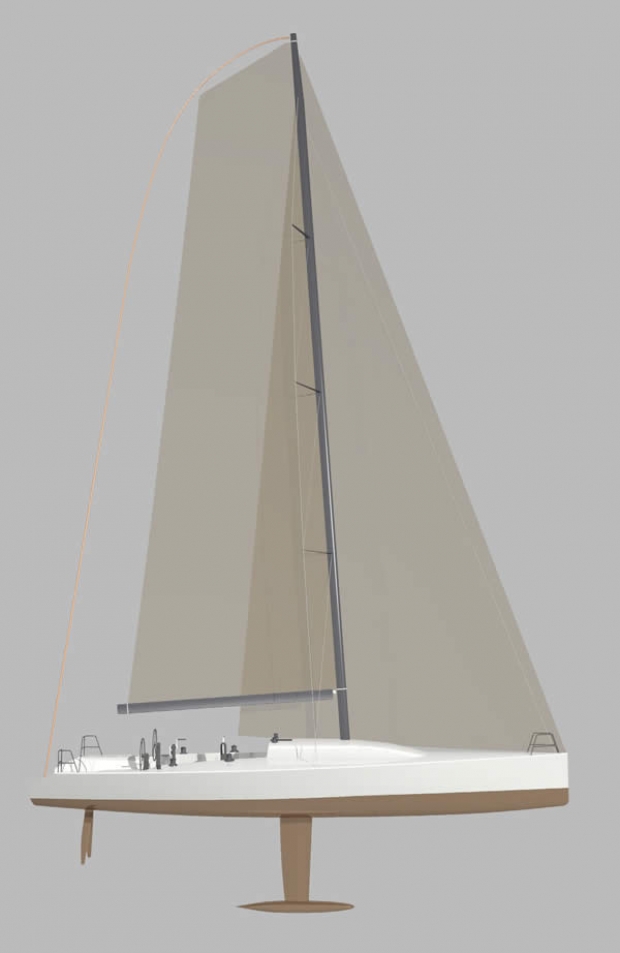
To increment the power from the sails the boat enjoys a top roach full-battened mainsail. To accommodate for the mainsail roach we opted for an innovative backstay designed by Andres Suar, one of the engineers working at JYD. This curved backstay made in Kevlar, presents no problem for tacking or gybing the big roach mainsail. There is also a system at the deck to regulate the tension of the backstay. In fact it works in very much the same way as the existing backstays with the only difference that upon release, it curves in the opposite direction.
The low stability issues seen on existing TP52 boats is put even more into evidence with this sail plan because of the higher position of the centre of effort. This leads to the second development of this boat which is the keel design. A steel plate machined into a foil is not recommended for a TP52 boat because the rule not only fixes an upper and lower limit for the vertical position of the center of gravity (CG) but also sets a maximum and minimum displacement. The best way to achieve an ideal compromise between weight and CG is by inserting lead into cavities inside the keel.
Controlling the shape of these cavities is important to obtain structural stiffness and weight optimisation of the combined material. The process used to achieve this consists on casting stainless steel into a mould. The critical part is that the models of the cavities, called core boxes, contained within the outer fin surface mould need to be engineered in such a way that they will not bend during the casting and that they will implode after the casting in order to de-mould. The process does not stop there; most of the properties of the stainless steel are given during the three heat treatments subsequent to the casting. Unfortunately all this process for just one or a handful of keels does not contribute to the budget.
Finally, the manoeuvrability and the ability to keep the boat under control are conditioned by the lack of stability of the TP52s. Ideally this would be solved with two rudders, but the rule limits the appendages to one rudder and one keel. Moreover, the rudder’s axis of rotation has to be in the center plane of the boat. However development in foil shapes is permitted. A curved foil surface solves in part this problem.
The construction of the first boat is reaching its final stages in Argentina at Compania de Barcos, where at the end of November the boat is going to be loaded into a ship to meet the commitment of sailing in Miami at the beginning of January.
To read more about Juan K's TP52 - click here

Most Read
Most Commented
Comments
Businesses


Pro businesses
-
United Kingdom
-
Netherlands
-
-
United Kingdom
Editor's choice
Member blogs
-
 Ned Collier Wakefield: MOD70 round BarbadosWell that was intense. 12 hard fought for seconds for the win. In idyllic conditions, Tony Lawsons MOD ...
 -
 Mini Transat leg 2 reportThe second leg of the Mini Transat started on 31st October, just over a month after ...
 -
Leg 1 reportI’ve been working towards the Mini Transat now for three years. In 2013 I was part ...
Business blogs
-
 The Island Sailing Club in Cowes, Isle of Wight, is delighted that Prince Michael of Kent ...
 -
Peta Stuart-Hunt chats with the 25 year-old British solo sailor Lizzy Foreman before she sets sail ...
-
The 2015 Student Yachting World Cup (SYWoC), an ISAF-recognised event hosted and run by students for ...
Editor's Choice
All time favourites...
-
 Three legs down into Ian Walker’s
 -
 Winning all but two races at
 -
 For the first time in its
Latest Comments
Add a comment - Members log in