
Three more box rules
Wednesday July 27th 2005, Author: James Boyd, Location: None
Following on from the TP52 and most recently the Storm Trysail Club's
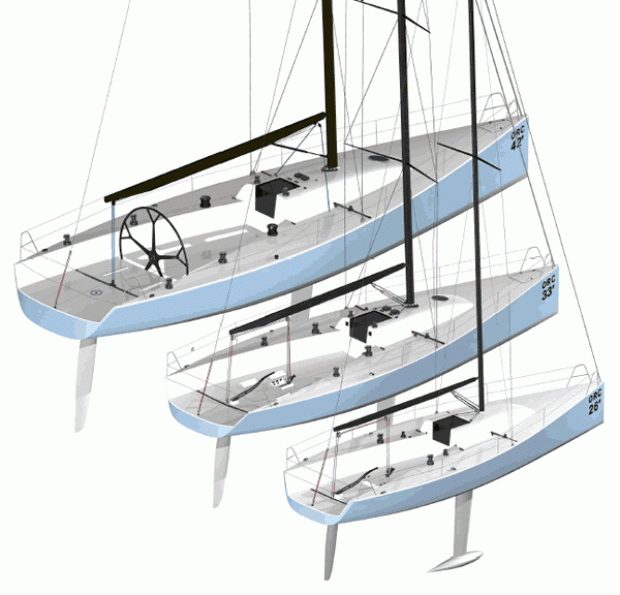
new 65 footer, so the box rule bonanza continues with the three new creations being touted by those champions of the IMS, the Offshore Racing Congress.
The ORC were spurred on to come up with their new 26, 33 and 42ft 'level classes' following the falling apart of the RORC, US Sailing and ORC endorsed Grand Prix Rule's Rule Working Party.
Paolo Massarini, the ORC's Level Rule Manager, was part of this Rule Working Party and says that the reasons it did not succeed was largely due to political differences between the three parties involved. In the US it is hard to legislate when you are trying to accommodate groups of owners who race in locations as diverse as Key West or the Great Lakes, whereas RORC were against box rules, adamant that the rule should focus on 30, 40 and 50ft classes tied together by an underlying VPP.
"We thought there was a need to have a new level rule anyway," says Massarini. Hence the new 'level classes'. These were presented by the ORC to owners at the IMS World Championship in Mahon recently and are now at the last draft stage, with final publication imminent. The definition of the 'box' for each boat - as they stand at present - is show in the dimensions in the table below:

(download the rule as it stands at present at the bottom of this article)
So how will it work? "It will be simple," says Massarini. "We are cutting out any reference to other rules. We are trying to simplify the measurement controls. There will be no IMS, there will be the weight of the boat and a fast procedure for the flotation of the boat to establish the range of the vertical centre of gravity because we thought that to leave it free would be too risky in terms of the cost of the boat."
'Simple' is perhaps overly optimistic, as a lot of the technique for measuring the boats reeks heavily of IMS, although saying this the stability of the boat is simply measured by hanging a standard weight from the end of a standard length pole at the maximum beam station. In this event the boat is not allowed to heel by more than 20 degrees.
"We are not going to request the offset file of the boat as the TP52 is doing because we experienced not all positive results about that, but in the end we are looking for an even performance because the range in choices are very small," adds Massarini. The size of the 'box' for each boat he maintains is as tight as the TP52 box.
In creating the new box rules, ORC polled 65 design offices around the world for their thoughts along with builders, sail makers and gear manufacturers. Many design offices are already fairly advanced with preliminary drawings for the new boats.
Rightly or wrongly the rule has been written from a clean sheet of paper and not with a view to allowing in existing boats. "We thought that would tie our hands around one existing boat," explains Massarini. "One designs or other kind of boats like that are not really recent projects. If we have to think about an existing yacht that is close to the box rule, I think the Farr 40 or Melges 30 but I don’t know what else would be very close as a concept."
Although the concept of the boat is similar, a significant difference between the ORC's new rule and the TP52 class is that they have attempted to counter escalating costs from the outset. Massarini says their new 42 footer for example is "for a different level of owner. We want to offer something which isn’t a million dollar product. We are looking at half of the price."
To do this they are looking more at controlling running costs than the initial capital cost of designing and building the boat. "We think we need an advanced technology product so we are looking at carbon/Nomex [construction] for the two bigger boats, but not for the 26. They will be boats with very high stability, larger sail area and not a lot of crew weight because we want to restrict costs on that side," he says in comparison to the purpose-built IMS predecessors.
Massarini expects the price of one of their new 42s to be around the same as a new purpose-built IMS 42 footer, and aside from offering considerably better performance boats should have a longer life expectancy too.
One distinct benefit of what ORC are proposing is that obviously racing will be boat-on-boat thus removing one IMS horror of not knowing where you have finished until you get ashore, although in all fairness the IMS500s and to some extent the 600 classes had developed to the extent that they were almost level rating.
While sceptics will presume ORC to have conjured up a rule optimised for owners in the Mediterranean, Massarini is adamant that this is not the case - ORC would like it to be adopted internationally. "There is a lot of interest in the States from a group of people who have contacted Nelson/Marek as well as Farr Yacht Design. We are trying to have the first event in Miami next year."
In terms of a circuit for the new classes, Massarini says that they will be looking at piggy-backing on existing events as the TP52s have done this year - the question is which events?. "We are trying to finalise a regatta circuit for next season which is probably the most difficult project because it is an international rule and it should be internationally advertised and located not only in some areas. But as usual transportation costs are high and the schedule and programs calendars are already very very full."
So what will the boats really be like?
Luke Shingledecker, one of the naval architects at Farr Yacht Design who has examined the ORC's new box rules summaries: "They are a little like smaller TP52s. They are light for their length and they have a moderate amount of sail area for their length, but plenty of sail area for their displacement. Their stability is not high stability - it isn’t on the TP52s either - it is probably enough to get good performance in a range of conditions. They definitely have more stability than a typical IMS boat but they are also so much lighter for their size which really changes the kind of boat they are."

|
Farr 40
|
ORC 42
|
| LOA |
12.41
|
12.8
|
| Beam |
4.03
|
3.5-3.9
|
| Draft |
2.60
|
3.5
|
| Disp |
4,945
|
4200-4400
|
| I: |
16.20
|
16.2
|
| J: |
4.71
|
5
|
| P: |
16.70
|
16.8
|
| E: |
5.90
|
5.9
|
| ISP: |
16.20
|
18.6
|
| SPL: |
4.71
|
6.55
|
| (figures in metres, disp in Kg) | ||
In comparison to internationally known quantities such as the Mumm 30 and Farr 40 the new ORC boats are generally for their length narrower, lighter and have a little less stability. Comparing the ORC 42 with the Farr 40 directly (above) from a stability perspective, the 42 has less beam, a slightly larger mainsail area (the 42 has a large top girth measurement requiring a whopping masthead crane), a bigger distance between the mast and the tack of the jib (J) and the possibility of much much bigger kites (at present these seem to have no luff or leech length controls, only girths - maybe this is an omission), and is substantially lighter. Redressing all these stability sapping features is that the 42 has much more draft.
Shingledecker reckons the new ORC boats will positively fly downwind but won't be as good upwind in breeze. He adds: "I don’t expect them to be incredibly tender boats. They will be what you expect out of a lightweight race boat upwind in big breeze - they will be a challenge but they won’t be excessive tippy."
Compared to the Farr 40 and Mumm 30 he adds that the new ORC boats should be "a very exciting boat. They will definitely be higher performance boats. It will be about as high a performance you can go without going to a canting keel or an incredibly exotic construction at those size ranges. It is like how light can you make a boat before it is too light to effectively sail."
Having less stability suggests the new ORC designed are conceived with the lighter average wind speeds of the Mediterranean/US eastern seaboard in mind rather than the brisker conditions of Northern Europe.
However assuming all the designs will be attempting to hit maximum stability, then the performance of the boats should be very similar. "The drive in this class will be to get them quite stiff so that they are powerful upwind, because the racing will be windward-leeward and I think stability will be important," says Shingledecker.
He acknowledges that the measurement will be simpler than IMS. "With the TP52 they require a full IMS measurement to get their VCG [vertical centre of gravity] which is not being directly measured in this case. There is this simpler stability test and that’s it. They have minimum and maximum keel weights. That might become an issue, so instead of being based upon just the righting moment test it could be the keel weight that constrains the boats from developing large differences in stability."
While the rules as they stand at present seem to be ambiguous regarding whether the two larger boats can carry asymmetric as well as symmetric kites, the 26 differs in having a bowsprit, thereby making it more akin to a sportsboat.
"The bigger ones just have a width measurement which would apply to either symmetric or asymmetric spinnakers," maintains Shingledecker. "They aren’t allowed a sprit. They have to use a pole. At one point they were considering leaving it open, but I think it is a good idea they didn’t because the boats will be more similar. In the TP52 class you can have a sprit rather than a pole but nobody has gone that way because even with a relatively fast 52 footer they are still squaring the pole a little bit."
Shingledecker thinks they have more to do in terms of attempting to limit costs from the outset. They could for example place a limit on the pressure applied during curing. Saying this through the stability restrictions the necessity of attempting an ultra-light hull and deck construction (these are already limited by having to adhere to ABS scantling requirements) will be reduced he thinks.
"The TP52 class does this by having a BCG limit. In that class if you make the boat lighter and lighter and lighter you can’t just put it [the saved weight] on the bulb because there is a CG limit so you end up with internal ballast instead and the benefit is reduced. It will be similar here because they have the stability limit. So if you hit the limit there is not much gain to be had by making the structure lighter."
For each boat there are limits to the numbers of sails that can be carried, but obviously not to sails that can be tested. There are also crew weight limitations and crew numbers will be a little on the low side given the size and power of the boat. The 42 for example will be sailed by nine.
So how will the ORC's new level rules stand up in the UK? Looking at the results of Patches and the boats that have been racing in the States, the TP52 box rule boats seem to rate favourably under IRC. Shingledecker has his doubts whether this will also be the case for the new smaller box rule boats.
"That could be somewhat of a concern because what we have seen of IRC is that boats above a certain size, somewhere around 50ft or so, that are light do very well IRC - the TP52 is fantastic, surprisingly. Whereas when you go down to the smaller sizes like 33ft, the boats that seem to do well are cruiser racers. There aren’t many lightweight raceboats trying to sail under IRC but the ones that do don’t generally do very well - like the Mumm 30. There is a feeling that these [new] boats won’t do very well under IRC and that could be a very valid worry. Whether that would change or not – that is up to RORC and UNCL – and whether people want to be racing this style of boat in that size range or whether they would prefer to be racing cruiser racers or one design boats only."
So the boats are not expected to rate well under IRC (although we were also told this originally about the TP52) and ironically Shingledecker expects this also to be case too under the IMS.
There is also concern about cost. Box rules seem to work well above a certain size range, but in the small sizes boats can be prohibitively expensive compared to what else is on the market. Are there enough owners these days in the smaller size ranges who are interested in the challenge of working with a designer and builder to conjure up their own unique boat? Maybe we are wrong and we can look forward to a surge in what could be the modern day equivalents of the 1/4 and 3/4 tonner classes. Maybe the rule will encourage a new generation of sports boats - a Melges/Mumm 26?
"Getting it started will be the trick," continues Shingledecker. "The same thing happened with the TP52s where it took a while to get going and some geographic shifts occurred and are still occurring. So it may just be a matter of critical mass."
To download the boxes rules as they stand at present (NB this is not the final rule) click the pdf icon below:

What's your view on the ORC's new box rules? Click here to send us an email
Most Read
Most Commented
Comments
Businesses

Pro businesses
-
United Kingdom
-
Italy
-
-
Editor's choice
Member blogs
-
 Ned Collier Wakefield: MOD70 round BarbadosWell that was intense. 12 hard fought for seconds for the win. In idyllic conditions, Tony Lawsons MOD ...
 -
 Mini Transat leg 2 reportThe second leg of the Mini Transat started on 31st October, just over a month after ...
 -
Leg 1 reportI’ve been working towards the Mini Transat now for three years. In 2013 I was part ...
Business blogs
-
 The Island Sailing Club in Cowes, Isle of Wight, is delighted that Prince Michael of Kent ...
 -
Peta Stuart-Hunt chats with the 25 year-old British solo sailor Lizzy Foreman before she sets sail ...
-
The 2015 Student Yachting World Cup (SYWoC), an ISAF-recognised event hosted and run by students for ...
Editor's Choice
All time favourites...
-
 Three legs down into Ian Walker’s
 -
 Winning all but two races at
 -
 For the first time in its
Latest Comments
Add a comment - Members log in