
Big Grin sailing
Tuesday August 9th 2005, Author: Andy Nicholson, Location: United Kingdom
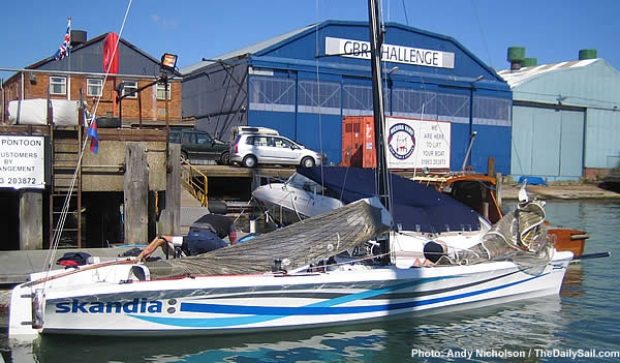
Skandia: Big Grin is a fresh approach to how to get a lot of fun out of a 8.5m boat - and it succeeds in getting those facial muscles smiling. On first look there is a clear family resemblance with Jo Richards’
Full Pelt and the boat is naturally introduced as ‘The mini-Full Pelt’. The design on this occasion is a joint effort between Richards and Christian Stimson.
The Grin however is more of a wayward son of some pretty alternative parents. Like its father it has little desire to conform to conventional wisdom or rating rule and is a designed purely to give its owner Mike Browne a wild time on the water.
What is surprising perhaps is that Browne is handicapped and unable to walk.
The boat has been project managed by John Santy and swiftly made it onto the water in five months; first discussions about the project with Browne were in the autumn last year. Santy is the Brand Manager for Skandia at Cowes Week and also their Geelong Week in Australia and looks after Browne’s racing in his spare time. He explained just what type of man orders a boat like this: “Mike is a Para Olympic sailor and a serious skiing accident seven or eight years almost killed him. He broke his back and is paralysed from the waist down. He still skis and we all figure that if we go where Mike goes we will be safe…but that’s not actually true!”
Browne’s successful business career has enabled him to tackle his disability with an enviable blank sheet of paper. In his early fifties he has recently retired having sold his company - the outdoor adventure retail chain Snow and Rock - and among other things is cruising the world on his equally unique 60ft cruising catamaran.
Browne competed at the Sydney Olympics in the 2.4m after getting involved with class at Queen Mary Sailing Club. Santy points out that it was the International 14s and 49ers that really grasped his imagination, with the physical reality preventing him from sailing that type of boat.
“This was a way of giving Mike a way of sailing a high performance dinghy,” says Santy of Skandia: Big Grin. “The whole concept with Big Grin was that after sailing cats and tris and sailing on rails the monohull thing was to sail against loads more boats. We needed a stable platform and when we saw Full Pelt, we thought this type of boat may be a solution. Mike hates to be labelled disabled. I suppose because of his wealth he is able to push the boundaries of what disabled people can do and I think he is very inspirational in that respect.”
The boat is very much a ‘Pride of Cowes’ effort with Jo Richards drawing the lines along with Christian Stimson and was built by Paul Jenning’s Project by Design outfit. The construction is fairly straightforward with E Glass and foam for the hull and deck, built using a 3D milled polystyrene plug - the finished bare hull weighing in at 300kgs. The keel fin is 2.5m of steel with some America’s Cup lead creating a 608kg bulb…which cants up to 30 degrees.
One principle difference with Full Pelt is that Big Grin is much narrower and carries a very hard chine down the hull. The chine is an attempt to have some leeway counter measures in place, however Santy says that they will probably put a small daggerboard in front of the keel to do a ‘proper job’.
Being a narrow design means that Browne can pretty much look after himself when sailing. Two rails are fitted across the aft cockpit area and on this is fitted Browne’s seat which he can tack and gybe to the other side as required. Steering is by a ‘twiller’ arrangement fitted onto a rudder quadrant under the deck.

The tiller and mainsheet hoop, the purple line is the backstay
The boat was out on the water last week at Cowes without its owner, due to cruising commitments and so Skandia: Big Grin was used as a flag waver for the regatta sponsor. On board was Santy and three Australians more specifically three Geelongians, who were helped up to the Northern hemisphere as part of the sponsor’s sailor exchange programme. All three thought that a Sunsail 37 awaited but were pleasantly surprised with their steed on arrival in Cowes.
Browne’s seat had been removed for able bodied helmsman Darren Pickering (a conventional tiller system was used too), Jordan Smith was up the front and Stuart Lee in the middle on the ropes with Santy. Fortunately for us it was windy Wednesday and so action on the Skandia: Big Grin wasn’t far away.

The crew (l-r) Darren Pickering, John Santy, Jordan Smith, Stuart Lee
The first impression when getting on board was that the boat barely heeled when stepping on - it was also pretty uncomfortable with nowhere really to sit - just some space to ‘squat’. Underway however things are much different with happy bums and comfortable room for all five us.
Sail-wise we left the 100sqm spinnaker on the dock and settled for the medium masthead which is around 78sqm. We had the big jib on hanks at the front and a furling ‘code zero’ which gave us some tight reaching sail area up front.
First thing we got wrong was what sail to have up at what angle - the groove for each sail proved to be pretty narrow - and so we quickly went from jib to code zero to spinnaker on the first leg away from the line. Jordan was pretty busy up the front as the code zero gets attached to the bow and then the hoisted and tensioned before being unfurled. Getting the spinnaker up and down is reasonably straightforward and it is set up with a retractable carbon bow sprit.
The canting keel was amazingly simple, as we hit the line Stuart started winding on the port primary bringing the keel up to windward. Underdeck there is a 3:1 purchase system and the keel rope (this needs some sort of name) exits to the deck through a clutch and runs to the primary winch on the sidedeck.
As we turned and headed upwind we really punched through the waves with boatspeed around 7 knots in the 14-18 knots of breeze. Again the groove was difficult to find and any height versus our competitors was rare. To keep the Grin on its feet the mainsail was heavily twisted and only in the lighter spots when the wind was nearing ten knots did we approach anything resembling leech tension. We did do a horizon job on the Melges 24 we rounded with however and soon caught up our similar-sized, but lighter and more conventional competition on the Thompson 830 Radost.
Tacking the boat was pretty painless. A simple case of easing the keel down and then trimming the sails and the keel back on as we settled onto the new tack. At all times the boat was very stable and never once did you really get any major heel on. Jib trim was simple with the sheet on a 2:1 purchase and then an underdeck fine tune which was lead to the windward side.
The next longer run was in a more steady 18-20 knots and we were all grinning. Again we were sailing a higher line than the Czech boat Radost but were very quick with the boat behaving extremely well at 10-12 knots of boat speed. All we had to do was get to the back of the bus, although we didn’t get close to a bad nose dive.
Click here for the Windows video (2.5MB).
Unfortunately we were enjoying ourselves a bit too much and ignored some additional upwind work that was required by the race officer. After three minutes we had gone quite some way in the wrong direction.
Another run and a short beat back up to the finish gave us fifth in the sportsboat class - four or so minutes off the lead on corrected time. What could have been!
The Grin is certainly a quick boat in the breeze and surprisingly well mannered in all directions. The addition of a small daggerboard for upwind sailing will help with pointing and over time the whole ‘What angle/sail combination do we need’ question will be answered.
It was quite unreal feeling the boat become underpowered in 15 knots as the keel came over, but that is the point really. Here is a fast, exciting boat, that quite surprisingly, is a very stable sailing platform.
When it comes to adding more horsepower there are thoughts says Santy of putting a bigger roached mainsail on, which then may require runners. The boat could also be made easier to manage too - Santy and team have discussed the idea of a spinnaker launcher with dinghy-style retrieval line. Systems could be cleaned up to enable disabled crew to sail the boat as well, something that Santy says Browne is interested in pursuing.
Thinking ahead the mast has also been set up to take three trapezes as well, the plan is to take the Grin to the lakes and compete in events like the Centomiglia and the Bol d’Or Rolex.
While one-off radical development sportsboats are not cheap what Skandia: Big Grin has done is to open the debate for this type of concept at the sub-30ft level and also how modern design can produce a boat which can be sailed very fast by all physical abilities against other sportsboats.
Most Read
Most Commented
Comments
Businesses

Pro businesses
-
Italy
-
Italy
-
United Kingdom
-
Editor's choice
Member blogs
-
 Ned Collier Wakefield: MOD70 round BarbadosWell that was intense. 12 hard fought for seconds for the win. In idyllic conditions, Tony Lawsons MOD ...
 -
 Mini Transat leg 2 reportThe second leg of the Mini Transat started on 31st October, just over a month after ...
 -
Leg 1 reportI’ve been working towards the Mini Transat now for three years. In 2013 I was part ...
Business blogs
-
 The Island Sailing Club in Cowes, Isle of Wight, is delighted that Prince Michael of Kent ...
 -
Peta Stuart-Hunt chats with the 25 year-old British solo sailor Lizzy Foreman before she sets sail ...
-
The 2015 Student Yachting World Cup (SYWoC), an ISAF-recognised event hosted and run by students for ...
Editor's Choice
All time favourites...
-
 Three legs down into Ian Walker’s
 -
 Winning all but two races at
 -
 For the first time in its
Latest Comments
Add a comment - Members log in