
Management man
Wednesday September 28th 2005, Author: James Boyd, Location: United Kingdom
A sad loss for the Volvo Ocean Race this year will be the absence of race veteran Grant Dalton, who has graduated up to the America's Cup where he is now applying his management talents heading Emirates Team New Zealand.
While his campaigns for the Volvo Ocean Race or The Race were far from small fry in terms of budgets and the number of people involved, they are a fraction of the resource required for a competive America's Cup campaign like Emirates Team New Zealand. For example while a one boat Volvo Ocean Race team might employ 25-30 people over the course of an 18 month campaign, Emirates Team New Zealand have around 95 employed over the four year Cup cycle.
One would imagine this step up for Dalts being comparible to the difference running a small and a medium-sized company, however the great man maintains this is not the case: "I was talking to a guy from Vodafone who we did our deal with. He used to run New Zealand, but was then promoted to run England, which is the jewel in the crown, because it's billions of pounds. He said the only difference was that there were more 000s, but basically the disciplines were identical and I think that’s exactly right. So rightly or wrongly I basically haven’t done anything different to what I have done with Volvo campaigns over the years."
Again it is a sailing campaign requiring the same basic ingredients of money, people, design, boats and sailing to be address, he says only that in the America's Cup teams are spending much more time and money delving into the detail and minutae.
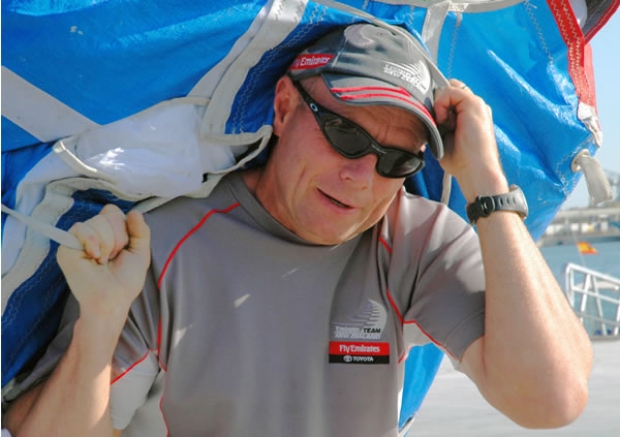
Dalton's move into the, for him, new arena of the America's Cup has personally involved a steep learning curve - in particular just 'understanding' the boats. To help himself get up to speed he sails on board the black boat in the menial role of grinder/spinnaker packer. "For me personally I love it and being physically involved is good, because I enjoy training and getting fit and strong," he says. "I think my own personal motivation would be severely hampered if I wasn’t on board the boat, because I would get bored. I was off for one race against China [in Malmo] which was the day we broke the end of the pole and I was climbing up the wall half way through the race… Plus I think it would be very hard to have a meeting with the sailors and lead the meeting and talk in an authorative sense in terms of drag and hydrodynamics and shape, etc if you weren’t on the boat. You’d feel removed and almost a fraud."
From growling about America's Cup sailors being a 'bunch of poofters' a few years back, Dalton when he talks about his afterguard of helmsman Dean Barker, Terry Hutchinson, Adam Beashel, etc today sounds almost star-struck. "It is almost an honour for me to sail amongst those guys. I know that sounds corny, but to listen to the mechanics of the back end of one of these boats - and I think our mechanics are getting quite strong - it is just amazing. They are so skillful. How many match racing starts have I done now? I am getting up there, but I still have very little idea of how Dean does what he does. To me I see situations where I wonder 'how did he work out what he wanted to do two minutes before?' I just stand there winding pumps and being bossed around at the top mark."
He is also impressed with the America's Cup Class boats - highly powered lead mines that are a far cry from the lightweight round the world race fliers, he is used to.
Despite his part in the sailing team, in spearheading a larger team Dalton has had no choice but to step back a little. He cites as an example the jib sheet they broke during one race in Malmo. "I doubt we’d break a jib sheet on the Volvo because I would know the system of maintenance, I’d understand it and I’d probably be one of the people checking it."
In a big America's Cup team it is almost impossible to be fully omni-present. Fortunately Dalton says he is blessed in having a great team of people working with him including those who report directly to him, many, such as Director of Sailing and Operations Kevin Shoebridge, whom he has worked with on previous campaigns.
Since being appointed Managing Director at Emirates Team New Zealand, Dalton has completely rejigged the management structure within the team. "That was one of it’s biggest issues - it didn’t have a management structure," he says. "It had a three-way report to a board, all with the same basic authority not necessarily understanding what the other one is doing and no CEO/MD or guy in charge. There is no company in the world that has that - three direct reports to a board . That was one of the fundamental flaws."
Now the board of Emirates Team New Zealand comprises Dalton, New Zealand businessman Gary Paykel, a sponsor of his Fisher & Paykel Whitbread round the world race entry and Jim Farmer, a QC who is the team's representative on the Challenger Commission. Both are deeply involved with the team, rather than being removed from it, says Dalton. "It is a very easy relationship - because they are mates."
One of the perpetually interesting aspects of Team New Zealand is that despite obviously being a leading 'fully-funded' campaign, having won, defended and lost the America's Cup, they do not have a Larry Ellison or an Ernesto Bertarelli-style sugar daddy as a major backer. Instead they have the support of the New Zealand government, for whom the gamble of winning back the America's Cup could result in signficant financial gain (not to mention restoring damaged national pride) nationally.
While Ellison or Bertarelli bank roll their campaigns and then recoup some funds (in Alinghi's case most of it) as commercial deals are done along the way, the deal with the New Zealand government has been very different. They have guaranteed 25% of the Kiwi team's budget and it has been up to Dalton and his marketing staff to hunt down the rest. "Without the government money we couldn’t have contemplated it and we are struggling as it is to get the last bit," he admits, adding that there is still a 4-5% short fall in their total budget.
The New Zealand government stumping up the money from the outset did have its advantages, enabling the team to offer security in getting sought-after individuals to sign with them early as well as proving to sponsors that their project was one of substance and not pie in the sky. Dalton adds that they have also benefitted hugely by the upturn in the value of the Kiwi $ against the Euro and US $.
Another way Emirates Team New Zealand are able to pitch up with a 'full-on' campaign is by continuing the tradition originally established by Sir Peter Blake in relying heavily on 'sponsorship in kind' ie goods for free or heavily discounted. "What you never see in the New Zealand budgets in terms of trying to compete against the big boys (because we can’t) is just the millions of dollars that come in via kind," says Dalton. "We have right now, including our three biggest sponsors, something in the region of 80 companies who have a contractual relationship with Team New Zealand. If we had a supplier party now, for companies giving us stuff, we’d send out something like 700-800 invitations."
Dalton provides as an example the building of their new base in Valencia. This will be around the same size as the BMW Oracle Racing and Alinghi bases but while those teams have been paying cash for contractors to build and assemble everything, the Kiwis have been in full-blag mode, companies around New Zealand being cajoled into contributing to their war effort. One company, for example, provided all the plywood for the floor for their base, another the steel while a third, a manufacturer of portacabins, supplied all the internal cladding. "The net result is that our base will cost a fraction of what it would normally cost," says Dalton.

Aside from this is there has obviously been the major initiative in sponsorship-hunting and, as is typical with such projects, Team New Zealand's backers are divided into different tiers. Primary sponsor is Emirates Airlines who have the naming rights to the boat, while a level down are their 'elite' sponsors, the Spanish brewery Estrella Damm and Toyota in New Zealand, a backer of Team NZ for the last 14 years. Below this are the 'exclusive suppliers' - Fisher & Paykel, Vodafone, Omega, Line 7 and P&O Neylloyd, then there are the ' official suppliers', at present 11 companies including accountant Ernst & Lloyd, the manufacturers of their CFD software and even the Loaded Hog, well known for their bar by KZ1 in Auckland's Viaduct Basin. "We get huge support from the Loaded Hog. Our cooks are paid for by them, all our food is supplied by them, all our kitchen equipment is supplied by the Loaded Hog," says Dalton. Finally there are around 55 ' team suppliers'. "It is very much the culture of Team New Zealand of the past and it still helps galvanise the culture within the team."
While some of the bigger teams employ whole departments deal with these 'relationships' Emirates Team New Zealand have just three - Doug Reid handling the bulk of it and Tony Thomas who is brought in for the big deals with his assistant Lisa Edser. Dalts is also wheeled out for the bigger deals.
With all this sponsorship in kind Dalton says it is nearly impossible to put a price tag on their campaign. He does say that they are spending significantly more money than they did for the 2003 defence. "It is a function of length and time, distance. I don’t think they spent enough last time, not that I think that would have changed the result."
Dalton confirms what we have always suspected - that the budget for a big league America's Cup team is more than can presently be funded by commercial sponsorship. "To be one of the top teams, I don’t believe you could commercially fund it alone. Someone might be able to prove me wrong - they haven’t this time - but you could never, because you just don’t have the signage, and you just couldn’t get the value up. Yes, you can fund smaller teams. Otherwise you couldn’t fund it without some thing different and our thing different is the government and even then we are struggling."
He believes the irmprovements made by ACM to the America's Cup format - in particular the introduction of the Acts - have transformed their ability to raise funds. "Take this conversation: “Hello Mr Emirates. We’d like x million, but it is going to be really hard to get any value for you in the first three years, and we might get in the Cup, but we don’t really know. Can I have all this money?” Well you wouldn’t even get on their radar. The conversation you have is 'we have got all these regattas - we’ll take this amount of money building up that amount of money at the end and you can amortise it over the years.' So from a commercial funded team’s point of view, the way it is running this time is the only way we have been able to fund it."
In terms of how he thinks Emirates Team New Zealand will get on in this America's Cup, the significant hurdle will be in toppling Alinghi. While the Kiwis came out on top in 2004, this year the Swiss defenders have completely dominated racing. "Maybe no one can beat her," Dalton ponders. "I look at it in terms of our own team. Basically when I came into Team New Zealand we had hardware disadvantages and people disadvantages. I think people-wise we are probably on the pace now and the stats back that up in terms of our starting and first cross percentage.
"There is a unity within this team as strong as any team I’ve been involved with. The guys like being with each other and I reckon in the America’s Cup, when push comes to shove, that will mean a lot, as I view the other main teams and see where they are at in terms of unity. Crew work-wise I think we are as strong as anybody, maybe better."
The major unknown is in the hardware and in this respect Alinghi at present clearly have the upper hand with SUI75. "Hardware-wise they are a light year away," agrees Dalton. "Ernesto made the comment that he thinks it is making everyone sail more aggressively or not in a fluid way because they are putting it all down to boat speed. I don’t sense that within this team at all. They were just going a load faster. and we can only hope our new boat is on the pace. I know what the hardware looks like coming on stream and I feel alright." While he was nervous last year, Dalton says this year he feels much more secure of their position.
No conversation Dalton and a UK-based website would be complete without some comment about Ben Ainslie, who earlier this year elected to steer the team's B boat rather than be merely part of the afterguard of the A boat. "He was faced with a call and he made the call I expected him to make and of course," says Dalton. "You’d say all we’re doing is potentially training him for someone else for next time - and that’s true, we probably are. But if something happened to Dean then I’d be more than happy...[to put him on the helm]."
This summer Ainslie has been learning match racing at events around Europe while wearing Emirates Team New Zealand colours. Dalton says this was on the basis that he performed - which he has. Ainslie now leads the Swedish Match Tour..."The guys who have been sailing with him have been absolutely impressed with him. He’s a great guy and a massive talent. And he’s really taken to match racing.
"In terms of our team he made the right call. The obvious comparison is his mate Iain [Percy]. He’s done it the other way [by skippering and steering +39]. So I don’t know. It is the old test driver for MacLaren or driving for a smaller team. He is a great member of the team and he fits in very well. I think he is happy. We talk honestly and frankly with each other. He's been paid plenty to go and win the Finn Worlds, so he’s not too badly off...I haven’t seen him for four months!"
Obviously with Emirates are their principle sponsor, the next America's Cup - should they win it - will be in Dubai as rumours suggest. This is absolutely not the case, says Dalton. "I can categorically confirm that if we win the Cup and I continue to breath we will be in Auckland. I think you can be pretty sure there will be some event in Dubai."
After Trapani, Emirates Team New Zealand head back down to Auckland and will be in training as they await the launch of their new boat sometime around mid-January to early February. This is slightly earlier than many of the European teams who are expected not to launch until later in the European spring. The new boat will then be shipped to Valencia where the team will remain for the most-part through until the Cup itself in 2007.
Most Read
Most Commented
Comments
Businesses

Pro businesses
-
United Kingdom
-
Italy
-
-
Editor's choice
Member blogs
-
 Ned Collier Wakefield: MOD70 round BarbadosWell that was intense. 12 hard fought for seconds for the win. In idyllic conditions, Tony Lawsons MOD ...
 -
 Mini Transat leg 2 reportThe second leg of the Mini Transat started on 31st October, just over a month after ...
 -
Leg 1 reportI’ve been working towards the Mini Transat now for three years. In 2013 I was part ...
Business blogs
-
 The Island Sailing Club in Cowes, Isle of Wight, is delighted that Prince Michael of Kent ...
 -
Peta Stuart-Hunt chats with the 25 year-old British solo sailor Lizzy Foreman before she sets sail ...
-
The 2015 Student Yachting World Cup (SYWoC), an ISAF-recognised event hosted and run by students for ...
Editor's Choice
All time favourites...
-
 Three legs down into Ian Walker’s
 -
 Winning all but two races at
 -
 For the first time in its
Latest Comments
Add a comment - Members log in