
An owner's perspective
Friday September 23rd 2005, Author: James Boyd, Location: none selected
Among the dynasties of race boat owners, one of the great names is Coumantaros. George Coumantaros owned three
Boomerang maxi boats which he actively campaigned at major regattas, both inshore and offshore, around the world over the course of 40 or so years. His
Boomerangs notched up numerous race wins both on handicap and elapsed time, setting course records for the Bermuda Race and the Fastnet Race, culminating in a new record for Block Island Race in 2002. Soon after setting this final record, Coumantaros, aged 80 at the time, retired from competitive racing, donating his 81ft Frers ILC maxi to the US Merchant Marine Academy in New York.
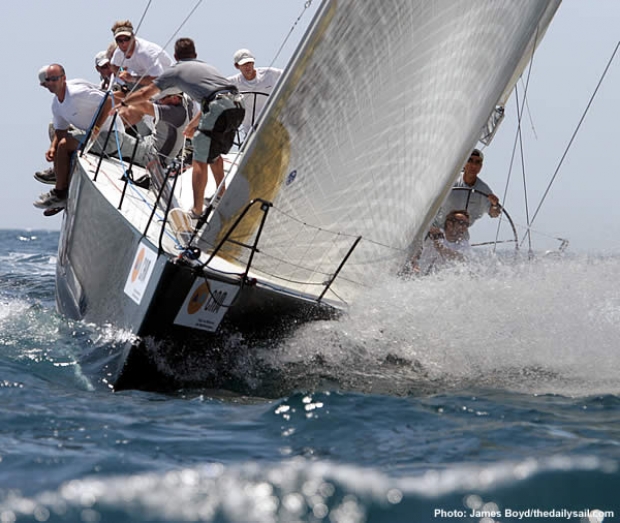
The Coumantaros yacht racing mantle has now been taken up by son John, who also works in the family shipping company. Having spent considerable time racing on his father's maxis, John Coumantaros has campaigned his own Farr 40 Bambakou and this year graduating up to the TP52 class, actively campaigning his Farr design on the Mediterranean circuit.
"My roots and heritage are European - my wife is Greek and I can run my business from here in the summer," John Coumantaros told us when we caught up with him. "Apart from that, it is great racing in the Med. I’m familiar with it. We used to race with my dad’s maxi boat all the time in Sardinia and Palma and I have great memories of that."
Aside from getting to race in the Mediterranean one of the principle reasons he moved out of the Farr 40 and into the TP52 was the prospect of more offshore racing. "We were doing windward-leewards - which was great - but we were doing them for three or four years and I really missed going offshore. I’ve done about 12 Bermuda races, my dad has done over 25 consecutively and for us that is the premier event - why we got involved in sailing from the beginning..."
 While Coumantaros has been racing in the more inshore-orientated regattas in the Mediterranean this year, one gets the impression he would be more at home racing with the US fleet in longer races such as the Newport-Bermuda, Pineapple Cup. "It would be nice if the Fastnet Race or the Bermuda Race were in the circuit. It would be great to have some more distance races," he says. When we spoke to him he was planning to campaign his TP52 in the winter circuit in the States.
In the TP52 he is coming up against many of the old faces he used to race against in the Farr 40. "It is fantastic to be sailing against Paul Cayard Tommaso Chieffi, Russell Coutts and all the other great helmsman and tacticians. It doesn’t make you feel as bad when you finish third or fourth in that kind of crowd."
Already in its first season the class in the Med has become highly competitive - a boat that wins one race can equally come last in the next if they make an error. "Make a mistake and you are out the back door. It is very similar to the Farr 40 and as the fleet gets bigger and bigger it will get more and more like that as the course gets crowded," Coumantaros agrees.
Despite the TP52 being a box rule with boats coming from a variety of different design houses, rather than being a one design, the boats have a remarkably even performance. This season Coumantaros has only on occasions been at a disadvantage through racing his 2004 generation Farr design, a boat that was originally intended for racing in North America and on the Transpac. "Frankly our boat speed - we’re very pleased with it," he says. "Upwind we feel we are every bit as competitive, except maybe in very light chop, but in stronger winds we feel we have an advantage. So the generational gap between the boats is really not the main contributing factor. There is room in the sail plan to develop sails that might help, but we have no complaints about the horse."
On the Breitling MedCup this year Bambakou has been up against the three new Cookson-built Farr designs - Bribon, Aifos and Caixa Galicia and despite ducking out of the final regatta of the season will end the year ahead of Aifos, the Spanish navy boat.
"You have to remember that the three new Farrs were designed for the Med," Coumantaros says. "They have a narrower entry and although they are beamy they are designed for the light air and chop. The Bottin and Carkeek boats [such as series leader Pisco Sour] - I think in the stronger breeze they look very powerful. What are the differences? With a new boat, with a female mould maybe you’d take 100kg out of the hull and put it in lead, maybe you’d have a different spar. But the boat is not the issue. What is more of a contributing factor is who is on the helm, which is me versus Russell Coutts. One or two or four boat lengths you might lose on a weather leg because of tacks or anything like that, makes much more difference than the boat."
While a majority of the boats in the Breitling MedCup have pro drivers, Coumantaros steers himself racing against the King Juan Carlos of Spain in the owner-driver, Corinthian division. "For me to spend all the money and time, and then someone else have all the fun…" he cites. Sailing he points out is one of the few sports were 'amateurs' can compete alongside pros, much like playing golf against Tiger Woods. "What more could you ask for than being on the same pitch as the best in the world?"
On the TP52 Coumantaros shares the driving with Craig Heeley, a dentist by profession, but also an experienced Etchells sailor. "He steers downwind and I steer upwind. On the Farr I would sail upwind and downwind and I found I never knew what was going on in the race. I wasn’t allowed to look away from the tell tales! Now at least when we go downwind, I can see what’s happening and I get a break from the helm which is nice, because you are on there for extended periods in the heat and the responsibility is shared. You feel terrible if you have all this team out there and you make a mistake..."
Coumantaros says that the situation in the Spanish fleet is different to, for example, the Farr 40 class as many of the Mediterranean teams have significant sums of commercial sponsorship behind them. "If someone is going to pay your expenses for the whole summer or whatever and they are going to contribute significant amounts of money - because it is not small change - they look for results which is what they are paying for. I understand that - and why not? It is to the benefit of the sponsor and the reason why we have this number of boats, because how many individual owners will be able to campaign this type of boat?"
While Coumantaros may puts himself down as an owner-driver, the Bambakou crew is very professional, run by Nick Larrey, who has been with the Coumantaros family for more than 20 years originally running the Boomerang programs. In addition to Larrey the afterguard on board includes the likes of Tornado Olympian and America's Cup crewman Santiago Lange.
In terms of the preference among the Mediterranean fleet for shorter courses Coumantaros feels this is partly a function of the conditions one experiences sailing in these waters. "If you look here at the Med sailing in the summer, how much do you really want to be out there in 2 knots of breeze or totally becalmed? It would be nice to have the Fastnet in there and some premium offshore events. Maybe we can get the fleet to the Aegean Rally in Greece. Also bear in mind, the offshore component is there to prevent 'horses for courses'. It keeps the boats more honest in what they are designed for."
There have been concerned both inside and outside of the class about escalating costs due to the nature of the box rule and over the longevity of the boats. Coumantaros feels though that owners are on relative safe ground. "The boats are close - nobody has come through and made our boats are obsolete - not by any stretch. There are people building new keels, but the boats are generally close enough in the box for there not to be huge gains. Maybe I am wrong but I think it will be relatively stable. What is important is that the European and American fleets are able to race together rather than having 10 boats here and 10 boats there, it would be nice to have 20 boats in one place. I think that will come."
So will we ever see another Coumantaros maxi? "It depends how well the business goes! It is a different game. Before there was a maximum rating. Now it seems you can almost go as big as you want. I am 43 years old and the 52 footer is a great boat to be in. My dad said that the best days he had were in his 50 footers. You can do a lot with it. You don’t need an army to move it. For the next decade for me, this size suits me fine. It is as exciting as the Farr 40 with another element added on it. It is very very good fun."
Most Read
Most Commented
Comments
Businesses
Pro businesses
Editor's choice
Member blogs
-
 Ned Collier Wakefield: MOD70 round BarbadosWell that was intense. 12 hard fought for seconds for the win. In idyllic conditions, Tony Lawsons MOD ...
 -
 Mini Transat leg 2 reportThe second leg of the Mini Transat started on 31st October, just over a month after ...
 -
Leg 1 reportI’ve been working towards the Mini Transat now for three years. In 2013 I was part ...
Business blogs
-
 The Island Sailing Club in Cowes, Isle of Wight, is delighted that Prince Michael of Kent ...
 -
Peta Stuart-Hunt chats with the 25 year-old British solo sailor Lizzy Foreman before she sets sail ...
-
The 2015 Student Yachting World Cup (SYWoC), an ISAF-recognised event hosted and run by students for ...
Editor's Choice
All time favourites...
-
 Three legs down into Ian Walker’s
 -
 Winning all but two races at
 -
 For the first time in its
Latest Comments
Add a comment - Members log in