
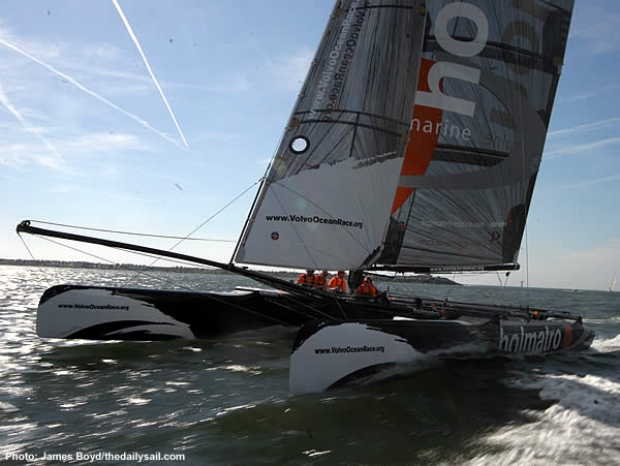
On board the Volvo Extreme 40
Tuesday September 6th 2005, Author: James Boyd, Location: United Kingdom
Aside from the in-port racing during the forthcoming Volvo Ocean Racing, stopovers in several ports will be enlivened by racing between the new Volvo Extreme 40 catamarans.
Holmatro 2, the first example of the Yves Loday designed, Marstom-built X40 has now been launched and was being exhibited last week at the HISWA In Water boat show in IJmuiden, Holland where in near perfect conditions cat sailing legend Mitch Booth took us for a blast.
At one point before Volvo's involvement the boat was known as the Tornado 40 and this pretty much sums up the boat's overall concept. 40ft (12.2m) by 23ft (7m) her length to beam ratio is larger than the 2:1 proportions of the 6m Olympic catamaran, while she carries 100sqm of sail area upwind and 153sqm downwind on an all-up weight of 1,250kg, making her only marginally heavier than the shorter Decision 35 catamarans that blast around the Swiss lakes (although they carry a substantially larger sail plan).
Like the Tornado she comprises two hulls joined by two crossbeams the forward one supporting the mast (with the additional bracing of a dolphin striker beneath it), the aft one carrying the mainsheet track. Her hulls are a more modern shape than the Tornado with the characteristic Yves Loday curve to the top of the bows (a la Spitfire), a fine entry forward, but with more volume in the aft and mid-sections, to improve her passenger-carrying potential. "We sailed on launch day with 11 and we were flying a hull without any problem," says Booth, although we imagine the engineers will shudder at this prospect...
The 40 has no forward beam, nor the flying central hull of the Decision. Nonetheless, protruding forward from the mast step is a formidable carbon bowsprit. This is tensioned in an interesting way with a metre long compression tube running up the bottom of the forestay: One set of cross bracing goes over the top of this tube and down to the hulls (much like the seagull striker on a maxi-cat front beam) while another goes across the top of the bowsprit at the bottom of the compression tube and down to the hulls on each side.

"It’s something developed from the small cats," says Booth (above) of the bowsprit arrangement. "When we changed the Tornado rig over we soon learned how that configuration had to work for a boat we didn’t want to put a forebeam on and a boat that we wanted to put the jib tack quite low, otherwise you are stuck with the jib way up at the intersection of the forestay bridle and it looks a bit strange." The system is now moved on from the Tornado and is being used on F18s such as the Hobie Tiger.
The pole also has slight downward pre-bend in it. "The way we set the pole up with pre-bend in them, it means that with the upward load on the pole end and the compression, the pole is braced in a way that it is not going to get out of column," explains Booth. "If it just sits straight when the upward pressure starts it starts bending up and then the middle of the pole starts to get all out of shape and you have to brace it really hard. With the pre-bend in it it sits there like a pre-bend mast - it can’t bend the other way."
The mast of course is a rotating carbon fibre wing braced by a single set of spreaders and diamonds and kept upright by a single set of PBO shrouds that are lashed to the deck. Mast rotation is limited by a substantial aft-facing mast spanner - made like practically everything else on the boat, in carbon fibre. Halyards and other lines exiting from the mast step are handled by jammers and winches either side of the mast on the main beam.
Like the Tornado, the Volvo Extreme 40 carries just three sails - mainsail, jib and genniker. The main is the now standard fully battened, flat-top affair made from carbon panels. The jib is on a self-tacker, the dished sheet track running along the front of the forward beam. The genniker of course flies from the end of the bowsprit. The jib is hanked on while the Code Zero-style genniker is on a furler and is wound in and then dropped at the leeward mark. The jib arrangement Booth says is temporary and they are likely to end up with a foil system.
The sails for the first five boats have been designed between the Ullman Italy and Newport Beach lofts, where their Tornado colleague Charlie Ogletree works. After the first races, the sail maker is to be opened up, says Booth. "We ran out of time to deliver the boats and allow the teams enough time to develop their own sails. So we felt it best if everyone had the same sails for the first Grand Prix".
Interestingly for a boat of this size both the main sheet and the Cunningham are tensioned by hydraulics, the cylinders for both located on the boom. "The main sheet in particular has got quite a lot of load on it and we thought that to be as fast and as efficient as possible with one person operating it, hydraulic is a good system to use," explains Booth. "It also tidies the boat up. There is a 1:1 main sheet with just a pump handle and aa pump box. It is so much simpler and saves an extra winch on the boat and a lot of line.
"The Cunningham we just decided it was the same thing - we didn’t need extra line on the boat. We are pulling up to 1.2 tonnes on the Cunningham. It would need another winch or something else up there to operate it and you want to operate it from the cockpit." The control panel for the hydraulics is located between the helmsman and the mainsheet trimmer.
So what's it like to sail? On the day we were on board there was around 12-15 knots of breeze and when Booth got in the groove she was clearly accelerating to 20 knots - unfortunately there were no instruments on board to confirm this. With modest freeboard and the boat readily able to lift her weather hull, you do get more of a sensation of speed compared to maxi-catamarans or 60ft trimarans where you are much further off the water. In these conditions there was no tendency to nose dive and as the video shows she seems well trimmed fore and aft.
According to Booth to date the top speed of the boat has been 31 knots achieved in 20 knots of breeze and clearly there is more to come. Herbert Dercksen, Booth's Tornado crew and who is running the Volvo Extreme 40 show says the crew have managed to lift the weather hull in just 4 knots of breeze, but this was reaching under genniker. Typically gybing downwind in a race situation the hull is likely to fly in 6 knots of wind. Still, this is Fun - with a capital F.
Aside from her speed, particularly in light winds, what impressed us most about the boat was just how stiff she feels. Marstrom up in Sweden built the boat in pre-preg carbon under pressure in an autoclave (normally this is reserved for carbon fibre mast construction) to ensure optimum resin/fibre ratio and she does feel solid, although during our sail we didn't encounter waves other than from other traffic going in and out of the busy Dutch port. The finish - in clear coated carbon - is generally good thanks to the autoclave although when we saw the boat there was still some detail work that remained to be completed.
Once the sails are up the Extreme 40 is, like most asymmetric boats, exceptionally straightforward to sail. The main is principally trimmed on the traveller, with the 1:1 mainsheet being used as a fine-tune and eased slightly to help accelerate out of tacks. In the event of a gust the traveller can be dropped down to leeward and the sheet can be dumped from the control panel.

The self-tacking jib looks after itself, trimmed and left according to the point of sail, although like the mainsheet it is eased to help the boat through manoeuvres. Downwind the jib is jammed off and the primary winch is used for the genniker. "It is all very simple," says Booth. "If you make it too complicated on a short course you are never going to be able to throw it around the mark."
About the only occasion all of the boat's four crew are required is hoisting and dropping the kite. During racing each boat will carry four crew as well as a mandatory passenger, who might be a cameraman or a sponsor for example.
The transom hung, lick-up rudders make for a light helm says Booth. "That is mostly because of the speed of the boat. Once you get to speed the helm just lightens up. It has long tillers, so there is big leverage on the rudder which makes it even lighter. I am steering with some very small beach cat tiller extensions which come from an A-cat, so the helm is light. At slow speed the boat turns well because the rudders are a little bit oversized. We decided to do that because of the grand prix racing, we wanted good manoeuvrability at slow speed to get out of docks or to round marks with a fleet of boats. The steering is very easy and very responsive."
Over the next couple of months Marstrom are set to deliver the next four boats that are due to have their first race in Vigo prior to the start of the Volvo Ocean Race. Dercksen expects that typically they will sail three or four races each day depending upon the conditions. "They'll be in the afternoon probably from 2 or 3pm on and then depending upon when the breeze there, maybe until 9pm. We will be racing when the spectators are there." He expects the duration of races to be 15-20 knots if they are televised, longer if they are not.
To televise the racing Dercksen says they are expecting to have on board cameramen as well as off the dock and helicopter-mounted cameras, although one could see the demand in the future for some fixed on board cameras.
While Holmatro - who have provided the hydraulics for the boats - are sponsoring the first boat that will be campaigned by Booth and Dercksen, Dercksen says that the final four boats have already been sold. The owners of these will be announced in due course but a name that repeatedly comes up in relation to the 40 is Vendee Globe skipper and BT Global Challenge winner Conrad Humphries. Humphries will neither confirm nor deny at this stage.
The price of the 40 is 300,000 Euros, and Herbert Dercksen estimates that on top of this there would be campaign costs of around 100,000 Euros per annum.
This week the Volvo Extreme 40 is off to the Volvo Champions Race in Germany.
More photos on the following pages...

Most Read
Most Commented
Comments
Businesses
Pro businesses
-
France
-
United Kingdom
-
-
Editor's choice
Member blogs
-
 Ned Collier Wakefield: MOD70 round BarbadosWell that was intense. 12 hard fought for seconds for the win. In idyllic conditions, Tony Lawsons MOD ...
 -
 Mini Transat leg 2 reportThe second leg of the Mini Transat started on 31st October, just over a month after ...
 -
Leg 1 reportI’ve been working towards the Mini Transat now for three years. In 2013 I was part ...
Business blogs
-
 The Island Sailing Club in Cowes, Isle of Wight, is delighted that Prince Michael of Kent ...
 -
Peta Stuart-Hunt chats with the 25 year-old British solo sailor Lizzy Foreman before she sets sail ...
-
The 2015 Student Yachting World Cup (SYWoC), an ISAF-recognised event hosted and run by students for ...
Editor's Choice
All time favourites...
-
 Three legs down into Ian Walker’s
 -
 Winning all but two races at
 -
 For the first time in its
Latest Comments
Add a comment - Members log in