
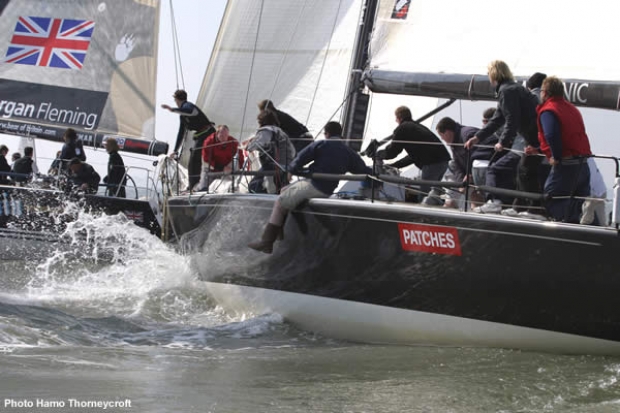
Over Easter Eamon Conneely's new Patches team was competing in RORC's Red Funnel Easter regatta in the former Team Tonic Farr 52
The new game in town
Monday March 28th 2005, Author: Ian Walker, Location: United Kingdom
With 29 boats currently built or on order the prospect of a first TP52 Class World Championship (assuming ISAF status) in 2006 is mouth watering. This summer’s European regattas, which could have 15 boats on the start line, should be quite a sight. The rate at which this class is growing is phenomenal, especially when you consider the fact that new boats cost approximately 1 million Euros and campaigning a boat with no sail or professional crew limitations has the potential to be very expensive. Quality boat builders and designers are rubbing their hands together, but no doubt they are all quite nervous to see how their creations will fare against everyone else this summer.
With several potential owners waiting in the wings to see how the class evolves this year one can imagine a lot more business coming the way of those who win.
So why has it taken off so fast? The Class Association was only formed in 2001 and immediate growth was steady at best. The real stimulus was provided by the King of Spain announcing his intention to build a boat for this year. Many others followed, with the simplicity of the box rule and the prospect of a high performance boat attracting owners from many directions. It has capitalised on all the IMS big boat owners who fell out of love with a rule that encouraged expensive, slow, ugly boats. It has also drawn several of the more wealthy Farr 40 owners who have been in the class for several years and want a new challenge. Finally it is drawing in the owners who do not want to sail one design and have been waiting for a new Grand Prix sailing rule to design a boat to.
All of these owners are attracted to the boat which is very fast, has level rating racing (no handicaps to compute or explain), has the intrigue of design and optimisation and which can offer good inshore and offshore racing.
The only real negative is the potential cost, but I guess if you have the money and are prepare to spend it then that is not such a big issue.
What effect will this have on other racing? I’m pleased to say that I do not think it will have any adverse effects. The Farr 40 remains strong with a fantastic 28 boat fleet at the recent Worlds in Sydney. I imagine the Worlds in Newport next year will be very well supported and perhaps it will be good for the class to lose a few of the very wealthy owners. The biggest threat to the Farr 40 is the ever increasing standard and cost of campaigning at that level. It is very hard to gain a foothold. The message is clear. If you want to do well in a Farr 40 you need to spend a lot of time practicing with the very best crew and equipment. Only after that and plenty of experience will you challenge the front runners. The biggest threat to the Farr 40 is almost its own success.
As for IMS racing, I don’t think there will be any tears shed as that dies away. Maybe it has a future in the Med with smaller boats for a while but how long will it be before smaller box rule boats and one designs eat into that support? It can only be a good thing to sail boats that are more fun as long as there are lots of them and everyone can find their cost bracket.
A strong TP52 class is also good for IRC. The last thing this rule needs is owners specifically designing boats to push the IRC rule to the limit. The IRC rule does a great job at events like the Commodore’s Cup but can it really handle the rigours of professional racing? I doubt it.
Class Association
Unlike most one designs, the TP52 Class is run by an Executive Director on behalf of the owners. It is not heavily influenced by any one designer or builder. Tom Pollack has done a great job at shaping the class but it will need some strong leadership to keep both the current predominantly owner driven US teams and the newly formed largely professional European Teams happy. While professional helmsmen are permitted on the European Med Circuit the class rule for anywhere else in the world (including any Championship events) will remain owner or amateur driver. This rule will be tested hard at the first World Championship - I predict many former Olympians and professional skippers who are now Cat 1 being in great demand. Another thing to note is for any change to the TP52 Class Rule or byelaws a ‘super majority’ of 80% is required.
Refreshing
I am excited about the diversity of racing this boat can offer. The Irish TP52 Patches that I will be sailing this year will race under IRC in the UK this season culminating in the Admiral's Cup and Fastnet Race before being shipped to the Mediterranean for the last of the Class circuit events in Sardinia and then the Middle Sea Race. I have done enough windward/leeward races in the Star and Farr 40 to last me for a while and while they are good fun it will be great to mix it up with some competitive offshore and coastal races. It will also be nice to learn more about boat, rig and sail design and optimisation.
I haven’t even sailed a TP52 yet but I am already a convert. I only had to listen to any of the crews or owners talking at Key West or Miami after racing to become convinced. The talk is of fun, speed, teamwork and excitement and not rules, protests, professionalism or crew weight loss. There is a buzz about this class and I can’t wait to sail one.

Most Read
Most Commented
Comments
Businesses

Pro businesses
-
United Kingdom
-
United Kingdom
-
Italy
-
Netherlands
Editor's choice
Member blogs
-
 Ned Collier Wakefield: MOD70 round BarbadosWell that was intense. 12 hard fought for seconds for the win. In idyllic conditions, Tony Lawsons MOD ...
 -
 Mini Transat leg 2 reportThe second leg of the Mini Transat started on 31st October, just over a month after ...
 -
Leg 1 reportI’ve been working towards the Mini Transat now for three years. In 2013 I was part ...
Business blogs
-
 The Island Sailing Club in Cowes, Isle of Wight, is delighted that Prince Michael of Kent ...
 -
Peta Stuart-Hunt chats with the 25 year-old British solo sailor Lizzy Foreman before she sets sail ...
-
The 2015 Student Yachting World Cup (SYWoC), an ISAF-recognised event hosted and run by students for ...
Editor's Choice
All time favourites...
-
 Three legs down into Ian Walker’s
 -
 Winning all but two races at
 -
 For the first time in its
Latest Comments
Add a comment - Members log in