
Three of the best from London Boat Show
Monday January 19th 2004, Author: James Boyd, Location: United Kingdom
Backman 21
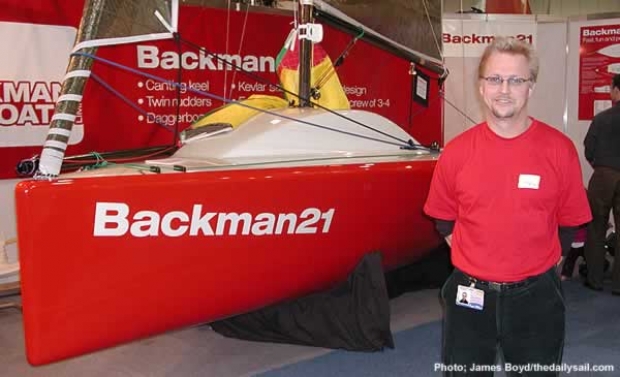
An unexpected new player at ExCel was the Backman 21 sportsboat. Concieved by Swede Hans Backman the first production example of this boat is currently under construction up at Ovington Boats in Newcastle (conveniently there is a ferry between Newcastle and Gothenberg) ready for launch in March.
Backman told thedailysail that he has been developing the boat in prototype form since 1999. Although a former sailmaker by trade he is also a yacht designer and came up with his first sportsboat of this size back in 1986.
"It's fast, because fast is fun," Backman sums up the concept. The boat has many whizzy features. Working from the bow aft, there is a carbon fibre bowsprit. Fully projected this measures 1.5m from the bow. The sprit can also articulate by +/- 20degrees allowing the tack of the asymmetric kite to be hauled up to weather allowing deeper angles to be sailed.
Rather than the bowsprit retracting into the hull like the typical J/Boat arrangement, instead it is all above deck, projected through an articulating steel ring at the bow - not as neat but certainly simple. The upward movement of the sprit's aft end is limited by a stainless steel bar that runs across the foredeck, where the tackle controlling the articulation is located. All control lines, plus that of the furling jib run aft to the cockpit.
Below the water the boat has a swing keel - the first production sportsboat to have one - with a 200kg bulb. The keel cants by +/- 40 degrees and is controlled by a 16:1 block and tackle system. Cleverly the case for the canting mechanism also forms the internal support for the deck-stepped mast. To prevent leeway when the keel is canted there is a single symmetrical daggerboard of around 1m draft. The keel can be hauled up into the boat for trailing.
Aft there are twin rudders. This seems excessive given that the boat is not overly beamy, but Bachman says that it allows the rudder blade to remain upright in the water when the boat is heeled and as a result rudder size can be reduced. The rudders are transom-hung and have a mechanism to pivot them out of the water exactly like that of a beach cat. On longer legs the weather rudder can be lifted out of the water to reduce drag as on some Open 60s.
Above deck the rig also has some unique features. It has swept back spreaders and no backstays fixed nor running, thereby allowing a generous roach for the mainsail - a quasi-square topped mainsail is planned for the boat. The capshrouds unusually pass through the main spreader and are used to set the pre-bend in the mast and as added support when using the masthead asymmetric.
With the twin rudders and canting keel it struck us that the boat could fit into the Mini class, but Backman says it is a few centimetres too long, needs substantially more sail area and doesn't have enough hull structure - it is designed for day racing, not ocean racing.
The boat costs £19,900 including VAT, carbon fibre mast, bowsprit, Kevlar sails and fittings.
LOA: 6.60m
Beam max: 2.40m
Draft: 0.4-1.5m
Displacement: 550kg
Working sail area: 27sqm
Spinnaker: 45sqm
Contact: Backman Boats tel: +44 (0) 1462 490445 email: sales@backmanboats.com
To see more photos - click here
LDC get sensible - introducing the RS Elite keelboat
Having fully exploited the asymmetric dinghy market with their RS range, LDC Racing Sailboats have taken a new turn with the introduction of another new keelboat to their range.
While the K6 was in much the same vein as the other RSes, but just with a keel, the new Elite on display for the first time at ExCel represents a much more significant departure from their existing range. Damn it - it even has a symmetrical spinnaker! How very uncool.
LDC's Martin Wadhams explains that the Elite is a modern incarnation of all the classic small keelboats that compete in rivers and estuaries around the world. He admits, somewhat through gritted teeth, that confined stretches of water do exist where screaming along zigzagging downwind under asymmetric kite is perhaps not as smart as popping a good old fashioned double D cup brassiere of a symmetrical spinnaker and running - not a word that has featured to date in RS vocab - downwind.
In fact the Elite has come about following LDC being cajoled by a group of sailors from Hayling Island Sailing Club who were looking for a new three person non-hiking keelboat that would suit their purpose - not too deep drafted, easy to maintain, strict one design, etc. Seven have so far been ordered by HISC members and other clubs are also taking a keen interest, Wadham says. "It has far surpassed what we'd hoped for at this stage. We haven't even started production yet." The tooling for the new boat is not expected to be finished until the end of March.
The boat has been designed by Phil Morrison and its hull shape, with a slight rake to the bow and conventional transom, is sweet, somehow ressembling a scaled-down 40 or 50 footer.
While the shallow draft was on the design wish-list so was high stability and thus while drawing just over a metre, she has a substantial encapsulated lead bulb, bring her overall displacement up to 925kg. A side effect, Wadhams says, is that the Elite is suitable for keeping moored to a buoy.
Construction is in straightforward GRP, and she is unsinkable, her enclosed cockpit self draining. Above deck the rig is again a modern incarnation of what you might find on a traditional small keelboat. The mast is made of carbon fibre, although the boom is alloy. The mainsail has a much more generous roach and the jib is non-overlapping and self-tacking.
Long, narrow and stable the Elite looks like she will be very well behaved, although Wadhams says that she has an exciting turn of speed. "Although she's not a planing boat, it does get over its own hump and we have regularly seen 12-15 knots on the clock even in flat water."
The price is £16,950 ready to launch. Optional extras include Tack Tick speed/depth/compass/timer units, cockpit cover, outboard motor and bracket and a trailer.
At the show RS were also launching the Vision, a larger version of their roto-moulded Feva.
LOA: 7.3m (24ft)
Beam: 1.72m (5ft 8in)
Draft: 1.1m (3ft 7in)
Displacement: 925kg
Sail area (main and jib): 23.5sqm 250sqft
Spinnaker: 25sqm (266sqft)
Contact: LDC Racing Sailboats tel: +44 (0) 2380 274500. Email: rs@ldcracingsailboats.co.uk
To see more photos - click here
J/133
At Schroders London Boat J/UK unveiled the latest in the American manufacturer's bowspritted range.
The J/133 is big brother to the all-conquering J/109. To date nearly 200 J/109s have been sold making it the company's best selling boat over 30ft. Aside from working well as a cruising boat, the J/109 works well sailed two handed (it won on IRC in the Royal Western YC's two handed Round Britain Race) and round the cans won black group overall at Skandia Cowes Week in 2002, SPI Ouest in 2002 and 2003 and the RORC class two championship in 2002 and 2003. J/UK's Paul Heys hopes that the larger 43ft J/133 now available will be equally successful - the first example is making its debut at Key West this week.
While the J/145, J/125 and J/90 are J/Boats carbon fibre racers, the J/109 and J/133 have a more conservative build in E-glass and balsa, as ever with J/Boats, using the SCRIMP resin influsion system. Compared to the high performance boats, with the latter two models J/Boats have attempted to create boats with better windward-leeward ability by coincidence in much the same way as LDC have with the RS Elite.
The J/133 has the company's characteristic bowsprit arrangement that retracts into a sealed tube in the forepeak. Paul Heys says that with the J/133 they have gone one step further in terms of stability with a Hall Spars carbon fibre mast fitted as standard. The result he says is that the boat will perform well with or without the crew sitting on the rail.
The working sail plan comprises a mainsail of modest roach and a 105% jib, but interestingly the boat is fitted with mile long headsail car tracks as in the States the boat is usually raced under PHRF where large overlapping headsails are popular. Standing rigging is in rod, while the backstay is hydraulically operated.
The standard keel option draws 2.29m while for the more cruising orientated, a shallow draft option of 1.90m is also available.
Maybe I haven't been on a cruising boat for a while, but down below I was struck by the huge expanse of wood. Agreed the satin-varnished cherry wood does make for a warm traditional feel but are such large acreages of hardwood really necessary in this day and age? I guess the market gets what the market wants.
The accommodation layout is conventional with a U-shaped galley to starboard, forward-facing chart table to port and forward of this the dinette offset to starboard, the table having a drop down leaf to port that allows it to extend to the seating on the port side of the cabin. All the fittings and joinery seemed large and robust.
In terms of cabins there are two standard layouts. At the show the standard model was on display with three cabins (two aft one forward). For the more cruising orientated the port cabin aft can be replaced with another head compartment.
The J/133 on display called Wow was hull number three, destined for Dublin and a former J/109 owner. Five examples have now been completed and impressively orders are already in for 17 of which five are destined for the UK.
On the J/UK stand we met Didier le Moal Managing Director of J/Europe who told us that production of the larger models in the J/Boats is soon to start in France at the Kingcat yard near Les Sables d'Olonne in which J/Boats now hold a share. Smaller models such as the J/22 and J/24 are still built under license in Italy and despite there being so many examples out on the secondhand market some new J/24 builds are still expected with the Worlds coming to Weymouth in 2005.
With 37 J/109s sold in the UK and Ireland a one design rule has been published. At the show a new class association for the J/105 also had its inaugural meeting. Looking ahead J/UK are anticipating a new version of the J/92 for Southampton Boat Show and a new 65 footer by the tailend of 2005.
Prices in the UK is 300,000 Euros ex sails and VAT.
LOA: 13.11m (43ft)
LWL: 11.52m (37ft 9in)
Beam: 3.90m (12ft 9in)
Draft: 2.29m (7ft 6in)
Displacement: 8.27tonnes
Sail area (upwind): 89.6sqm (964sqft)
Contact: J/UK tel: +44 (0) 2380 455669 email: info@j-uk.com
For more photos click here

Most Read
Most Commented
Comments
Businesses


Pro businesses
-
-
Netherlands
-
Italy
-
United Kingdom
Editor's choice
Member blogs
-
 Ned Collier Wakefield: MOD70 round BarbadosWell that was intense. 12 hard fought for seconds for the win. In idyllic conditions, Tony Lawsons MOD ...
 -
 Mini Transat leg 2 reportThe second leg of the Mini Transat started on 31st October, just over a month after ...
 -
Leg 1 reportI’ve been working towards the Mini Transat now for three years. In 2013 I was part ...
Business blogs
-
 The Island Sailing Club in Cowes, Isle of Wight, is delighted that Prince Michael of Kent ...
 -
Peta Stuart-Hunt chats with the 25 year-old British solo sailor Lizzy Foreman before she sets sail ...
-
The 2015 Student Yachting World Cup (SYWoC), an ISAF-recognised event hosted and run by students for ...
Editor's Choice
All time favourites...
-
 Three legs down into Ian Walker’s
 -
 Winning all but two races at
 -
 For the first time in its
Latest Comments
Add a comment - Members log in