
The next Big Thing?
Thursday June 17th 2004, Author: James Boyd, Location: United States
One of the first things to understand about the Transpac 52 class, is that despite it's name and that is was originally written on behalf of the Transpacific Yacht Club for its races, it is no longer a flat-bottomed mini-sled that only knows the way to Hawaii.
While TP52s built to date are mostly of American origin, there is a growing interest in the class in the Mediterranean. With these two powerhouses combined the Transpac 52 is being touted as the next big class, ultimately a successor to boats such as the Farr 40 and the IMS500. The prospect of this becoming reality is a serious one to the extent that it has been the principle point of dispute between US Sailing and the two other original stake holders in the new Grand Prix Rule.
The irony of this is that the aim of the Transpac 52 rule is to produce a quick boat with both offshore and round the cans potential and where go-slow features are not credited as they are currently under the IMS. This general concept is exactly what RORC and ORC, the two other original stake holders in the Grand Prix Rule, want from their new rule too.
The main points of dispute ( as we have already written) are that the Transpac 52 is an IMS-based box rule, whereas the Grand Prix Rule is primarily VPP-based with 'boxes' creating boats of 30, 40 and 50ft size. Significantly the TP52 rule requires boats to have an IMS measurement certificate and therefore be subject to procedures such as wanding. This is felt to be an unnecessary complication by RORC while US Sailing believe it is essential for a truly Grand Prix Rule where designers are expected to exploit the rule to the limit. We find it hard to believe that ORC, the chief exponents of IMS, are not aligned with US Sailing on this point.
So enough of politics - what is a Transpac 52?
The TP52 box rule is flexible so that (to quote the rules) 'development is allowed in such factors as hull shape, foil shape, construction, interior, deck layout and rigging. However speed producing factors such as length, minimum displacement, maximum draft, and maximum sail area are strictly controlled'.
In practise designers are almost certain to go for maximum length and sail area and minimum displacement. The biggest variable with the hull design is over waterline beam.
Mercifully the rule is 'first across the line wins' and there are no time allowances. The Transpac 52 is also an owner-driver class, the rule stipulating that in point to point (offshore) races the owner steers for the start sequence and 30 minutes on from there, or in round the cans races the owner steers for the start, the first beat and all mark roundings. Otherwise the boat must be steered by a category 1 sailor. There is no limit to the number of category 2 and 3 sailors on board.
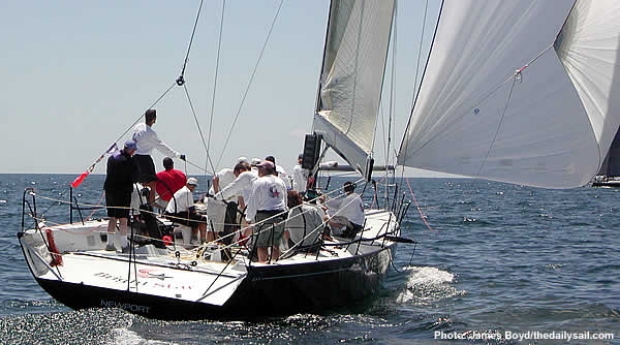
In reality, the Transpac 52s we have seen are like upmarket, turboed versions of the Farr 52 (our apologies to other designers). The rule of course allows a free-for-all in terms of choice of designer, builder and sailmaker. Since the rule was launched in 2000, using the unrestricted Laurie Davidson design Pendragon IV as its model, the Transat 52 is now into its third generation with a run of three new Farr designs launched within the last month by Goetz - Esmerelda, Bright Star and Sjambok. Trader, a design by Jim Donovan, is due to be launched imminently. Other designers who have had boats built for the class include a pleasantly diverse group: Laurie Davidson, Reichel-Pugh, Nelson-Marek, Alan Andrews and Brett Bakewell-White. There are now 11 Transpac 52s in existence and at least six more in the planning stage.
In many ways the rule is conservative - one keel and rudder are allowed, while canting keels, water ballast and trim tabs are prohibited. Equally the rig has a fixed backstay and no runners.
The TP52 rule promotes a good looking yacht: No hollows are allowed except in the front 30% of the boat, bumps are prohibited at freeboard measuring points and there are rules governing the continuous curve of the sheer. In terms of stability there is a minimum AVS of 125deg.
While none of this really gets the pulse racing, there is the 'turbo' aspect to the rule: the rig is fractional, but masthead Code Zeros are allowed (these must be loose-luffed but can attach to the bow or to the spinnaker pole or bowsprit). Deck-operated halyard locks are also legal. Similarly high-tech construction is allowed with carbon/Nomex laminates that can be cooked at temperatures of up to 105degC.
Within the box rule there is the possibility of moding the boats. Clearly early TP52s were geared up for Transpac-type events, but recent examples such as the three new Farr sisterships Esmeralda, Bright Star and Sjambok have been designed to offer a mixture of offshore and round the cans potential.
There is now an active owner's association who met last weekend during the New York Yacht Club's Annual Regatta. It is this owner's group who are now driving the class rather than the Transpacific Yacht Club.
The Transpac 52 rules are to be commended for producing a boat that promotes speed and excitement and is great fun to sail. But how does it stack up as a state of the art grand prix rule for international competition? There are two views on this.
The pro-argument is that the Transpac 52 is a step in the right direction, particularly if it is enticing to those who would otherwise be sailing IMS. The boats are fast, stable and with a keel change and minor mods to the rig, can be made to rate well under IRC, allowing owners flexibility to race in non-TP52 events. The box rule is tight making for competitive racing. While exciting the boats are not extreme and prohibit all the modern appendage and movable ballast options therefore keeping a lid on costs.
The con-argument is that the rule is inflexible and produces boats that are state of the art circa 1995. We now live in a time where Wild Oats with her canting keel has stormed around the Solent to win last year's Admiral's Cup and there is an awful lot of tried and tested technology, such as canting keels and trim tabs that the TP52 rule prohibits. In this respect the rule is out of date from the word go and while rule amendments are in the hands of the owners and therefore possible, the box rule is so tight that costly wholescale upgrades seem unlikely.
There is also the thorny issue of whether or not owner-driver classes are what are required for the international grand prix competition. In pure competitive terms the three boats in a British Admiral's Cup team should be driven by (for example), Ben Ainslie, Iain Percy and Ian Walker, who are three of the top helms in the UK. The reality of course is that neither Ainslie, Percy nor Walker can afford their own boat for the Admiral's Cup, nor probably would they have the desire to do so, thus the whole process relies on the good will of well-heeled owners. Some owners are happy to sit at the back and enjoy seeing the young talent in action, while others want the wheel themselves. The success of the Farr 40 class indicates that the latter are almost certainly in the majority. However a fixed backstay boat doesn't sound like a Grand Prix product.
What is most significant is that while the Transpac 52 may or may not be the right bit of kit to be the big boat within a larger Grand Prix rule, the rule exists, has competitive boats already built for it, with many more in the offing. It looks set to be the boat of the moment and raced to the highest level and in this respect cannot be ignored.
Over the next pages Patrick Shaughnessy, Senior Designer at Farr Yacht Design, Jim Donovan and Mark Mills give their views on the class.
To download standard polars for the Transpac 52 - click here
What are your views on the Transpac 52? Click here to send us an email.
Present Transpac 52 line-up
| Name | Owner | Designer | Builder |
Launched
|
Homeport | |
| Lightwave | Dave Ford | Laurie Davidson | Cookson | Bristol, RI | ex Bill Turpin's Alta Vita | |
| Flash | Mark Jones | Alan Andrews Yacht Design | Westerly Marine |
May-01
|
San Francisco, CA | Ex JBird III |
| Yassou | Jim Demetriades | Nelson Marek | Goetz Custom Boats | Long Beach, CA | ||
| Rosebud | Roger Sturgeon | Reichel-Pugh | Westerly Marine | Santa Cruz, CA | ||
| Beau Geste | Karl Kwok | Farr Yacht Design | Southern Ocean Marine |
2003
|
Hong Kong | |
| Braveheart | Charles Burnett III | Bakewell-White | Lloyd Stevenson Boatbuilders |
Jun-03
|
Seattle, WA | |
| Bright Star | Richard Breeden | Farr Yacht Design | Goetz Custom Boats |
May-04
|
Newport, RI | |
| Esmeralda | Makoto Uematsu | Farr Yacht Design | Goetz Custom Boats |
May-04
|
Japan | |
| Sjambok | Michael Brennan | Farr Yacht Design | Goetz Custom Boats |
May-04
|
Annapolis, MA | |
| Trader | Fred Detwiler | Jim Donovan | ML Boat Works |
Jun-04
|

Most Read
Most Commented
Comments
Businesses


Pro businesses
-
United Kingdom
-
-
Italy
-
Editor's choice
Member blogs
-
 Ned Collier Wakefield: MOD70 round BarbadosWell that was intense. 12 hard fought for seconds for the win. In idyllic conditions, Tony Lawsons MOD ...
 -
 Mini Transat leg 2 reportThe second leg of the Mini Transat started on 31st October, just over a month after ...
 -
Leg 1 reportI’ve been working towards the Mini Transat now for three years. In 2013 I was part ...
Business blogs
-
 The Island Sailing Club in Cowes, Isle of Wight, is delighted that Prince Michael of Kent ...
 -
Peta Stuart-Hunt chats with the 25 year-old British solo sailor Lizzy Foreman before she sets sail ...
-
The 2015 Student Yachting World Cup (SYWoC), an ISAF-recognised event hosted and run by students for ...
Editor's Choice
All time favourites...
-
 Three legs down into Ian Walker’s
 -
 Winning all but two races at
 -
 For the first time in its
Latest Comments
Add a comment - Members log in