
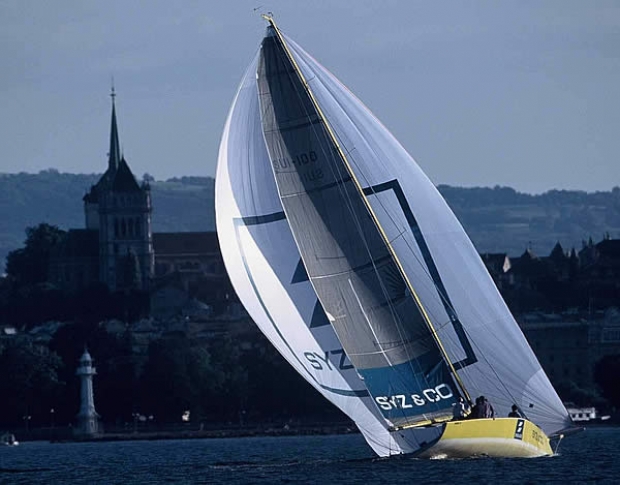
Fastest monohull on the lake
Tuesday June 15th 2004, Author: James Boyd, Location: Italy
This article follows on from yesterday's look at the new Decision 35 catamarans.
Swiss designer Sebastien Schmidt like several yacht designers, most notably Jean-Marie Finot, began life as an architect. In 1983 he teamed up with Philippe Meyer and during this time they combined an architectural practice with drawing many well-known lake racers including Formula 28s multihulls such as the catamarans Miss Julie and Charleston.
In 1993 Schmidt set up in his own right as a yacht designer as Meyer chose to concentrate only on architecture.
Aside from his lake racers he has also spent much time designing and optimising 5.5 metres, a popular class on Lake Geneva. Alongside the Decision 35 cats he has recently launched a new example of the class metre boat. "We learned a lot from the America's Cuppers and we applied that to the 5.5," says Schmidt. "The new boat has a self-twisting mast and the attachments are special so we have optimised that. It is an evolution."
As an aside Schmidt says he has just taken over the archives of Swiss yacht designer Henri Coppenex, one of the leading lights in the 5.5 class in the 1950s and 60s. Among the finds in his archives was a 5.5 with a 'knuckle' bow, similar to the sensational 'Davidson' bow found on NZL60, only it was designed circa 1955. "On a 5.5m you have exactly the same rule with the girth and the waterline measurements and you aren't allowed to have hollows in the hull and he made the knuckle bow to increase waterline length."
While the Decision 35 catamarans may be the ultimate expression in multihull lake racers, previously Schmidt came up with the ultimate monohull equivalent complete with trapezes, bowsprit, canting keel and water ballast in the Psaros 40, built by Maxi Dolphin in Italy and finished in Geneva.
These extreme monohulls are now into their third season racing on Lake Geneva and are regular winners in the monohull class.
Schmidt say the Psaros 40 came about more simply than the 35ft catamaran as initially they only had two clients for the boat and they paid for the tooling. At present three Psaros 40s exist with the arrangement that buyers can purchase one of these while the sellers gets a new boat.
Again this is a one design but not as strict as the catamarans and to make the class more versatile the boat fits into what is considered the monohull class one on the Lake (the Bol d'Or for example has seven classes). Thus the numbers of trapezes was left open to start with and even the roach of the mainsail was unrestricted. The rules regarding the mainsails changed this winter and all the mainsails are now 3DL and square topped.
40ft long the boats weigh a mere 2.8 tonnes all up ready to sail, including a bulb weight of 800kg and 250kg of steel fin. Although the boats have a water ballast capacity of 480lt, Schmidt says it is rare for them to take on more than 450lt a side. "I don’t like the [water] ballast, but when you have strong weather it gives inertia to the boat."
While the top speed of the boat is a lively 20-23 knots, as ever it is the low wind performance of the boats that impresses. Upwind in 6 knots of true wind for example the Psaros 40 will manage six knot.
The retracting bowsprit arrangement is also unique and has two positions. For use with the large genoa it is extended to its first position tensioning a bobstay that handles the downward loads. For the big kites, an pole extends out further from within the bowsprit. In the first position the bowsprit is 1.5m long, in position two a wopping 3.5m.
"The goal is to get a good all round performance, so that you can have 360degs of wind orientation and 0-30 knots strength. That is what you need in order to win the Bol d’Or."
The rules for the Psaros 40 are based on a version of IR2000 taking length, sail area and weight. Thus exotic items such as canting keels and carbon masts are not prohibited, just taxed.

The canting keel swings through 40 degrees and to prevent leeway they have Open 60-style asymmetric daggerboards that are toed out. In fact these boards are borrowed from the moulds of the Schmidt and Jo Richards-designed 42ft Alinghi catamaran.
Above decks the rig has some unique features. The mast is fixed with slightly swept back spreaders, but unusually with two sets of runners each side. "We use the forward runners upwind," says Schmidt. "In light winds when you have the light genoa you need the top backstay. This is just an experiment at the moment. It is not a definitive solution because it is less stiff than if you have them aft. But the target was to be able to forget them upwind like on a multihull so you can put your genoa up without thinking about your backstay. On the second boat they have grouped the top mast backstay and runners like the America’s Cup boats."
The Psaros 40s have their own circuit that takes in all the Lake Leman (Geneva) classic events like the Bol d'Or, where they are regular winners.
Once again the Psaros was conceived backwards from the price. While Schmidt worked out the size of the catamaran using a righting moment:SwFr connection with the monohull there is a cubic relationship between volume and price.
"The problem is that if you have to build a 14m long boat you double the price. You add two metres to our boats and you double the price. We made a calculation that 10.2m was 220,000SwF, 12.2m was 420,000SwFr and this boat 14.2m was 800,000. It was really interesting."


More photos on the following pages...


Most Read
Most Commented
Comments
Businesses

Pro businesses
Editor's choice
Member blogs
-
 Ned Collier Wakefield: MOD70 round BarbadosWell that was intense. 12 hard fought for seconds for the win. In idyllic conditions, Tony Lawsons MOD ...
-
 Mini Transat leg 2 reportThe second leg of the Mini Transat started on 31st October, just over a month after ...
-
Leg 1 reportI’ve been working towards the Mini Transat now for three years. In 2013 I was part ...
Business blogs
-
 The Island Sailing Club in Cowes, Isle of Wight, is delighted that Prince Michael of Kent ...
-
Peta Stuart-Hunt chats with the 25 year-old British solo sailor Lizzy Foreman before she sets sail ...
-
The 2015 Student Yachting World Cup (SYWoC), an ISAF-recognised event hosted and run by students for ...
Editor's Choice
All time favourites...
-
 Three legs down into Ian Walker’s
-
 Winning all but two races at
-
 For the first time in its
Latest Comments
Add a comment - Members log in