
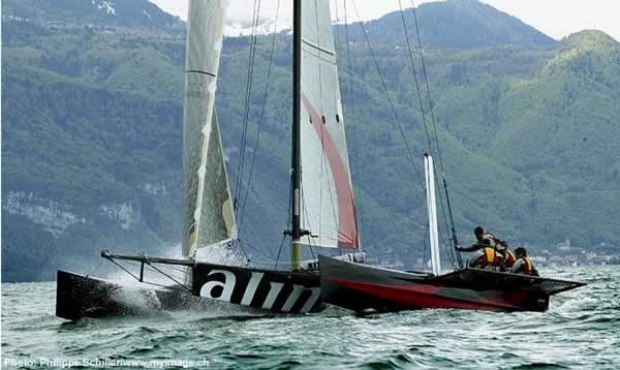
Swiss lake one design cat
Thursday June 10th 2004, Author: James Boyd, Location: France
Racing on the Swiss lakes where the wind speeds are typically in single figures has led to a Darwinian-like process in the evolution of the grand prix boats raced there.
In the late 1980s following the demise of the class in France, many Formula 40 multihulls ended up on trailers bound for Switzerland. Perhaps the best demonstration of the direction sailing on the Swiss lakes was going at this time was when Stephen Fein's Full Pelt F40 trimaran ended up there and the new owners feeling she was underpowered fitted a 60ft trimaran rig on her...
Towards the end of the 1990s the evolution has taken to the nth degree with the construction of Ernesto Bertarelli's new Alinghi catamaran designed by Jo Richards and local Swiss architect Sebastien Schmidt. Before this Bertarelli had been racing another Alinghi multihull, a trimaran design by Gino Morrelli.
Displacing just 1,300kg the new Alinghi was 12.5m long. With a 24.5m tall mast, a 4.5m long bowsprit and 3m bumpkin (aft sprit) she could carry 285sqm of sail upwind and 346sqm downwind - in other words an upwind sail area similar to an America's Cup boat on a boat weighing 150kg less than an Etchells.
Since her launch in 2000 the Alinghi catamaran has won the Bol d'Or for the last three years. With the lake multihulls arms race at its peak, there was a general feeling among Lake sailors that it was time the prototype wars should come to an end.
"The problem was the price and the arms race," explains Sébastien Schmidt, who has been designing extreme multihulls and monohulls for the Swiss lakes for two decades. "It is no longer clever to win. The last budget [for Alinghi] was 1 million SwFr just for building and if you spend 2 million you are 100% sure you are faster. So it is not interesting. Maybe 10 years ago it was a social act to have the biggest boat but now times have changed and it is no long enough just to win a regatta. To be proud of your victory you have to win with your skill. So it will no longer be a case of if you have these conditions this boat will win, if you have another another boat will win."
Schmidt compares the evolution of the lake boats to that of the French Open 60s and multihulls where the OSTAR and Route du Rhum 20 years where a free-for-all bed of innovation with remarkably different boats including wierd ones such as proas, whereas today these classes are approaching one designs, simply because people discover which corner of the box works best.
The prospect of an extreme one design multihull for the lakes has been mooted for some time. The original concept towards the end of 2002 was for a boat with planing hulls (read about this boat here). However the need for the one design to progress was accelerated when two of the top multihulls were destroyed when strong winds struck the Geneva fleet during the 2003 Bol d'Or.
"So it was time to go one design," Schmidt takes up the story. "We took the owners of the ex-Formula 40s and some owners from the F27/28 class and we grouped together to try to make a common project. Normally you have one owner at the table, but this time you have seven, so you can imagine there were different ideas..."
Schmidt was brought into co-ordinate the design team, comprising Damien Cardenoso, Bertrand Cardis, Christian Favre, Jean-Marie Fragnière, Gérard Gautier, Rémi Laval-Jeantet, Sébastien Schmidt and Steve Wasem. Schmidt says his job was to create a design team that would have come up with a positive result - "I was brought in so that there was not too much democracy: to design a race horse rather than camel."
"So time was very short and last July we decided to go to the new class with eight boats. Six was the minimum to begin with in order to keep the target of 350,000SwFr (230000 Euros)," he adds.
With the development process of the one design sped up, so they were forced to abandon the idea of the planing hull M35 35ft catamaran. In a design evolution bearing some similarity to that of Yves Parlier's Mediatis Region Aquitaine, part of the design team, Christian Favre and Rémi Laval-Jeantet, had come up with a 16ft prototype that showed great potential and clearly has prospects to be scaled up in the future.
The name of the boat also changed from the M35 to the FL35 after the Ferrier Lullin bank came in to sponsor the initial tooling and design studies. Because of a conflict of interest between the various Swiss banks who wanted to get involved with the class, the name was then changed to the Decision 35. Bertrand Cardis' famous Swiss composite boatbuilding facility, responsible for Whitbread maxis like UBS Switzerland, La Poste and Merit Cup and best known recently for constructing the Alinghi America's Cup boats, stepped in to sponsor the building of the moulds and ultimately have build the first series of boats, all of them masterpieces in carbon nomex.
Compared to the previous Alinghi catamaran, Schmidt says the boat is slightly more conservative. "The boats are still extreme with very high masts and very powerful sail area, but it is a catamaran with floating [rather than planing] hull, one rudder and daggerboard per float. In fact the biggest challenge was the building optimisation to keep the price down."
Working back from the price they came up with a formula linking price and righting moment. "It is a very very smooth curve and you can go from a 20 footer to Maiden and you take the price and then you choose your righting moment. So our cat has 7-8 tonne/metre righting moment, which is half the old cat. In comparison a 60ft tri is 55 tonne/metres. It gives you the weight, etc so we made a reverse process and it gave us the size of 35ft and in the end we also increased the length of the hulls to add some more control to the boat."
Schmidt says the new Decision 35 is an evolution of the previous Alinghi catamaran. With her large highly loaded rudders there were some issues of balance with the oldboat due to her outrageously large sail plan - specifically for example the effect on the helm once the light genoa has been poled out so far in front of the boat. To counteract this on the old boat they put a canard forward in each hull.
The most noticable evolution was the decision to go down the route multihull designer Derek Kelsall had 20 years earlier with Nick Keig's catamaran VSD in having a central 'hull' clear of the water to take the fore and aft rig loads. On the Alinghi catamaran where there was 23 tonnes of mast compression (similar to an ACC boat) these loads were taken by two longitudinal tubes and a 26mm Future Fibres PBO cable with a breaking load of 56 tonnes. "The breaking load of the whole structure was 23 tonnes of mast compression like an America’s Cupper on a 1.8 tonne boat," says Schmidt of the Alinghi cat. "So that is very complex, you have one guy to check all the lashings and everything. The goal with these boats was to spend more time on the water and less time in the shipyard. You raise the sail and you go sailing."
On the new Decision 35 the mast compression upwind is 8 tonnes on a 1.2 tonne boat, although in a gust this could increase to 12 tonnes, still 10 times the weight of the boat. "Previously you had the structure that helped depowering. Now with carbon fibre hulls and carbon sails, everything is so stiff, now nothing is depowering and on the water the guys are so crazy on the water that they just keep going..."
To improve the reliability of the boat they built in a 'safety factor', increasing the amount of structure in the boat by 200-250kg . Schmidt maintains that had this been a prototype they could have parred the weight down to less than 1 tonne but as it is a one design reliability is more important.
Aside from simply being able to take the load, the central 'hull' simplifies construction. "With aircraft or cars they try to reach one solution that solves three goals," says Schmidt. "This enables you to be lighter, more reliable and cheaper - you just work on the decreasing the number of pieces. So we followed that principle and everything that we can build with one piece instead of three with connection or bonding, we do that."
The central hull should also improve top speed. "It was strange to design because it is not a floating hull," he continues. "It has structural parts but it has to have shape because of the spray drag. The loads are so high and the hull is very close to the water and it is very narrow in shape to avoid slamming or spray drag. With the cables [on the old Alinghi] it was crazy, because at 25 knots you can’t go faster because of the spray drag of the cable. The old Formula 40s were faster than the Alinghi cat at high speed. But that was not the target - it was not the objective to reach high speed." The objective was to sail fast in light winds and the conditions found on the lakes.
Upwind the VPPs of the Decision 35 indicate that they will be sailing at 1.9 times wind speed with a top speed of around 13 knots. Thus in 4 knots of wind, which you often see on the lakes, boat speed will be approaching 8 knots. Compared to the Alinghi cat the Decision 35 will be a little slower - Schmidt reckons that in 12 knots of wind, it might be 1 knot slower, making 12 knots instead of 13, but he believes that because the boat is a one design, the optimisation programs carried out by the teams will bump up the performance. "The trimming of the boats will be much finer than with the prototypes particularly after one or two seasons. Even now the teams are thinking they will be at the same speed as the previous boats. Some of the teams already have the same targets as the old boats."
The boat will also not have quite the same extreme amounts of sail area as the design team realised that having too much extra sail also comes with a signficant amount of drag.
In terms of the Decision 35 rule, Schmidt says that it is very similar in concept to the Mumm 30. There is a quota of sails each year but there is no restriction on which sail maker you can use or what materials you can use. The sail wardrobe will include a mainsail with one reef, solent, light air genoa (with the change to the Solent in 6-7 knots of true wind!) and a genniker and a storm jib.
Crew weight is limited to a maximum of 437.5kg and a minimum of five crew (on Alinghi there were six or seven crew depending upon the conditions). Crew weight equates to slightly more than one third the displacement of the boat so crew positioning is critical.
"On these boats the crew influence is more effective than on the old boat," says Schmidt. "Which is what we like for one design. You have to work a lot to get good speed. If the crew are not well located they will just be slow."
The class is run by Bertrand Favre of the Association des Multicoques de Compétition (AMC) while Grand Chelem Management SA handle the sponsorship and marketing of the class.
The boats have been made demountable so that in theory they could be taken to somewhere like Valencia, but Schmidt says they are very much inshore or lake boats and thus bringing one to the UK and sailing it across to France isn't appropriate. Ultimately the maximum wind speed he expects them to sail in is 25 knots, but this may not be seen until next year by which time the crews will have more experience sailing them.
While six was the minimum order in order to make the series cost effective to date eight Decision 35s have been built - one of them a new Alinghi for Ernesto Bertarelli. The second boat, Bedat & Co, is owned by Nicolas Grange, while the Ferrier Lullin boat is co-owned by Philippe Cardis and Francois Mordasini. Zen Too belongs to Guy de Picciotto, while Frédéric Amar has the two Team Red boats, one of which is being raced by former trimaran skipper Loick Peyron this season. Jean-François Demole has the Chopard-sponsored boat Cadence while the eighth boat sponsored by Gonet & CIE Banquiers has a syndicate of owners.
When thedailysail visited the boats it was one of the Decision 35's first sailing days and of course one of the two days each year in Geneva when it was blowing 35 knots.
A RIB trip around the boats showed them to have a chine in the hull but otherwise they appear very Formula 40-like. The beam is much wider than a Formula 40 catamaran - 6.89m or 8.74m with racks - which is roughly the same as the larger Alinghi.
The crossbeams themselves are tubular and fit into sockets in the hulls (so that they boat can be disassembled). The bowsprit is enormous and very 18ft skiff-like - slightly downward pointing and with a substantially rigged fore and aft dolphin striker. All the carbon fibre tubes on board - the bowsprit, racks and rudders were made by the Isle of Wight-based company CompoTech.
Being a one design class, future evolution is a possibility. For example with such large rigs, a T-foil rudders would be a possibility to help reduce pitching as they have in a number of other classes.
The Decision 35s had their first race of the season last week, but their real test will be in the big event of the year this weekend - the Bol d'Or.
Program:
Bol d’Or 12 June 2004
Grand Prix de Genève 19-20 June 2004
Transvalmont 26 June 2004
Open de Morges 27 June 2004
100 Miles 11 September 2004
Grand Prix Beau-Rivage Palace 24-26 September 2004

Most Read
Most Commented
Comments
Businesses


Pro businesses
-
Italy
-
-
France
-
United Kingdom
Editor's choice
Member blogs
-
 Ned Collier Wakefield: MOD70 round BarbadosWell that was intense. 12 hard fought for seconds for the win. In idyllic conditions, Tony Lawsons MOD ...
 -
 Mini Transat leg 2 reportThe second leg of the Mini Transat started on 31st October, just over a month after ...
 -
Leg 1 reportI’ve been working towards the Mini Transat now for three years. In 2013 I was part ...
Business blogs
-
 The Island Sailing Club in Cowes, Isle of Wight, is delighted that Prince Michael of Kent ...
 -
Peta Stuart-Hunt chats with the 25 year-old British solo sailor Lizzy Foreman before she sets sail ...
-
The 2015 Student Yachting World Cup (SYWoC), an ISAF-recognised event hosted and run by students for ...
Editor's Choice
All time favourites...
-
 Three legs down into Ian Walker’s
 -
 Winning all but two races at
 -
 For the first time in its
Latest Comments
Add a comment - Members log in