
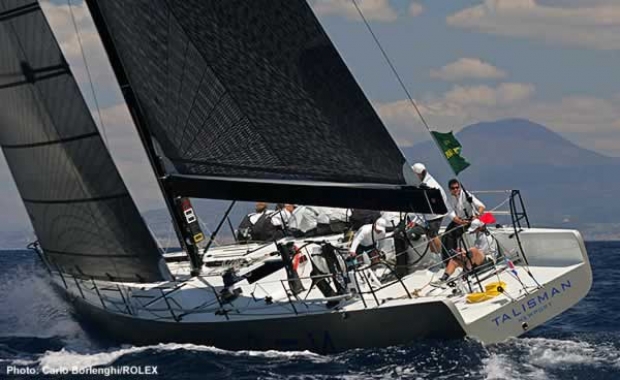
Marco Birch's Botin & Carkeek-designed Talisman is one of several brand new IMS race boats competing in the Med
Get back round that table
Friday May 21st 2004, Author: James Boyd, Location: United Kingdom
When RORC, ORC and US Sailing created the Rule Working Party last year the main remit was to find some global consensus in order to reunite the currently disparate elements of high end handicap yacht racing and allow international competition to resume.
Yet on 29 April it was announced that US Sailing ‘were placing a moratorium on it's participation with the International Grand Prix Rule Working Party (RWP) to allow time for wider review of national opinion among U.S. offshore racing interests.’ In short, agreement hadn’t been reached between the three stakeholders. US Sailing’s withdrawal came as a surprise to many who thought that if there was a weak link in the trio it would be the ORC, who’s IMS rule is generating many new Grand Prix level handicap boats in the Mediterranean.
The Rule Working Party it seems had become bogged down in the esoteric intricacies of rulemaking rather than keeping in mind that what was of paramount importance was to come up with a rule - something, anything - that would work internationally.
At present RORC and ORC are continuing with their Grand Prix Rule. With the broad brush strokes made, the Rule Working Party has now been disbanded and the rule is now in the hands of a technical group comprising RORC Chief Measurer James Dadd, Manolo Ruiz de Elvira from ORC and Andy Claughton, Chief Technician at the Woolfson Unit who chairs the group. They are currently in the process of filling in the detail of the new rule and their work is set to be finalised by the end of this year.
Meanwhile in the States another grand prix rule is in more embryonic form. A new organisation called the Offshore Racing Club of America (ORCA) is in the process of being set up by the core of US Sailing’s representatives from the original Rule Working Party - Jim Teeters, Peter Reichelsdorfer and Stan Honey. Others involved include sled guru Bill Lee (writer of the Transpac 52 and maxZ86 rules), Dan Nowlan of US Sailing and Barry Carroll. Teeters is currently co-chairman of ORCA with John Winder, Chairman of the Newport-Bermuda Race organising committee.
“Right now we are talking to yacht clubs, race organisations and we’re doing a survey of what is happening in offshore racing in the US, looking at what is working and not working,” Jim Teeters told thedailysail. Teeters has worked on the design side of America’s Cup campaigns since 1983 including PACT95 and Young America. From the mid-1990s he has been Director of Research for US Sailing and was US Sailing’s technical representative on the Rule Working Party.
“There is a clear need for a grand prix rule but I can’t answer any questions because I don’t have any answers yet. We know we’re going to do something for grand prix boats. We have already made a commitment to the Transpac 52s. If we can get some consensus from clubs we will proceed on acting on whatever we see their needs are.” Bringing the Transpac 52s into the new Grand Prix Rule Teeters says was one of the stumbling blocks with the Rule Working Party.
So where did it all go wrong between the Grand Prix rule stakeholders? Ironically it seems that the RWP came very close to achieving its goal and there was mutual agreement over the broad principles of the rule between the three parties. Over the last months thedailysail have been following its development via the RORC where the idea constantly mooted has been to come up not only with a Grand Prix rule that works internationally, but that produces boats that are competitive, fast, exciting and generally desirable to sail.
Talking to Teeters one gets the impression that US Sailing’s desires are identical. “I’d like to find something that works for sailors, boats that are exciting and boats that have a bit of longevity, something that can be competitive for three years - then we have done our job,” says Jim Teeters adding that they were entirely in agreement with the proposal presented in Barcelona in November 2003 ( click here to see the RWP's Powerpoint presentation - NB: it is 1.6MB in size).
So the general concept of the rule was agreed by all parties but as ever the devil was in the detail and on this occasion, so far at least, the devil has got the upper hand.
Fundamentally where the agreement over the Grand Prix rule appears to have come unstuck is in establishing who it is being written for.
“There’s the guy who says ‘rate my boat, here it is, I’m not going to change it, just give me a fair rating. And there’s the guy who says give me a rule and I’ll get a team together and we’ll design and build a boat to beat that rule,” explains Jim Teeters “Both are very honourable forms of racing, but I don’t think you can service both of them with the same solution.” Rules such as IMS, IRC and PHRF handle the former admirably while the new Grand Prix Rule or ORCA’s new equivalent should deal with the latter.
In the UK the situation is not nearly so black and white. There are few programs run along America’s Cup lines with professional crews and boats that undergo regular wholescale development or are replaced every two or three years, as one finds in the upper echelons of the IMS class in Spain and Italy. Nick Lykiardopulo’s Ker 55 Aera and perhaps the Farr 52s fall into Teeter’s view of what constitutes ‘Grand Prix’.
There are however many more semi-pro boats where the owner has a reasonably quick platform, has one or two ‘pros’ or semi-pros sailing on board and season to season might tweak the keel slightly and get some new sails. The disagreement between the original Grand Prix Rule stakeholders boils down to whether or not a Grand Prix rule should encompass this group - should a Grand Prix Rule apply to the top 20% of race boats or the top 5% internationally for example? RORC think the former, fearful of another Admiral’s Cup where no teams turn up, whereas US Sailing think that is not ‘Grand Prix’ enough and prefer the latter.
Specifically the dispute between US Sailing and the other two stakeholders has been over how boats should be measured. “We felt that the IRM-type approach would not be sufficient at the Grand Prix level," says Teeters. "It hadn’t been accepted when it was first brought up and it hadn’t been proven to be sufficient since, so US Sailing was reluctant to commit our resources and our credibility to reviving that kind of a measurement system."
The Grand Prix Rule RORC and ORC's technicians are currently conjuring up has boats being defined by point measurements whereas the US Sailing view is that this is inadequate for the highest level competition. “Designers are going to exploit any rule - that is a given - and we took that premise as a given when we first started,” says Teeters. “We could expect designers to exploit whatever we come up with. What is critical is what direction does that exploitation take? We didn’t want to go into distortion, nor did we want it to make slow boats.” Neither to our understanding does RORC.
Points measurements, Teeters maintains, allow designers to distort their boats around those points. “If you are measuring a point at one specific location what happens in the neighbourhood of that where there are no measurements taken? For all of its failings at the Grand Prix level, what did come out of the IMS rule was a very good measurement system. It did full surface measurement rather than point measurement.” However he adds that they are not trying to revive IMS, merely to plunder its best features.
“I think IMS could have worked in England if we hadn’t done performance curve scoring. I think in the Solent with your current conditions and as we’ve seen in San Francisco Bay with their current conditions, the attempt to provide that level of technical exactitude is the wrong thing to do, because you can’t predict those conditions with sufficient fidelity to warrant the complexity of your scoring system.
“In tidal conditions, it hasn’t demonstrated that it has done the job and perhaps a single number time on time would have been better. We could have done that with IMS but that was not what our thinking was at the time. That was a mistake and IMS paid for it in the UK and I think people learned from it, but probably didn’t learning quickly enough.”
So the argument boils down to whether or not owners who want to go ‘Grand Prix’ racing can be bothered to go through the rigmarole of wanding hulls, building up a fully integrated VPPs and having a huge matrix of scoring for different wind conditions. Under Teeter’s higher level definition of what constitutes a ‘Grand Prix’ boat, owners might. Under RORC’s definition, the majority probably wouldn’t. The first step of the Rule Working Party was to carry out a giant international survey of owners - surely there was some indication in this?
Despite establishing ORCA, Teeters says that the US Sailing delegation would still like to reach agreement with ORC and RORC and that an internationally endorsed Grand Prix rule is definitely the way to go. “We’d love to get back to the table. Our viewpoint is that an international rule would be better and we will keep ORC and RORC and others up to date with our progress. The thing got stalemated and we felt obligated to keep going. We couldn’t see how the stalemate was going to be resolved.”
What is certain is that an international Grand Prix rule agreed by the RORC and the ORC alone is as unlikely to succeed as one conjured up by ORCA on its own as there just aren’t enough willing owners to go round. What will happen to the Admiral's Cup say in the present scenario? Will there just be no US entries again?
Before the new rules get finalised and we have another decade of handicap yacht racing being in the wilderness, the parties need to get around a table again - sooner rather than later - and be prepared to make some compromises: US Sailing need to lower their sights and appreciate that not everywhere in the world does Grand Prix racing take place at America’s Cup level (inevitably the level will rise anyway over the course of time) while RORC need to accept that handicap yacht racing elsewhere in the world, particularly in Spain and Italy, is being played at a higher level than we are seeing in the UK at the moment.
If US Sailing think a Grand Prix Rule should apply to the top 5% of race boats internationally and RORC and ORC the top 20% (these numbers are purely arbitrary) then surely the way forward is to come up with a rule that applies to the top 12.5% and then to thrash out whether owners in this league are prepared to go to the lengths of having their boat put through a quasi-IMS measurement or whether they aren't or whether there is a half way house to be reached. For example maybe the 50 footers, the bigger and presumably more high end boats, should have an IMS style of measurement and the smaller boats not? Maybe there is a way to start with a point measurement with a view to moving to an IMS-style system in the longer terms when the game has been raised and more sophistication and exactitude are required?
Of paramount importance is that agreement is reached internationally. Of less importance is what is agreed. For the present 'solution' is no solution at all.
Box rules
There has been a strong lobby over why the Grand Prix Rule isn’t a box rule, but neither the RORC nor US Sailing are keen on this.
“We looked at box rules and decided that would be fine for a while, except there wouldn’t be any boats fitting in the box to start and box rules never last because you can’t develop them,” says Stuart Quarrie, who represented RORC on the Rule Working Party. “You can’t give credit ratings for out-of-date features. Unless you had a new boat in the box you wouldn’t succeed and you can’t move the box on without outdating everyone who is already in the box. So it is hard to grandfather or move on.
“If you have a rating calculator then as developments happen you can follow the development with the way the rating calculator perceives how fast the boat goes. So a last year’s boat, might not be quite a competitive, but at least it won’t be out of the class.”
Teeters says that they were not quite so adverse to it and one of the few parts of the ORCA rule that has been agreed in principle is that it will include the Trans Pac 52 which is a box rule. “We had a quite a bit of discussion about the pros and cons of box rules. Ultimately everyone felt that was not the way to go. We in the States have a Transpac 52 class which is a box rule and arguably a grand prix class and one that is growing. We felt obliged to support that class and encompass them in whatever we did even if it meant doing a box rule. We even considered in the States simply doing a box rule. That was one of things we offered to the RWP. Towards the end we said, “look, we’ve got to do something so why not a set of box rules at different class sizes?”
Reader's who want their views published on this should email thedailysail here
To read some background to the Grand Prix rule see
- our original look at the Grand Prix rule when the Rule Working Party was first formed ( click here )
- our interview with Steph Merry, head of the IRM Association ( click here )
- our interview with Bruno Finzi, Chairman of the ORC ( click here )
- our interview with 'pro-IRM' designer Jason Ker ( click here )
- our update following the RWP Barcelona conference ( click here )
Most Read
Most Commented
Comments
Businesses

Pro businesses
-
Netherlands
-
France
-
United Kingdom
-
Editor's choice
Member blogs
-
 Ned Collier Wakefield: MOD70 round BarbadosWell that was intense. 12 hard fought for seconds for the win. In idyllic conditions, Tony Lawsons MOD ...
 -
 Mini Transat leg 2 reportThe second leg of the Mini Transat started on 31st October, just over a month after ...
 -
Leg 1 reportI’ve been working towards the Mini Transat now for three years. In 2013 I was part ...
Business blogs
-
 The Island Sailing Club in Cowes, Isle of Wight, is delighted that Prince Michael of Kent ...
 -
Peta Stuart-Hunt chats with the 25 year-old British solo sailor Lizzy Foreman before she sets sail ...
-
The 2015 Student Yachting World Cup (SYWoC), an ISAF-recognised event hosted and run by students for ...
Editor's Choice
All time favourites...
-
 Three legs down into Ian Walker’s
 -
 Winning all but two races at
 -
 For the first time in its
Latest Comments
Add a comment - Members log in