
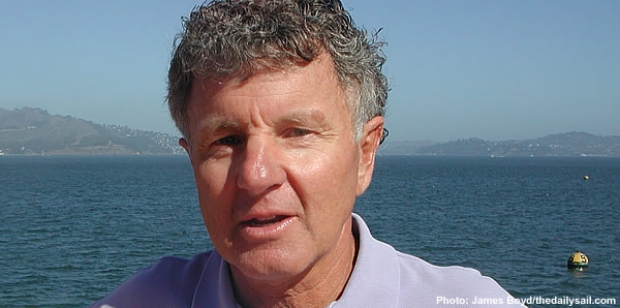
Master of the One Design
Wednesday September 15th 2004, Author: James Boyd, Location: United States
For those who follow the progress of keelboat and one design classes then by rights the Farr 40, now into its eighth year of existence, should be reaching the end of its shelf life. While a small handful of traditional one design keelboats have managed to weather the test of time and frequent changing trends within our sport, most, particularly the larger variety, haven't and at present the Farr 40 is under threat from the new kid on the block - the larger, faster, more glamorous TP52.
Yet at the Rolex Farr 40 Worlds in San Francisco last week, there seemed to be very little evidence of owners planning a mass exodus into the TP52. Racing was as competitive as ever with amateur owners driving and sharing the back of their boats with an impressive crop of top professionals, including Cayard, Terry Hutchinson, Dee Smith, Ed Baird, Vasco Vascotto, to name a few. While the racing was furiously competitive, there was a decisive winner in Jim Richardson, Terry Hutchinson and the Barking Mad crew, who have raised the bar yet again in this class.
The only owner we came across who is planning to join the new TP52 class is Mean Machine's Peter de Ridder. He has commissioned Rolf Vrolijk, with whom he has worked previously on an ILC40, to design him a TP52, but not until the 2006 season. "In Europe there are already seven or eight boats that are going to be built for next season. But we want to see what the development will be in the class design-wise and then we go," de Ridder told us.
If there is a mastermind behind many of the most successful one design keelboats of recent years it is Farr International President and owner Geoff Stagg. "Well, we have created all of them: the Mumm 36, then the Mumm 30, then the Farr 40, then Corel 45, then our 52, and now our new 36 and our 395. We have seen it all come and go," sums up the Annapolis-based Kiwi. "And I was involved with the IMS50 class 20 years ago and the One Ton Class and the ILC40 class. I got kicked out of the Corel 45 class, because the owners thought they could do a better job and I was asked to come back nine months later and I refused that offer."
The following interview should be read bearing in mind Stagg's bias as representative of the dominant commercial entity in this field.
Stagg maintains that what makes the Farr 40 class different from less successful classes that have gone before is the healthy blend of owners and professional management that his organisation brings to the table. "It works both ways. The owners are keeping the commercial interests in check and we are keeping the enthusiasm of the owners in check from being their own worst enemies."
On the Farr 40 class' Executive Committee there sits owners such as Jim Richardson (the President), Philip Tolhurst (Technical Chairman), Peter Stoneberg, Peter de Ridder, Vincenzo Onerato and Richard Perini - into addition to Stagg and boat builder Barry Carroll.
"It is a very good cross-section of people and we are always trying to be pro-active rather than re-active," says Stagg. "A lot of the problems to do with the previous handicap rules were that they were very cumbersome with the administration and it took so long to get an answer on anything and most of the time the answer was just plain too late." As a result the Executive Committee are attempting to stay ahead of the game and for example their World Championship schedule is mapped out for five years hence taking in Sydney (March, 2005), Newport, RI (2006), Europe (somewhere - Palma? - 2007), Miami Beach (2008), etc.
Clearly Stagg assumes that the Farr 40 is not a boat with a shelf-life as limited as some of its forebears. Why should it be different from say the Mumm 36?
"With the Mumm 36 we won a contest for the Admiral’s Cup small boat. The class was managed by the RORC Rating Office. It was conceived to be a full-on professional boat. So it had that image to live with and only so many people can play that game. We built 100 of them, then we tried to instigate some Corinthian rules into the class for the amateur owners who couldn’t complete against the pros, but they were most probably too late. And then RORC dropped it from the Admiral’s Cup, which ironically was when the Admiral’s Cup ceased to exist - they dropped it for no really good reason, I thought it was ridiculous what they did - and that was the end of that class."
However in the ever-evolving world of yacht design the Mumm 36 had also become outdated as Farr International themselves demonstrated when they produced their next boat - the Mumm 30.
"We got exposed to a lot of elements on the Mumm 36 that we looked at and we came up with the Mumm 30 - with the carbon, runner-less rig, the big rudder, high stability, no rule influence whatsoever," recounts Stagg. "So that was a trend-set boat despite everyone saying 'it won’t work. you can't have non-overlapping jibs, carbon rigs, it won’t go in light air, etc'."
To date 200 Mumm 30s have been built and it has outstripped all of the competing 30ft one designs - the Melges 30, the Mount Gay 30, the J/30 and the Henderson 30 - combined says Stagg. "It is just a sweet boat. And we’re still building them. Eight years down the road people still say it is their favourite boat."
The Farr 40 was conceived soon after along similar lines - fast, easy to sail to suit amateur helmsmen and crew, hard to sail well to suit the professions. To date 134 Farr 40s have been built and are to be found in 18 countries around the world. Sales have slowed over the last three years, admits Stagg, attributing this to the downturn in the global economy. Six new Farr 40s have been launched this year by US Watercraft, who have taken over as US builder from the defunct Carroll Marine, and DK Composites in Australia.
A prime reason for owners moving out of a class is when a boat that is newer and usually faster comes along and Stagg's view is that this is one reason why the Farr 40 will have longevity: as it already has 'got all the juice' - the carbon rig, high stability, etc. If there is downside to the boat it is that while it does rate well under PHRF in the US, it doesn't elsewhere in the world under IRC or IMS. This infuriates Stagg as while on the one hand the boat is considered 'the America's Cup class of keelboats' it is equally the ultimate beer can race boat because it is easy to sail having no runners or overlapping jibs and hence should be looked upon more favourably than it is presently under these all-encompassing rules.
There is another view felt by some that Farr International show considerable arrogance for coming up with One Designs without consideration for existing rules. There are obviously commercial considerations at stake here - why put your effort into an IRC 40 or an IMS 40 when a Farr 40 can only come from one place? Is this in an owner's best interest? Probably not, but equally the owners have voted with their feet and the Farr 40 and Mumm 30 are undeniably two of the most popular, successful and hotly contested fleets sailing at present.
Stagg gives his reasons for avoiding rules: "New boats take two years to make. By the time you have come up with the idea, put the investment package together, finalised the drawings, constructed the tooling, built the first boat - it takes two years. The rules are such a moving target that by the time you put a boat in the water it stands a good chance of being obsolete. To do a boat around a given rule is pretty risky in this day and age."
At a meeting of the tacticians and boat captains at last week's Rolex Farr 40 Worlds, Stagg was laying down the law. While obviously there are Farr International commercial interests at stake, not to mention the livelihoods of the boat captains and tacticians, Stagg rightly points out that the owners in the class are busy, successful powerful people for whom sailing is their ultimate relaxation: if they aren't having fun then they are all too likely to go and take up golf or some other recreation outside of sailing. This is bad for everyone.
Aside from professional management, key to preventing this, in Stagg's view, is in keeping the playing field as level as possible. "At the moment so there is a lot of pressure on the class from the pros and boat captains to do a good job for their owners because they all want to win. Over the last six months, we have put a lot of effort into corralling the enthusiasm of the boat captains who have been making modifications and then pleading for forgiveness."
There have been many small things that Stagg cites like replacing sheets and halyards with low-stretch versions, non-standard shackles, stanchion and lifeline mounting (if the angle of the stanchions or the lower lifeline is moved outboard by a few degrees it enables crew weight to be shifted out further). There have also been other issues to do with rig repairs and 'refairing'.
Hence in San Francisco last week Rene Mehl and her team had six people going through each of the 31 boats with a fine toothcomb - examining every one for discrepancies with the rule, the boat and crew weights, sail measurements, sealing the lower lifelines, measuring the boom above shear line. Also being noted was the extra gear - from overweight anchors, warps and chain, excessive spare tools, to water stored in glass as opposed to plastic bottles.

To counteract this, in San Francisco last week Stagg was trying to encourage the boat captains to form their own 'union' to create a proper channel for proposing any rule changes. These would then be passed on to the Farr 40 Class Association Technical Committee on which Stagg sits with Philip Tolhurst and representatives from the design office and one of the builders, and from there to the membership for voting on.
"Ultimately our job is to get the boats as identical as possible, so that when the owner leaves the dock at the start of the day, fate is in his hands," says Stagg. "If they sail the boat right - they can win. That is why generally you see such wild fluctations in boats’ performances. The secret of these regattas is consistency."
Also interesting is the lack of discard in the class rules, in there partly for safety reasons, says Stagg. "We didn't want to tempt the tacticians into putting the boats into a position which didn’t fit - where they’d say ‘if we don’t get away with it, we’ll use it as our drop’. So less fliers: less risk."
Since the inception of the class, standards have been raised immensely among the teams - the four professional crew allowed on each boat, the owner/drivers and the other 'amateurs' as well, something which Stagg has enjoyed watching immensely. "The top ten guys [owner/drivers] are as good as many of the pros in the world at the moment, in my opinion," he says. "There is very little yelling. The boats are very well behaved. There are a lot of penalty turns happening but there are few protests." Throughout last week's Rolex Farr 40 Worlds, there were only four protests.
Plans are afoot to develop the class further. A development for next season will be a Corinthian Trophy. Racing within the existing class, boats racing for this will only be allowed to have two pros on board instead of four and three new sails each year (rather than seven).
This comes at a time when second-hand Farr 40s are available for around $150,000 (new they are $245,000) compared to around $650,000 for a one-off 40 footer estimates Stagg.
The big hit for owners comes in annual campaign budgets which Stagg estimates to be between $125,000 and $500,000 per annum, the richer teams running two boats with seven new sails (usually all saved for the Worlds), four often highly paid professionals on board (Paul Cayard, for example, doesn't come cheap), plus coaches and coach boats and shipping this circus around the world between regattas.
In comparison the budget required for a TP52 campaign is a quantum leap - $1.4 million for the boat, uncapped spending on future development such as keel, rig and sail mods, plus salaries, flights, accommodation and expenses for 14 or so professional crew.
In part two of this article tomorrow - Geoff Stagg gives his opinions about rating rules
To respond to Geoff Stagg's views - click here to send us an email
Most Read
Most Commented
Comments
Businesses
Pro businesses
-
-
France
-
United Kingdom
-
Editor's choice
Member blogs
-
 Ned Collier Wakefield: MOD70 round BarbadosWell that was intense. 12 hard fought for seconds for the win. In idyllic conditions, Tony Lawsons MOD ...
 -
 Mini Transat leg 2 reportThe second leg of the Mini Transat started on 31st October, just over a month after ...
 -
Leg 1 reportI’ve been working towards the Mini Transat now for three years. In 2013 I was part ...
Business blogs
-
 The Island Sailing Club in Cowes, Isle of Wight, is delighted that Prince Michael of Kent ...
 -
Peta Stuart-Hunt chats with the 25 year-old British solo sailor Lizzy Foreman before she sets sail ...
-
The 2015 Student Yachting World Cup (SYWoC), an ISAF-recognised event hosted and run by students for ...
Editor's Choice
All time favourites...
-
 Three legs down into Ian Walker’s
 -
 Winning all but two races at
 -
 For the first time in its
Latest Comments
Add a comment - Members log in