
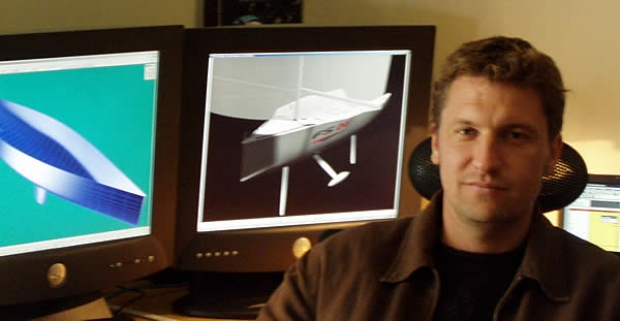
Transpac 52s - designers notes 1
Tuesday October 5th 2004, Author: James Boyd, Location: none selected
In their eight years of existance the Southampton-trained Spanish-South African duo Botin & Carkeek have become the dominant design force in the Mediterranean IMS scene - no small claim as outside of the America's Cup and Volvo Ocean Race this is one of the few areas of keelboat racing where 'full on' race boat programs with custom builds and heavy weight development programs still exists.
Botin & Carkeek first came to public attention when their 46 footer Zurich won Spain's top regatta, the Copa del Rey in 1999. When the King of Spain encouraged the maximum length limit of the IMS fleet to be enlarged resulting in the birth of the IMS500, it was Botin & Carkeek's 57ft designs that came to the fore. Their boats have won the Copa del Rey for the last three consecutive years, the latter two occasions by 57s - first Vicente Tirado's Caixa Galicia and this year by Italian Stefano Spenagaro's Subaru X-Sport. Earlier this season they launched a third 57 in Talisman.
With the King of Spain and many of the other top owners in the Spanish IMS scene making the move into in TP52 class, so Botin & Carkeek are planning to move with them. This is an interesting prospect for the duo who at present are only known for their work in IMS. To date they have an order for one TP52 from Italian Pirera Alessandro, owner of the Farr IMS 53 footer Orlanda, on which Tommaso Chieffi is helmsman, with active enquiries from Italian and French clients and even one from the UK.
At present Shaun Carkeek will say little about the specifics of their new TP52, other than it will maintain some features of their IMS boats and will be built in Italy - a further development of their unique association with Italian production builder Grand Soleil. In an arrangement similar to that which Jeanneau had with their 'special projects' division in the 1980s, Grand Soleil have been building these custom Botin & Carkeek IMS boats - both 57s and 42s - with considerable success for the last three years.
"From a marketing point of view and in terms of upping their profile from a technical standpoint it has done wonders for Grand Soleil," says Carkeek. "So they have got a lot of good mileage out of it and we as a company are now designing their cruising range for them as well and will continue to evolve the limited series race boats for as long as they want to do that."
With the TP52 class still in its infancy the 2005 season will be interesting as it will see a wholescale battle of the design houses, Carkeek feels: "There is not really anywhere to hide. This is pure understanding of what is required and I think the talent of all these offices is going to be tested to the maximum here. In the past you could hide in the VPP and there were many excuses. Now it is time for all of us to get it on and put up or shut up."
So how will next year's introduction of the TP52 in the Med affect the present IMS circuit there? Carkeek ultimately expects a wholescale move by those currently with IMS500s into the new class. "With the IMS we are going to see the size range decrease. We’re not going to see any more 57s and those boats will disappear. No one is going to go for that kind of boat and that kind of budget, because they are expensive and they are slow.
In fact the Grand Prix contingent moving out of IMS has to be good for the IMS. "The IMS has always struggled, because we’ve asked the system to do more than it was capable of doing. You cannot rate boats equally of different sizes which was always the goal of the IMS VPP in its inception. It is just not fair when a boat goes around the course in different conditions and finishes in different conditions to someone else - it is just impossible to get a fair result."
Aside from those currently involved with the IMS circuit, Carkeek also believes the TP52 will attract owners from one design classes such as the Farr 40 and Swan 45. "I think there are owners who like one designs and there are owners who like developmental classes and box rules where they can come involved in the project and can line up on the start line, like Formula 1, with a tightly controlled rule and can have input into their design." The rule is also the way to go from a performance point of view - 20 knots of boat speed in 20 knots of TWS, he predicts - and the size is managable.
Carkeek believes we will be seeing around 10 new TP52s launching next year in Europe, with that figure doubling for 2006. "There are quite a few IMS owners and others who are being a little bit more cautious to see who is coming up with the fastest before they choose their design office."
In terms of cost a TP52 will be much the same as an IMS boat of the same size, although the materials will be more expensive. "On an IMS 50 you would still be debating whether you went for a Kevlar boat or a carbon boat. With the TP52 it is definitely going to be carbon, pre-preg and Nomex. So the technology is at a higher level.
"Keels could become complex in terms of the way they are constructed. That’s something that we haven’t seen up till now. If that is not capped off we could see people spending a lot of money on different foils. We’re studying this in a lot of detail and depending upon the type of sailing owners are going to be doing - offshore v inshore and depending upon what they are trying to win - they will optimise accordingly."
The boats will almost certainly have C&C machined keels, carbon rigs, etc as they presently have on the IMS500s and crew numbers will be around the same.
Looking at the box rule Carkeek says the main choices to make are waterline beam, appendages, how volume is distributed throughout the hull, etc. "Unlike in the IMS where you would have a VPP rating throughout various wind conditions and course types, here you are designing a boat for one-on-one, scratch racing. A boat which is designed specifically for 6 knots of wind and a boat designed for 16 knots would look very different. And boats optimised for offshore and one designed designed for more all-purpose style racing are going to be different. So it comes down to how much one gives away in terms of form stability for downwind slipperyness."
In the end Carkeek feels the way the TP52 rule has been written, specifying the balance between windward-leeward and coastal/offshore will demand good all-round performance. For 2005, the class' first season in the Med, he doesn't expect there to be too many radical designs as teams concentrate on making their boats consistent and getting the class going.
In terms of competitiveness within the fleet, Carkeek believes it will be good provided that owners and designers stick with the specified 70-30% split between windward-leeward and offshore/coastal racing. If this happens then US TP52s and Med TP52s becoming two different breeds within the class, as has been feared, is unlikely to happen.
With the big take-up of the TP52, Carkeek believes it will be hard for a new Grand Prix Rule to gain a foothold. "if big regattas like the Admiral’s Cup adopted the new Grand Prix Rule and not the TP52 then there would be a glimmer of hope for it, but the way things are going now if I was the Admiral’s Cup organisers I would be wanting to get the TP52 as the big boat as soon as possible. It is almost a pity it’s not there for next year, but that’s just too soon."
The new Botin & Carkeek TP52 is due for launch mid-April ready for the first regatta of the Med TP52 circuit in Punta Ala.
Most Read
Most Commented
Comments
Businesses

Pro businesses
-
United Kingdom
-
Italy
-
-
France
Editor's choice
Member blogs
-
 Ned Collier Wakefield: MOD70 round BarbadosWell that was intense. 12 hard fought for seconds for the win. In idyllic conditions, Tony Lawsons MOD ...
 -
 Mini Transat leg 2 reportThe second leg of the Mini Transat started on 31st October, just over a month after ...
 -
Leg 1 reportI’ve been working towards the Mini Transat now for three years. In 2013 I was part ...
Business blogs
-
 The Island Sailing Club in Cowes, Isle of Wight, is delighted that Prince Michael of Kent ...
 -
Peta Stuart-Hunt chats with the 25 year-old British solo sailor Lizzy Foreman before she sets sail ...
-
The 2015 Student Yachting World Cup (SYWoC), an ISAF-recognised event hosted and run by students for ...
Editor's Choice
All time favourites...
-
 Three legs down into Ian Walker’s
 -
 Winning all but two races at
 -
 For the first time in its
Latest Comments
Add a comment - Members log in