
A fresh approach
Thursday October 14th 2004, Author: James Boyd, Location: United Kingdom
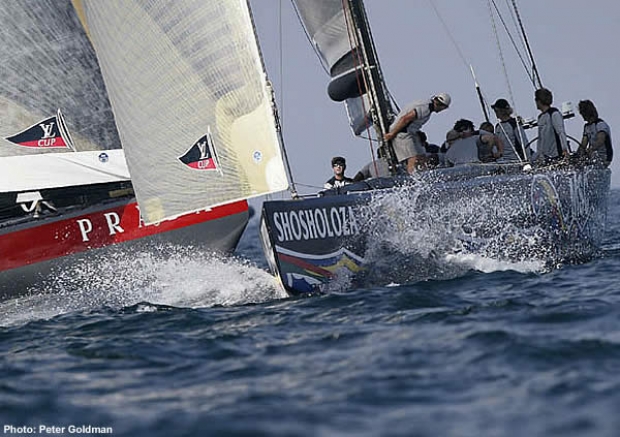
They may have failed to score any points in the races they sailed in Act 2 of the 32nd America's Cup, but one of the most plucky performances of the eight teams taking part was that of the South Africans on board Team Shosholoza. It was Shosholoza for example that led the mighty BMW Oracle Racing around the course on the penultimate day of racing, until they were pipped right at the post.
Team Shosholoza is the brainchild of Captain Salvatore Sarno, Director of the Mediterranean Shipping Company in South Africa. Sarno is Italian, but has lived in South Africa for 18 years and has become completely besotted by the country. He is also an intense yachting enthusiast and an avid club sailor in Durban (although the team is Cape Town based). It was he who came up with the notion that South Africa had to be represented in the America's Cup.
First point of contact for Sarno in setting up the campaign was getting Geoff Meek on board. Meek is probably South Africa's most accomplished sailor over the last decades, having steered Stephen Fein's Full Pelt to victory in the Sardinia Cup in the 1980s, winning the 1/4 Ton Worlds in Corsica aboard Royal Flush against strong French opposition and having spent much time on the international racing circuit.
Meek quickly got Whitbread and America's Cup veteran Paul Standbridge on board as the team's Sailing Manager. Standbridge is not South African, but has had a long association with the country - he raced the South African boats Xargo III and Atlantic Privateer in the Whitbread in the 1980s, is now married to a South African and lives in the country. "I am happier in an underdog campaign with more responsibility rather than being the janitor at Oracle!" Standbridge quips. "So I’ve got tons to do, tons of responsibility and decisions - and it’s good fun."
By BMW Oracle standards the campaign is a low-budget affair. Geoff Meek says that the budget for Team Shosholoza is "around one fifth" that of the big AC teams - "it will be a very tight budget even if we get what we want." We would guess around the 20 million Euros mark.
At present the Mediterranean Shipping Company has underwritten the project but more sponsorship is still being sought in South Africa and it is likely that the success of this will dictate the number of pro sailors that will remain on board. For example Andy Green is racing on board Team Shosholoza as tactician in Valencia as well as being the team's match race trainer. Both he and the team would like their association to continue.
Earlier this year Team Shosholoza acquired ITA48, the 2000 generation Luna Rossa that did one round robin but was otherwise unused. Unfortunately the boat came 'out of class' and in order to get it to rate the team had to lop 10sqm off the mainsail and remove 300kg of lead from the bulb. "So we’re scuppered in the light because of the sail area and in the heavy because we’ve lost 300kg from the bulb!" says Standbridge.
For the present Ac racing they bought four new jibs and spinnakers, but are running the original mains. "They aren’t excuses - that’s just where we are," continues Standbridge. "We didn’t want to spend money on 20 sails, because this boat is going in the bin and so are it’s sails, so we thought we’d save the money for the new boat."
Uniquely while most AC teams will leave the building of their two new boats until much further into the America's Cup cycle, Team Shosholoza are planning to have their first boat, built to the new Version 5 of the America's Cup Class Rule (a configuration the boats are obliged to race in from 2005 on) on the water in Europe ready to compete in next year's Acts starting on 10 June. She will be the first Version 5 boat to be launched.
"If we modify this one, we’ll still be back here with excuses," explains Standbridge as to why they are not just modifying 48. "We’ve just got the time and the money, so we said ‘let’s go for a new one and have a stab at it’. It won’t be our best shot, but we can change it and we are going to build a second boat anyway. And the only way we can do two boats is to do them spread out."
In fact building a new boat in South Africa works out cheaper than buying a second hand boat and changing it.
To create the new boat the team have employed Jason Ker as principle designer. Standbridge says they were impressed by Ker's ability to design boats that have to rate. While Ker and his design partner Simon Schofield are British the design team wherever possible is South African. They include design engineer Alexander Friess, fluid dynamicist Charles Crosby, software engineer Siphiwe Edwin Mthandi, composites engineer David Jonson and build manager Tony Evans who was part of GBR Challenge's construction team.
Team Shosholoza may be a 'budget' campaign but they have all the bells and whistles when it comes to CFD, FEA and tank test work. With a new Version 5 boat in the water in 2005 they will be able to study this and see how it performs against the competition in the Acts before building their second boat that is scheduled for launch at the end of 2006. Meek who runs North Sails in South Africa will be in charge of the sails while they plan to attempt the construction of a carbon fibre mast in-house (it is believed many campaigns are planning this).
While the team may only be working on a limited budget they will benefit greatly from being based in South Africa where costs are low. Evans is setting up their own facility in Cape Town where their new boats will be constructed. "If say we are 20 [million Euros], we are probably worth 23 or 24 because we are South African-based," says Standbridge. While they will compete in all next year's Acts in Europe, they won't be based in Valencia full time until 2006 and at present they are operating without a shore crew - the sailing team fulfilling this role.
As their new boat is building, so the team will continue training on ITA48. "We will just keep sailing around in circles, so that we get better and better with tighter and tighter margins, shorter laylines and just go around in circles until we can do it inside out," says Standbridge. The team can also carry out match race practise on board Lavranos 34s in Cape Town.
Meanwhile skipper Geoff Meek plans to take to the international match race circuit to hone his boat-on-boat skills. Meek says that he used to match race regularly up until 12 years ago and took part in a Lymington Cup on one occasion but admits he hasn't done any since and a lot has progressed in those intervening years.
And what are their prospects? Standbridge is realistic: "I don’t think we’re going to win it. Alinghi won it by buying Brad Butterworth and Russell Coutts. We are not doing that. I have literally gone down to the local yacht club and dragged the people out of the pub and we are learning how to sail America’s Cup boats. It is not a fair comparison. And we don’t know who is going to race yet. So until the competition is there it is hard to say who we’re going to beat. The only teams to have entered yet are big ones. I intend to take races off them occasionally, but to beat BMW and Alinghi overall - I don’t think that is realistic. But there will be a number of other syndicates that will be beatable - we don’t intend to come last."

While most of the top America's Cup teams such as Luna Rossa and Team New Zealand that have traditionally been national affairs and this time are becoming more international, so by contrast Team Shosholoza will remain a mainly South African effort. Part of Captain Sarno's vision is for the campaign to be something of a showcase for South Africa, an attempt to prove to the world that the country is mature and has the technology and personnel to undertake such a project and shouldn't be thought of as a third world country on the dark continent, as Standbridge puts it. As a result all the crew - with the exception of Standbridge and Andy Green - are South African including familiar names from the international circuit like Jonathan Swain, Jan Dekker and Mike Joubert plus Olympic Finn sailor Ian Ainslie and a number of young sailors who are being trained up.
"We’ve got a lot of young guys from South Africa who are new to big boats. We are definitely aren’t going to look around the world," says Standbridge, who admits that until recently he was worried that they might have to employ some hired guns simply to get the boat around the course. However since acquiring ITA48 the crew have spent 53 days out on the water training. "They are doing very well. Six of our crew had never sailed anything bigger than a 30 footer before they came with me on this boat. And now they are racing Alinghi in 30 knots of breeze. They are learning quick and are enthusiastic. Also some of them have never left South Africa, never been to Europe, never spoken a European language, so it is a cultural shock as well. It is great to be part of that."
Among the crew are a number of young black and coloured sailors such as Golden Mgedeza, Solomon Dipeere, Ashton Sampson and Marcello Burricks. Standbridge says that they are not mere adornments - they have no government backing or sponsorship that requires them to be on board - they are there because they earned the position.
Key to their participation has been the Izivunguvungu MSC Foundation for Youth, a 'development sailing school' set up by Olympic Finn sailor and teacher Ian Ainslie in Simonstown in 2001. Ainslie's Finn campaign for Sydney was backed by the Mediterranean Shipping Company who have since provided funding for his school, based in the Simonstown naval facility, which takes children aged 8-20 from underprivileged communities such as the local townships and teaches them valuable life skills through sail training and other outdoor activities.
 "When we started a friend of mine and myself decided to do it once a week. We just went to the street in town and spoke to the street kids and said ‘do you want to come for a sail’ and they sail ‘well, ok’," recounts Ian Ainslie. The following week 20 kids turned up and they have since had to limit numbers. These days Ainslie is often woken at 7.30am with rocks being pelted at his house because the kids want to go sailing and he has chase them off to school.
"There is no problem getting kids, because there is nothing for them to do in their communities," he continues. "There are no facilities. Now with this Shosholoza program being in the press a lot and Marcello, one of the guys sailing on the boats who's come through our school, in his community all the kids dream about is to sail on Shosholoza and doing the America's Cup."
Ainslie has a number of boats at his disposal including Lasers and a 26ft keelboat similar to a J/24, but most of their sailing is carried out in the Navy's Bosun dinghies. Kids who show talent get to take part in regattas not just around the Cape Town area but further afield in South Africa such as Durban or Johannesburg. "That is massively exciting if they have never left their township," says Ainslie.
Through sailing many of the kids have been able to reappraise how they respond to danger in their every day life. "This is a fear they have to face because sometimes the winds off Cape Town really blow but now they can’t respond in the normal way of being aggressive or trying to show no fear. So we are trying to say - now we are scared and how you become aware of how you are feeling. And it works really well. Once the kids have been there for a while we see a really positive change and we are in contact with their teachers as well. It is always a bit of a threat from the teachers that they are going to phone me."
From a situation 10 years ago when you could count on one hand the number of black people who sailed in South Africa, now they are regular participants at regattas and Ainslie says the prospects for those who have started his school aged six and are sailing every day are tremendous.
Ainslie recognises that the kids being able to sail is of little use if they don't have a job. As a result he has set up a boatbuilding apprenticeship scheme. At the school they have built a number of canoes and dinghies as well as boat repair work and Ainslie has put word around Cape Town's ever expanding boat building industry that he has able workers on offer.
Of the sailors Ainslie has brought into Team Shosholoza Golden and Solomon he taught sailing duting his year as a teacher at Simonstown High School. Meanwhile Marcello came out of his own school.

19 years old, Burricks (above) grew up in the tough township at Ocean View, near Kommetjie, on the Cape and is now Team Shosholoza's starboard grinder. At present he is attempting to beef himself up through work outs but claims he is more than tough enough for the job following his teenage years as a fighter in Ocean View's gangs - he has scars from screw drivers and knives to prove it.
"I was quite a naughty boy and was sent to Ian Ainslie's sailing school in Simonstown six years ago to keep me out of trouble. I wasn't a member of a gang but I fought them to protect my friends. I am a good fighter," said Burricks.
"Marcello just kept coming back and was soon sailing everyday after school," recounts Ainslie of his star pupil. "He helped us with boat maintenance and started coaching other kids. He also read everything he could about sailing, all the big races
and the America's Cup. I had to chase him home during exams."
In South Africa Burricks has competed in five Lipton Challenge Cups, the first with a development team and subsequently as crew for Izivunguvungu coach Mathew Mentz on the L26 MSC Donna Mia owned by Captain Sarno. He has also competed in most local offshore regattas and was on the delivery crew of a Cape to Rio yacht returning from Rio in 2000. He has also won two development regattas in Simonstown.
He matriculated last year from Simonstown High School where the curriculum includes maritime studies and joined Team Shosholoza full time in April this year. "I was at school in Ocean View and only went to Simonstown High because of an American Round the World sailor, Kelly Wright, who paid for my tuition," says Burricks. "I always liked hanging around boats in Simonstown and used to help him with his yacht. He asked me if there was anything I wanted. I said no, but my friend told him that I wanted to do maritime studies in Simonstown."
Besides grinding, Burricks helps service the winches and ensures the on board cameras are in position and switched on during races.
From our prespective it is nice to come across an America's Cup campaign that truly has some soul.
More photos on the following pages...


Most Read
Most Commented
Comments
Businesses

Pro businesses
-
Italy
-
-
United Kingdom
-
Editor's choice
Member blogs
-
 Ned Collier Wakefield: MOD70 round BarbadosWell that was intense. 12 hard fought for seconds for the win. In idyllic conditions, Tony Lawsons MOD ...
 -
 Mini Transat leg 2 reportThe second leg of the Mini Transat started on 31st October, just over a month after ...
 -
Leg 1 reportI’ve been working towards the Mini Transat now for three years. In 2013 I was part ...
Business blogs
-
 The Island Sailing Club in Cowes, Isle of Wight, is delighted that Prince Michael of Kent ...
 -
Peta Stuart-Hunt chats with the 25 year-old British solo sailor Lizzy Foreman before she sets sail ...
-
The 2015 Student Yachting World Cup (SYWoC), an ISAF-recognised event hosted and run by students for ...
Editor's Choice
All time favourites...
-
 Three legs down into Ian Walker’s
 -
 Winning all but two races at
 -
 For the first time in its
Latest Comments
Add a comment - Members log in