
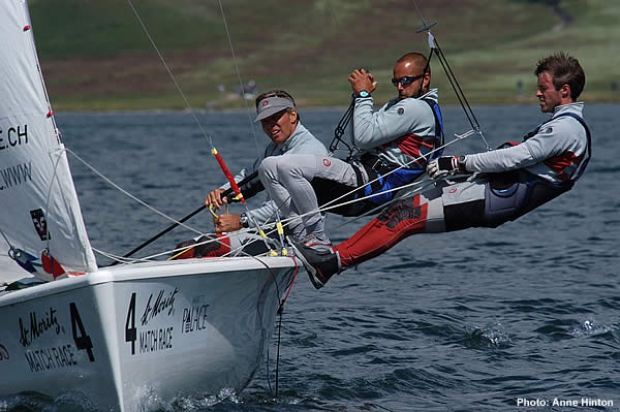
Laser sailor scores in St Moritz
Sunday July 18th 2004, Author: Anne Hinton, Location: France
St Moritz is known as the place to see and be seen in the winter ski season. It is the world’s most expensive skiing resort.
Aside from the building work - summer is off season - St Moritz is pretty and at 1,775m above sea level, is high enough for snow to have fallen in the town only the weekend before the match race event. The town is dominated by large hotels on the mountainside up from the lake.
St Moritzersee (the lake around which the town is based) is actually very small - max. 500 metres wide and 1.8 km long, but 40-50 metres deep in the middle and very cold, even in summer, at only 12C. This does make for easy viewing of sailing from the shore for spectators - and short races (generally less than twenty minutes).
The Maloja wind, a katabatic (down-valley) thermal breeze, blows from a southerly direction, getting up later in the morning, much like a sea breeze, and then dying away at night. It can really blow here, but in general the Maloja does not tend to exceed 15 knots. Winds not from this direction tend to be much more variable (and the Maloja is itself not that stable in direction).
The match race event in St Moritz began in 2001 as one of the UBS-sponsored match racing events in Switzerland that were started as a result of the Union Bank of Switzerland’s sponsorship of the Alinghi America’s Cup team. This event and the Société Nautique de Genève’s Bol d’Or race, around Lake Geneva, form the main international sailing competitions in Switzerland each year.
The initial two events were won by Jochen Schümann. Last year the event officially became the St. Moritz Match Race and has now been accorded Grade 2 status by ISAF.
Winner last year was American Laser sailor Mark Mendelblatt, who defeated Murray Jones in the finals. Mendelblatt was back to defend his title this year, taking time out of his Olympic sailing to do so. Mendelblatt recently finished second in the Laser Worlds and is representing the USA in this class at the Olympics in Athens.
This year the Alinghi participants were both Jochen Schümann and Peter Holmberg. They were joined by Sebastian Col from K-Challenge, Simon Shaw from GBR Challenge, Dane Jesper Bank (formerly of Victory Challenge), Frenchman Luc Pillot (formerly of Le Défi Areva), Simon Minoprio of Vision Yachting (the Australian National Match Racing Champion, hailing from New Zealand, but not a member of Emirates Team New Zealand), Carsten Kemmling (German National Match Race Champion), Matthias Rahm (Sweden - ranked nineteenth in the world for match racing), and two Swiss qualifiers, Eric Monin and brothers and Michel Vaucher. For those who visited the Alinghi base in Auckland and played with the match race simulators - Jean-Claude Monin was the software engineer who wrote the programs for this. This Monin still does software development work for Alinghi.
Most unusually for a match racing event, the boats were three-man double trapeze keelboats - the five year old Judel/Vrolijk Streamline. At 7.15 metres loa, 600kg all-up weight, with 250kg of this in the keel, and an upwind sail area of 33.2 square metres and 51 square metre kite, these boats are highly manoeuvrable. However, with light winds on the lake the traditional slower and heavier design match racing boats could become frustrating in the extreme. The Streamlines were supplied free as a
sponsorship deal.
Racing on the first day was held in light and variable northerly winds of 1-2 Beaufort. The first match was a re-match of the Soling Olympic finals in Sydney in 2000 - Jochen Schümann against Jesper Bank. Bank is the Olympic champion, having won 4-3, but there were some interesting calls during the racing and some feel that the Gold medal should have been Schümann’s. Bank is strong in light airs, so this match was potentially very interesting. In the event it was Schümann who won through by a very
decent margin - much to his great delight.
On the second day the wind more than boxed the compass. The light and variable northerlies turned into the Maloja southerly, but then returned to the north at the end of racing, going around further to the west after sailing had finished. On all days wind strengths could be very variable during racing – with 3 to 13 knots not uncommon during a race.
The fully battened mainsail of the Streamline meant that, in the light airs in particular, the battens - and hence sail - was often inverted. This did become a problem on one occasion. Late on the second day the last flight was held in light and variable northerlies - the Maloja having gone to bed rather earlier than usual. Matthias Rahm had a very close match with Michel Vaucher. Luffing and gybing duels ensued. On one occasion,
Rahm was certain that Vaucher had gybed. However, the full battens on the mainsail ensured that the sail had not filled on the new gybe before Vaucher had gybed back. Therefore the umpires did not concede that Vaucher had gybed. The resulting protest went against Rahm, who lost the match due to this. Possibly one for the ISAF committee to consider in terms of definition of gybing with a fully battened main that 'won’t' gybe easily in light airs, or, alternatively, a good way around the rules to defeat your opponent.
Jesper Bank went on to much more aggressive racing in the Maloja winds on the second day.In one race he managed to score two collisions, incurring a penalty on the first in the pre-start, and alarming the occupants of a stationary umpire boat on the second occasion. However, this aggressiveness paid off. He won through on the cut to the top six - partly, also, by virtue of Schümann losing his final match of the day to the New Zealanders, giving Minoprio his first win, and so ensuring that Schümann ended up in the bottom half of the draw. The British team managed, as they put it, “a perfect score for fleet racing” with zero points at the end of the first round robins. Holmberg had the perfect score for match racing with five wins.
Mendelblatt, Holmberg, Col, Bank, Pillot and Monin made the cut for the top six. In this next round robin there was some particularly aggressive racing between the French pair (Pillot and Col), resulting in a win for Pillot. Holmberg and Bank usually seem to have tight matches. On this occasion Bank was well in the lead, but had failed to notice at the start that the number of rounds had gone up from two to three, so carried on to the finish line too early and lost the match. Mendelblatt was showing his class, taking all five wins from this round robin. However, Holmberg had been well ahead, and a penalty up, in his match with Mendelblatt until Peter van Nieuwenhuyzen managed to hook up on Mike Drummond’s trapeze as well as his own. The weight of two people broke the trapeze and Drummond ended up swimming rapidly in the very cold water. He was retrieved in less than five minutes by Holmberg, after the latter had held out the spinnaker sheet to Drummond on a sail past (a technique that he had adopted himself
recently when knocked overboard elsewhere), enabling Drummond to get a tow behind the boat.
At the end of this round robin, Holmberg and Bank claimed three wins apiece, with Pillot getting the last semi-final berth with two wins.
In the losers round robin, Rahm claimed top spot with four wins, with Schuemann, losing only to Rahm, just behind him. Simon Shaw pulled up to finish ninth overall, with Minoprio in tenth.
On finals day the Maloja turned up mid-morning (a little earlier than usual), enabling racing to get underway. Bank lost out to Holmberg 2-0. However, there was much ado in one of Pillot’s matches with Mendelblatt as the Frenchman had failed to notice a change of course and went around the wrong mark. (It should be said that course changes were very frequent, often occurring several times during a race, due to the variability of the wind.) Both lodged red flag protests and it took the umpires a good half
an hour to agree with the Segel-Club St Moritz race committee, led by Christian Scherrer, formerly of Alinghi. Following this Pillot lost the next match to be set up against Bank in the petit-final, while Holmberg faced Mendelblatt in the final. Col sailed off against Monin for 5th/6th place and won 2-0.
The best-of-three semis went easily 2-0 to Bank. However, the finals were a much tougher fight. Mendelblatt won the first race. In the second, Holmberg was ahead but then approaching the top mark for the second time on starboard tack, with Mendelblatt in the vicinity on port, Holmberg lost concentration momentarily, hit the mark, then hit Mendelblatt, then hit the mark again. The umpires summed this to a total of one penalty to Holmberg. Mendelblatt had got ahead at the mark and Holmberg was unable to catch him and clear the penalty. Result: 2-0 to Mendelblatt.
In race three of the finals, Mendelblatt tacked in Holmberg’s water during the pre-start. This resulted in contact and Mendelblatt was penalized. Mendelblatt was behind until the third visit to the top mark, after they had split sides on the beat. After this it was close right up to the finish. Both boats took down their kites shortly before the line and Holmberg was able to prevent Mendelblatt from taking his penalty and squeeze between the committee boat and Mendelblatt to cross the line. This pulled the score back to 2-1 to Mendelblatt.
Race four saw a pre-start penalty to Holmberg, apparently for claiming water unnecessarily. On the first beat he acquired a second penalty after slam-dunking Mendelblatt and then failing to keep clear. He was still ahead of Mendelblatt at the first top mark rounding after taking the second penalty. Holmberg tried luffing Mendelblatt downwind in order to wipe off his penalty. However, the latter managed to keep clear and got around Holmberg, staying ahead to the finish to win 3-1 in the best of five finals.
Commenting on the light, variable, wind conditions on the lake, Holmberg said “It’s a great place, but I wouldn’t like to do this [sail here] every day.” Both he and Mendelblatt agreed that the fast, manoeuvrable, boats placed a premium on boat handling as opposed to match race tactics. This was the first time that Mike Drummond (ex Team New Zealand) had sailed with Alinghi and, as Holmberg himself is a new recruit, without any prior practice, the trio had not worked out roles, so tripped themselves up on the boat on occasion.
Mendelblatt’s crew, Pete Spaulding and Ed Smyth, are 49er sailors and Spaulding will, like his helmsman, represent the USA at the Olympics in Athens this year. Mendelblatt, who was with One World in the last America’s Cup, acknowledged that the Streamlines were not typical match racing boats, saying “It’s more of a boat handling and a boatspeed place than it is a true match racing place. I think it helps me out a bit against these guys.” The other semi-finalists, Holmberg, Bank and Pillot, are a decade or so older than 31 year old Mendelblatt. Mendelblatt himself now heads for Warnemünde, on the north German coast, for the Laser European Championships, before going to Greece.
More action photos on the following pages...

Most Read
Most Commented
Comments
Businesses

Pro businesses
-
France
-
United Kingdom
-
Italy
-
France
Editor's choice
Member blogs
-
 Ned Collier Wakefield: MOD70 round BarbadosWell that was intense. 12 hard fought for seconds for the win. In idyllic conditions, Tony Lawsons MOD ...
 -
 Mini Transat leg 2 reportThe second leg of the Mini Transat started on 31st October, just over a month after ...
 -
Leg 1 reportI’ve been working towards the Mini Transat now for three years. In 2013 I was part ...
Business blogs
-
 The Island Sailing Club in Cowes, Isle of Wight, is delighted that Prince Michael of Kent ...
 -
Peta Stuart-Hunt chats with the 25 year-old British solo sailor Lizzy Foreman before she sets sail ...
-
The 2015 Student Yachting World Cup (SYWoC), an ISAF-recognised event hosted and run by students for ...
Editor's Choice
All time favourites...
-
 Three legs down into Ian Walker’s
 -
 Winning all but two races at
 -
 For the first time in its
Latest Comments
Add a comment - Members log in