
Vrolijk's viewpoint
Tuesday July 6th 2004, Author: James Boyd, Location: none selected

A gentleman at the heart of many areas of yacht racing, whether it is the America’s Cup or the Mediterranean IMS circuit is designer Rolf Vrolijk. Somewhere between his commitments to Alinghi, as head of the Swiss AC defender’s design team, Vrolijk finds time to run his own design business with partners Friedrich Judel and Torsten Conradi.
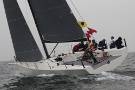
When it comes to drawing Mediterranean IMS boats, judel /vrolijk & co are at present among the most prolific designers with a string of recent launches including their 57ft TAU-UBS, skippered by Javier Banderas (brother of Antonio) and winner of the big boat class at the Audi IMS Europeans last month, and Forum Filatelicio, one of Pedro Campos’ Evento 42s, third in Group B in that regatta while their 37 footer Citta Di Jeselo and Squalo Bianco came first and third in Group C and their Evento 46 QQ8 World Cargo was second in the big boat class.
They also designed the 46ft Cristabela of British owner John Cook, third last weekend at the VI Trofeo S.M La Reina series in Valencia.
With the international rule situation in a state of high flux at present, we were keen to find out Vrolijk’s views about the direction Mediterranean IMS owners are turning.
While Mediterranean IMS boats are unpopular with UK sailors, in their home environment they are the ideal tool for the job. What is significant about the Mediterranean IMS scene is that it is one of the few areas within our community where full-on race boat campaigns complete with professional crew and hefty development budgets are not only surviving, but bubbling along nicely with new boats launched every year.
As with owners in the US, so those in the Med are becoming tired of waiting for an international rule to materialise and are taking the law into their own hands, says Vrolijk, with a number teetering on the verge of purchasing new Transpac 52s (or TP52s as we are supposed to call them now - they are not necessarily sleds).
Judel / Vrolijk of course have a TP52 design, yet Vrolijk views the rule with some scepticism when it comes to achieving what the lobby of Med owners, with the King of Spain at its centre, want it to do. “I’m not keen because they are expecting too much out of a box rule and their expectations are cheap, long life, resale value - there are a lot of other issues that are critical of course,” he warns, adding that campaign costs ultimately will not end up any cheaper than those of present IMS boats of this size.
Aside from this the owners, Vrolijk says, want to have better competition and to get rid of IMS and its complexities.
On the positive side a group of Med owners choosing to go down this route is likely to coax out new owners who have been sitting on the fence waiting to see where any new rule might settle. The problem is how to introduce a box rule boat into the Spanish and Italian circuits in a way that doesn’t make the existing IMS boats obsolete overnight.
“If there is a movement into the TP52s, then you have to really think what is the position of the rest of boats in the fleet - how are they going to survive and race and under which rule?” says Vrolijk. “It is even more important now that there is very good guidance, and of course one of the options is the IMS rule. I see there is a chance to have a good fleet if they manage to let the Transpac 52s race under IMS for a certain period, like one or two years just to keep the fleet growing and interested otherwise you kill existing projects and existing boats. So I see the Transpacs participating, and having a one-design IMS certificate or a number and then they will participate in a few events and then there might have to be corrections to make sure they are all competitive.”
Similar reappraisal must be done among the smaller boats too, says Vrolijk. “I don’t know what exactly they are going to do but it would be good if they could come up with a class in the 40-41ft size that could be competitive and could be built by production boat yards and by putting rules on it that make it possible to sail and be competitive under IMS with a production boat.”
At present in this size in decreasing order of cost are the one-off Grand Soleils, the small production run Rodmans and Eventos and then boats like the Beneteau 40.7. The Spanish have been pushing in this area with their new IMS670 rule where boats can be up to 37ft long, have a production run of more than 10, while spars must be alloy, hulls constructed in glass and interior ballast is prohibited.
“Maybe you have to make it even stricter: a 40ft class where you probably say ‘this is the length or a length measurement under IMS and a beam, displacement, sail area, stability factor’, so you control it more,” ponders Vrolijk. “Then you will automatically get boats that are more similar. It will not be easy, but that has a better future. That would mean there would be interest from the boatyards to do a boat like that and be competitive for a reasonable price with a good resale value and still the racing would still be as good as it is now. At the moment the boats are 2x or 3x the price of a production boat and their racing isn’t any better.”
At present regular discussions about all this are taking place between owners groups in Spain and Italy with guidance from the sailing federations in these countries. A decision is expected to be made at the Copa del Rey once enough consensus has been reached and commitments made by the various parties involved.
So where does this leave the Grand Prix Rule? “I think the chance there was for a new Grand Prix Rule, looks like it is not there anymore,” says Vrolijk. “You can push to get it through in different countries, but it doesn’t look like it will succeed.”
Despite ORC being one of the stakeholders, he maintains that the Med owners were not strongly presented on the Rule Working Party and hence they have been looking at alternatives. “We are interested in our own groups and fleets and that is what is happening everywhere. So I don’t think there will be one rule for everyone. It is a shame - the chance was there, but it wasn’t supported enough.”
Owners in North America and the Mediterranean are keen on the TP52s as the newest game in town and on the surface this bodes well for future international competition. Knowing the Mediterranean scene well, Vrolijk again thinks otherwise. “There might be some sailing together, but the boats will be optimised for different conditions - that is what people are a little bit underestimating. The box rule will push the boats very differently and boats will either be competitive or not in certain conditions and that’s just a box rule issue.”
Surely you can change sails/keels, etc? “A little bit, but you won’t get the perfect boat. If someone comes along with a new generation boat that is optimised for a certain area, it will be the better boat and then all the rest of the fleet will have a tough time competing against the boat and of course IMS is correcting for that.”
Aside from this international competition may also be scuppered as most of the Mediterranean teams have sponsors that are only interested in their own domestic markets. At present it is hard enough getting the Italians and Spanish on the same stretch of water says Vrolijk. “They just manage, the Spanish and Italians, to set the schedule so they can do two or three events like Punta Ala and the Sardinia Cup and the Italians all come to the Breitling Cup and the Copa del Rey or Valencia. So they have managed to have a few events where more or less all the boats come together and that is already a tight schedule for them because they have a lot of races.”
Another area where there seems to be differing opinions between the Anglo-Saxons and Latins is over offshore racing. The American owners are all revved up for it, but Vrolijk says that the Med owners are less enthusiastic. “They like one or two of the long distance races. We’ve seen a revival of the Middle Sea Race, of the Giraglia and a few others, but it is because they like those races because it is fun to go to St Tropex, Malta etc and it is more because of the tradition. It is not because it is a long distance race. So there is a movement away and towards. If you race 10 years in Majorca then you start looking for something else and then suddenly the Giraglia becomes a nice race again…”
Aside from developing a Mediterranean breed of TP52, Vrolijk also thinks it likely that the owners will want to dispense with some of the class rules, most notably the present owner/driver requirements.
At the end of the day Vrolijk remains pro-IMS. “IMS is a very good rule and the racing I think is very good - it just has not got a very good lobby. It is always easy to point to the failure of handicap systems, but as soon as the box rule comes there will be problems and as soon as you push the IRC you will get big problems. It is always when you let the professionals jump on something they will find ways around it and then you have to close the gaps and the fill the holes.”
Judel / Vrolijk’s hole filling this year has been introducing America’s Cup-style knuckle bows to their latest boats such as TAU-UBS.
Finally on to a different topic: Judel / Vrolijk’s involvement with the Spanish Volvo Ocean Race team. Vrolijk says they were involved and now they’re now they’re not. Although the Spanish team had the budget the money was not forthcoming in time for them to carry out enough R&D into the new design. “We think we can only do this kind of game if we can do it 100% right, not just participate in it. We agreed that if they had committed early we would have done it.”
Although it hasn’t been confirmed it is likely that Spanish team have been knocking on the door of Annapolis’ top design house instead.
Design details on the following pages...

Most Read
Most Commented
Comments
Businesses
Pro businesses
-
-
Italy
-
United Kingdom
-
Editor's choice
Member blogs
-
 Ned Collier Wakefield: MOD70 round BarbadosWell that was intense. 12 hard fought for seconds for the win. In idyllic conditions, Tony Lawsons MOD ...
 -
 Mini Transat leg 2 reportThe second leg of the Mini Transat started on 31st October, just over a month after ...
 -
Leg 1 reportI’ve been working towards the Mini Transat now for three years. In 2013 I was part ...
Business blogs
-
 The Island Sailing Club in Cowes, Isle of Wight, is delighted that Prince Michael of Kent ...
 -
Peta Stuart-Hunt chats with the 25 year-old British solo sailor Lizzy Foreman before she sets sail ...
-
The 2015 Student Yachting World Cup (SYWoC), an ISAF-recognised event hosted and run by students for ...
Editor's Choice
All time favourites...
-
 Three legs down into Ian Walker’s
 -
 Winning all but two races at
 -
 For the first time in its
Latest Comments
Add a comment - Members log in