
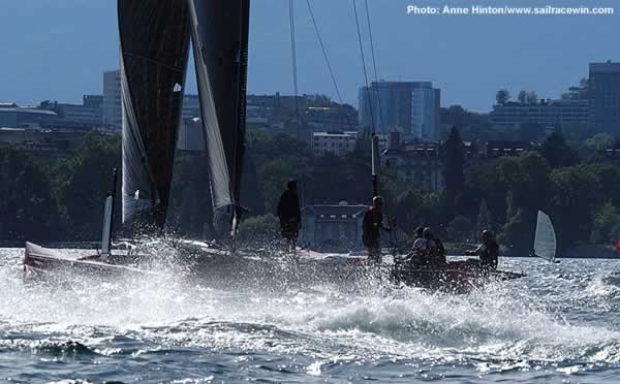
Bol d'Or first home - 'Team Red (Zebra 5)', skippered by Etienne David enjoys the conditions on Lake Geneva.
Decision 35 wins Bol d'Or
Sunday June 13th 2004, Author: Anne Hinton, Location: France
The Bol d’Or Rolex line honours this year went, at no surprise, to one of the new Décision 35 catamarans. The first boat home was decided by which boat made the correct tactical decision after passing the turning mark at Bouveret.
The wind had gradually increased, as forecast, from a northwesterly zephyr. After a number of holes and fits and starts, a new breeze emerged which reached the Décision 35s after they had passed the turning mark at Bouveret at the far end of the lake. The race almost started again from this point.
The wind had been forecast to veer to the north and then northeast and increase in strength. The forecast turned out to be fairly accurate, as, after a lull, the direction changed as predicted and a reasonably steady breeze of force 3 (to 4 at times) set in to see the competitors home.
Team Red (Zebra 5) (SUI 5), skippered by Etienne David, with sailmaker Jean-Marc Monnard as tactician, was first across the line in 8 hours, 59 minutes and 2 seconds. “Just because we catch the wind [the new wind after Bouveret] before the others [is why we won]. If you catch the wind you go 20 knots and the other are 5 knots [so you get away].”

“The new wind came from the Swiss [northern] coast. We wasn’t really close to the Swiss coast, but we always tried to catch this wind [so moved north of the other Décision 35s after Bouveret]”, said David.
David’s background in sailing covers the full range. Now 36, the Geneva-based sailor started in the Laser as a child, but then moved on to much bigger things in 1993-4 when he joined Pierre Fehlmann’s team on Merit Cup in the Whitbread. Subsequent to this he sailed with Ernesto Bertarelli on Lake Geneva in the old (yellow) Alinghi. After that he did the Tour de France á la Voile before getting involved in the Décision 35 project.
David is very taken with the Décision 35. “I really like it”, he said. “It’s a really nice boat and it’s fast and light and very technic[al].”
On board Team Red (Zebra 5) they reached a maximum of 22 knots during this year’s Bol d’Or, a velocity reached when they had 15 knots of wind. Even in the virtual drift at the start they were still moving. “In the light wind [today] we were [moving at] between 4 and 8 knots”, said David.
The first boat always attracts a large following of spectator craft throughout the race. The boats switch allegiance to remain with the boat that is apparently in the lead position at any given time. The numbers increase further as the first boat approaches the finish. The speed of the catamarans meant that many spectator boats were going flat out just to keep up, as well as jostling for position and dodging each other’s wakes. Some minor collisions occurred, but more regulation would appear to be needed as the 20-30 fast powerboats following, or sometimes going too close alongside and impeding the manoeuvrability of the sailing vessel, with the spectators’ eyes largely on the sailing boat, rather than the other vessels around, would suggest that there is a major accident waiting to happen. David’s crew had to wave away a number of these boats that got too close to the fast and very manoeuvrable Décision 35 as they approached the finish line.
After David, second across the line, as he was the previous weekend in the race from Geneva to Rolle and back, was Phillipe Cardis with another Décision 35, Ferrier Lullin (SUI 3), in 9 hours, 16 minutes and 33 seconds. Again following the pattern of the previous weekend, the new Alinghi Décision 35 was helmed into third place by Ernesto Bertarelli, who had shared the helm with Pierre-Yves Jorand during the day, a further three and a half minutes later. The remaining Décision 35s all finished within half an hour of the first boat.
Somewhat later (with finishing times yet to be confirmed), the first monohulls arrived. This year was not to be that of the winner of the previous two years, Taillevent II. In her stead, monohull line honours went to the Psaros 40, Tilt.
After the arrival of the first few monohulls, I watched the dismasting of another large monohull, Relance, less than a kilometre from the finishing line. The mast buckled and broke clean through midway between the lower two sets of spreaders for no immediately apparent reason. Two of the crew, already sickened by the dismasting so close to the finish after such a long race, of more than eleven hours, had to go for a swim in the cold water of the lake in order to sort out the sails that were in the water. Given the huge spectator craft presence, two boats were immediately in attendance and a lifeboat arrived in a lot less than five minutes, ready to tow the vessel to safety if need be.
The wind is maintaining its pressure and veering further east as forecast. A steady stream of finishers was crossing the line off the Société Nautique as darkness fell this evening. The vast majority of the 510 starters should have crossed the line by daybreak, although the back markers have until 1600 hours local time tomorrow to make it home.
Most Read
Most Commented
Comments
Businesses

Pro businesses
Editor's choice
Member blogs
-
 Ned Collier Wakefield: MOD70 round BarbadosWell that was intense. 12 hard fought for seconds for the win. In idyllic conditions, Tony Lawsons MOD ...
 -
 Mini Transat leg 2 reportThe second leg of the Mini Transat started on 31st October, just over a month after ...
 -
Leg 1 reportI’ve been working towards the Mini Transat now for three years. In 2013 I was part ...
Business blogs
-
 The Island Sailing Club in Cowes, Isle of Wight, is delighted that Prince Michael of Kent ...
 -
Peta Stuart-Hunt chats with the 25 year-old British solo sailor Lizzy Foreman before she sets sail ...
-
The 2015 Student Yachting World Cup (SYWoC), an ISAF-recognised event hosted and run by students for ...
Editor's Choice
All time favourites...
-
 Three legs down into Ian Walker’s
 -
 Winning all but two races at
 -
 For the first time in its
Latest Comments
Add a comment - Members log in