
Climbing the pinnacles
Tuesday April 22nd 2003, Author: James Boyd, Location: none selected
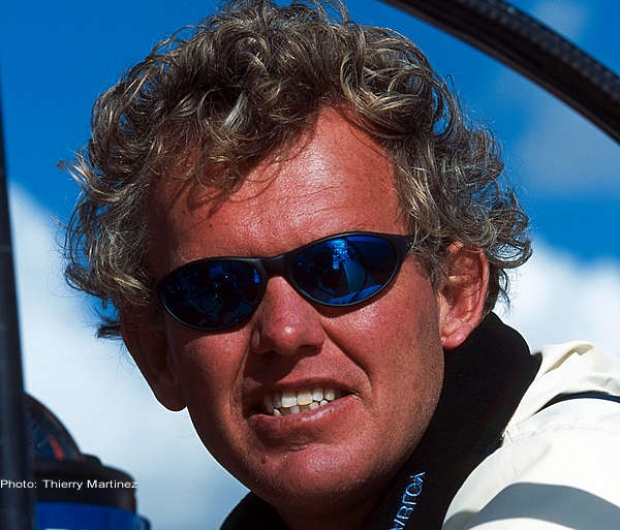
When it comes to diverse backgrounds in our sport few can claim to have competed in as wide a variety of disciplines than top Dutch sailor Roy Heiner.
Well known on the Olympic circuit, Heiner picked up a bronze medal in the Finn in Atlanta and was fourth in the Soling in Sydney. His career in the Whitbread/Volvo Ocean Race is more checkered - in the 1997/8 race he was brought in to skipper the Dutch entry Brunel Sunergy after leg two and against the odds did much to turn that campaign around while in his position as skipper of Assa Abloy in the subsequent race came to an abrupt end when he was replaced by Neal McDonald in Cape Town.
 Aside from this Heiner was part of the winning Dutch Admiral's Cup team in 1999 and sporadically competes in match racing events around the world. Most recently he was in Auckland employed by Oracle as the B boat helm/tactician and afterguard, coach and advisor on the A boat. This was the first time he was involved with the Cup.
Despite his face appearing everywhere, Heiner says that his main aspirations are still the America's Cup and the Volvo Ocean Race. "I once was a civil engineer and when I decided to go sailing I decided that I wanted to compete at the highest level. For me that is definitely the America's Cup and the Volvo Ocean Race: Those two amphitheatres, I’d like to sail. The interesting thing right now is - is it possible to do both? Is it possible that if you do one it excludes the other?"
While Heiner says it would be nice to go from one to the other, today the level of commitment required from teams taking part in each makes this difficult. "These days it is difficult if for no other reason than the financial side. I still think it would be perfect - while the sailors sail one, the designers are designing the other one. Sailors need to spend a lot of time racing. We don’t need to spend a lot of time practicing. We sell racing. We cannot sell practise time. So if this sport becomes more professional you need to spend more time racing. It would be nice to do the combination, but the time scales will mean it is not going to be possible."
In an ideal world Heiner would like to have both an America's Cup and a Volvo Ocean Race team, both emanating from Holland or a joint campaign between Holland and South Africa, where he has lived from most of his life.
As a theoretical European entry next time round Heiner says he is uncertain that the event coming back to Europe for the first time in its history will make it the big event some are expecting.
"Everybody is very upbeat that the America’s Cup is coming to Europe. I think it is definitely a big change for the event. It is the first time it has ever been there. It is going to talk to a different environment and a lot of different people, but I still think it has to prove itself. I don't think you can say that by definition it is going to be a big success. We know the Spanish have another entry, the Italians, the Swiss, etc but will Europe embrace it?
"In the first instance there will be a lot of interested parties that might want to be part of it, but when it comes to the crunch and you have to pay your $250k to be a challenger I think you'll see the big countries with the entries and all the others will still have a hard time with only small campaigns. I think a lot of people will be looking at it and there will be a lot of interest to start with and that is good. If you defend it there and it succeeds then people might step in the time after that.
"It is a difficult time in Europe with wars and economies and whatever. I would say the concept has to prove itself. It is not going to successful by definition because it is Europe. It has to adjust to the European mentality and don’t forget it is not a commercial product you can sell. It is still dominated by wealthy individuals and it is a question of how well that is received in Europe."
Aside from getting the boot from Assa Abloy, Heiner was also during the Cape Town stopover of the last Volvo Ocean Race, being touted as the skipper of a potential South African entry for the 2005-6 race.
Generally he thinks that when compared to the Cup, the VOR is a more "commercially sellable product".
He is in favour of the changes to the race announced by Volvo. "I've spoken to a lot of people about it. I think definitely the intention was laid down for the future. I think it is very exciting. Again what they announced was also introducing the race to a new market of sailors. It has gone a little bit more down the Open road. It’s gone more away from the two boat America's Cup style of campaign. It has gone more towards the French approach - Open rule, even more adventure-type of sailing, more exciting type of sailing. I was surprised they didn’t go to an 80 footer. A 70 footer is still a little bit on the small side.
"The rule is still very open. They only come up with the final rule later in the year and in that respect anything can still happen. So it has gone away from - it wasn’t a one design rule, but the boats were becoming fairly one design, and has gone more to a rule that will be allowing a lot more development in the future.
"I think some of the elements are very good. It was important to go for a bigger boat or a 60 footer and a lot more entries, but we will never see 35 boats. So I think it is good then to go for a bigger boat and less stopovers. I am a little bit scared that it is slowly creeping in that there will again be too many stopovers. It should end in Gothenberg and not go on anywhere else.
"I think it is a good move they’ve shortened the race - nine months is becoming a long time these days. So it starts in November and is a faster race in bigger boats. I think the concept of the gates is not bad - it adds interest along the way. Less people and sails on the boats - I think it has all gone the right way. My only big concern is the size of the boat and that is purely expense-driven. I would have personally gone more for a one design type of concept even with a swing keel and all the bits."
Although Heiner acknowledges that the rule for the new class of Volvo boat is yet to be finalised he believes that a tighter, less 'Open' rule would be better for the race. "For me the Volvo Ocean Race is about providing value for money at the same time sailing the Mount Everest of the sport. It is doesn't have to be a technological race. It needs to be an exciting, impressive, spectacular race. I think a technological race means that the boat speed diffences will be bigger. Then the boats are sailing further apart which makes it less interesting to follow. I think the Volvo Ocean Race sells the human story, sells tight competition, sells adventure. The America’s Cup sells the high tech and in that sense the race needs to go more towards more of a one design concept, but still with exciting boats to sail."
He is not thinking 'Grand Mistral/Maxi One Designs' - another class he sailed in a lot when it was up and running - just a component that should be one design or indeed anything that makes the boats closer in terms of performance.
Like many of the other potential Volvo skippers The Daily Sail have spoken to on this subject Heiner believes that the campaign costs will not be a lot less than last time. "It depends upon what the rule is. The boat will be more expensive, than an existing one. It is a bigger boat. Design-wise it will be more expensive, because there will be more options. The nine sails you have on the boat will be less expensive but to get to those nine sails will also be more expensive again. But it will be an absolute pleasure not to have to cart too many sails from one side to the other. But the nine sails will also have to cover a much wider range of conditions, so there is a good chance that people will put a lot of money into cloth design. So I question of how much cheaper it will be. I think the winning campaigns will still be running at the same numbers. But it won't be half [what it was last time]."
Heiner was not one of the exponents of a big multihull future for the Volvo Ocean Race. "The only times I’ve sailed on cats I’ve broken them! And it was by no means big ones either... To be quite honest - I don't think it matters what you are sailing. For me the Volvo Ocean Race sells the human factor, adventure, boxing up against Everest, competition. It is the challenge and the boat is the vehicle. There is no point in going in a very slow boat around the world, but provided it is a racing boat it doesn’t really matter.
"This last Volvo Ocean Race was fantastic to follow with boats having crossed the Indian Ocean to Australia and still being hours apart rather than having someone a day ahead. It makes the race interesting and if you can add that ingredient to the race it makes it brilliant to follow and exciting for everyone. It causes people to wake up and go straight to the internet instead of going three days later, because you can’t make up 800 miles in a day."
He feels that Volvo should be making a big push in terms of how they get TV footage back from the race course. "I think that side of it is the side that really provides the return on investment for the sponsors. There are too many sports of X Games quality where people are doing crazy things on mountain slopes or whatever. The Volvo Ocean Race needs to get amazing TV pictures to land that then can be directed to the media of the world.
"So if we can get better quality pictures off the boats, it will be a big step, because the quality of the pictures last time round was not stadium quality. I think that could be a lot better. Maybe more automation in the system for the boats? Maybe less expensive to get the pictures off the boats? Maybe without the crews even knowing?
"In the end, it is the moment when the shit hits the fan - those are moments you want to take pictures and those are the moments for the sailors when you have a problem because everyone is working hard. If you can make that process more automated it will be amazing." He adds that another alternative, and one far from being a new suggestion, is that some form of media boat follows the race.
Again Heiner's plans for the Volvo are fairly embryonic. "A lot of effort has gone into it - a study of the possibilities of what the goes and no-goes are. The problem we ran into was knowing where the race was going to go. There was basically no goal. Now the announcement’s been made we are going to get back around the table."
Although the campaign flaunted in Cape Town during the last race is going on, Heiner thinks that the most likely scenario will be a joint Dutch/South African effort but with an international sponsor also involved.
"It is very possible it will be a combination. There are a lot of interested, enthusiastic people there [South Africa]. It is a sporting nation. It is a stopover port. It has history and there is a great link with Holland. There are a lot of the ingredients there you need to make it happen. The South African Rand doesn’t go far internationally, but if you prepare there where it is cheap, but the international money comes from somewhere else, it is a good link. "
Along with Paul Cayard, Heiner is also one of the 'names' being touted as a potential entry in the Antarctica Cup - assuming this event finds its feet. He seems genuinely enthusiastic about this race in one designs around the Southern Ocean. "I think Antarctica Cup is a completely original totally fantastic race course. I think it could be really awesome. It is a six month campaign. It is a defined period. It is a great race course - it is a great continent that you race around. It is a good match with the Volvo Ocean Race. On the other hand it is difficult to start something like this with people more concerned about wars than sponsorship. So it is not easy to make the event happen."
Aside from all this talk for big projects, Heiner has his sailing school in Holland that has recently moved from Medemblik to new premises in Lelystadt, where they operate from what Heiner describes as "the biggest floating office in Holland". In addition to their two South African built Whitbread 30s (Heiner was involved with importing six of these into Holland), Team Heiner are now selling ownership programs for their new boat - the MaxFun35.
While at the 'sailing academy' side you can learn how to become a pro sailor, they also run courses in campaign management and, most successful of all, are their team building courses for corporate Holland.
"Over the last five years we’ve developed a team building side of the equation and for the last three years we’ve had a company within that company that does a lot of management training, team building and media training that we provide to companies. We work in the first instances at CEO level and we have a partnerhsip with an existing team building company at management level where the big numbers are. Ourselves we cater for smaller groups and the bigger groups - like 5,000 employees - they go with DOOR Training, who is our partner on the team building side."
At Team Heiner they are now employing professional management trainers and team building experts. Heiner says his role is to draw the lessons learned from his being involved in sport at a top level and he hoped to integrate sportsmen from other top team sports in his company.
Heiner's exposure to the Dutch business world via this training also provides some extremely useful introductions to potential sponsors for his grand sailing plans - as diverse and as ambitious as they seem to be at the moment.
Most Read
Most Commented
Comments
Businesses


Pro businesses
-
Italy
-
United Kingdom
-
-
France
Editor's choice
Member blogs
-
 Ned Collier Wakefield: MOD70 round BarbadosWell that was intense. 12 hard fought for seconds for the win. In idyllic conditions, Tony Lawsons MOD ...
 -
 Mini Transat leg 2 reportThe second leg of the Mini Transat started on 31st October, just over a month after ...
 -
Leg 1 reportI’ve been working towards the Mini Transat now for three years. In 2013 I was part ...
Business blogs
-
 The Island Sailing Club in Cowes, Isle of Wight, is delighted that Prince Michael of Kent ...
 -
Peta Stuart-Hunt chats with the 25 year-old British solo sailor Lizzy Foreman before she sets sail ...
-
The 2015 Student Yachting World Cup (SYWoC), an ISAF-recognised event hosted and run by students for ...
Editor's Choice
All time favourites...
-
 Three legs down into Ian Walker’s
 -
 Winning all but two races at
 -
 For the first time in its
Latest Comments
Add a comment - Members log in