
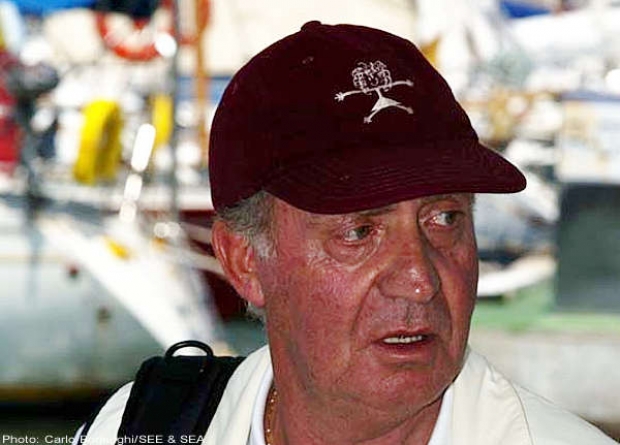
HRH King Juan Carlos of Spain enthusiastically campaigns his IMS boat Bribon
Royalty racing
Thursday April 10th 2003, Author: James Boyd, Location: Italy
Italian Bruno Finzi is the Chairman of the Offshore Racing Council, the international ISAF-recognised body which runs IMS. Also under the ORC's mandate is the management and administration of the cruiser-racer rule ORC Club, IOR (god bless it!) - including the once popular Ton Classes, the International Level Class (ILC) and the ILC classes within IMS.
ORC is also one of the sponsors of the new working party looking at whether or not a new rule would make for better international competition at top level regattas and, if so, what form it would take. However as a stakeholder in this process Finzi says he cannot speak about what the working party is up to as understandably there is the fear that in knowing a new rule was about to be introduced owners would hold off building new boats "and this is bad for our sport," he says. Right enough, but the cat is now out of the bag and the horse has bolted. Instead Finzi brought us up to date with the state of IMS and discussed why it is going from strength to strength.
"It is really booming in the countries where it has been implemented like all the Mediterranean areas, like Germany, Sweden, Finland, Holland and also Japan and we’re starting now to have some success in Eastern Europe, countries like Croatia and Russia," says Finzi. "Over the first three months of this year the numbers of certificates has increased by 30% compared to last year, so we are really astonished by that." Switzerland, now apparently yacht crazy following Alinghi's win in the America's Cup, are also getting enthusiastic about IMS.
Part of the reason for this widespread take up, he feels, is that the IMS rule itself has matured and that those who have been sailing under it for some years now have a better grasp of its quirks and workings.
Numbers may be increasing around the world for IMS certificates, but a majority of these are production boats. The only countries really building one-off IMS boats are Italy and Spain. Finzi says there are around 5-10 new IMS one-offs being built in Spain and a similar number in Italy.
In addition to the IMS50 rule - to which the new one-offs are built - is the year old IMS600 class which is also adding strength to the rule. Substantial development has gone on here too just over the last 12 months. Originally the class was for existing production boats such as Beneteau 40.7s and IMX40s, but now there are purpose-built IMS600s such as the Synergia 40 and the Judel-Vrolijk designed Rodman 42 (IMS600s must be production boats which is defined as more than 5).
The IMS600 Worlds last year (see photo below) proved that these new boats are a step ahead of the existing production boats. It is likely that most of the well resourced Admiral's Cup teams will be fielding the new generation examples.

This year the IMS600 World Championships are to be held in Slovenia. Another plus point to IMS is that the race schedule - particularly in Spain - is intense. It seems you can race almost every weekend whereas in Italy there are fewer key events such as the IMS Worlds in Capri.
Many believe that the popularity of IMS in the Med is down to the presence of the Spanish royal family - in particular the King Juan-Carlos, who races his yacht Bribon and currently has a new Judel-Vrolijk design on the chocks.
"It is like the chicken and the egg," says Finzi, when we ask if IMS would be so popular in Spain were it not for Spanish royalty taking art. "They [the Spanish IMS teams] are capable of finding sponsors and they have very well financed programmes that are paying for the construction and running of the boat and the crew because the King is there and the media are following many races over there. And it is not only the King, but the whole royal family - both the prince and princesses are racing. So I cannot answer your question, but every year it is more and more popular in Spain."
(To see Carlo Borlenghi's photo gallery of the Spanish royal family from last year's Copa del Rey - click here)
Below: King Harald V of Norway at the helm of his Farr IMS 50 Fram XV . King Harald is Honorary President of the ORC

Although IMS is big in Spain and Italy and is being taken up sporadically around the world - which, let's face it, is more than IRM is - there are still big holes in its usage.
"What we are missing at the moment is the old level classes, keeping together the top owners," says Finzi. "Most of them have migrated to the big boats, with new tools like canting keels, fast cruiser racers, while others went to the one designs. So we would like to find a way for some people to get back into the rule and race at the top Grand Prix level while having the possibility to choose what they like - the designer, the yard and so on - and having also the possibility to have some input and dialogue with the designers. This is what was lost from the past years when you had the ton classes and then the level classes."
Despite the increasing take-up Finzi does acknowledge that there is a need for a new grand prix rule, that would promote a new generation of fast boats. "When you design a rule, which is a scientific rule, a VPP-based rule, you intend to have something that is capable of rating ANY kind of boat. That means to catch the cat, the dog and the fast boat! This is why you should possibly find a combination or a tweak of a rule or a new rule to allow fast boats that are more contempory - this is the intent of the working party: To find a way to attract people to this kind of boat and then to get them together from all over the world and not just for one race per year. This same boat should also be capable of racing, inside other fleets in other existing events. The difficulty is how you could accommodate some grand prix rule with boats that are capable of racing in both a normal fleet and grand prix fleet."
Below: Fernando de Leon and Francisco Sanchez's Farr 51 Cam on which Prince Felipe de Bourbon sailed last year

However he points out that top teams will always try to beat the rule whether it is IMS, IRM or the America's Cup class box rule. "The game when you have such a scientific rule is to find some way that your design rates slower than it actually performs on the water. So this is the game that it has always been in the past with the rules. The problem is to maintain and update the rule so that the performance on the water is as close as possible to the predicted one. And therefore you don’t have to push for some design where the slower it is predicted the more it is likely to win. This has always been the case with handicap rules. Any handicap rule whether it is a measurement rule, a VPP rule or a box rule, you have this game between the rule and the design."
Aside from their work with IMS the ORC are looking at developing the Sardinia Cup. While the new format Admiral's Cup is now open to teams from clubs, the Sardinia Cup Finzi hopes now to promote as the premier team racing event for specifically national sides. In 2002 it was held with an IMS class and a Farr 40. Next time there will be two IMS class, one of them the IMS600 plus the Farr 40.
This year Finzi is intending to race on the new Italian IMS53 Orlando Lympus. But this will only be as often as his busy schedule allows. "For example they are testing the boat right now in Genoa and I am here in the office!" he moans.
Click here and then on 'events' to view the complete IMS calendar for 2003.
| Is IMS suitable for a Grand Prix rule? What's your view? Click here to here to send us an email via Outlook or here to use a text box. |

Most Read
Most Commented
Comments
Businesses
Pro businesses
-
Italy
-
Italy
-
France
-
Editor's choice
Member blogs
-
 Ned Collier Wakefield: MOD70 round BarbadosWell that was intense. 12 hard fought for seconds for the win. In idyllic conditions, Tony Lawsons MOD ...
 -
 Mini Transat leg 2 reportThe second leg of the Mini Transat started on 31st October, just over a month after ...
 -
Leg 1 reportI’ve been working towards the Mini Transat now for three years. In 2013 I was part ...
Business blogs
-
 The Island Sailing Club in Cowes, Isle of Wight, is delighted that Prince Michael of Kent ...
 -
Peta Stuart-Hunt chats with the 25 year-old British solo sailor Lizzy Foreman before she sets sail ...
-
The 2015 Student Yachting World Cup (SYWoC), an ISAF-recognised event hosted and run by students for ...
Editor's Choice
All time favourites...
-
 Three legs down into Ian Walker’s
 -
 Winning all but two races at
 -
 For the first time in its
Latest Comments
Add a comment - Members log in