
The hunt for 75 million Euros
Friday November 21st 2003, Author: James Boyd, Location: Australasia
Following their disastrous defence of the last America's Cup in the spring, Team New Zealand have been demonstrating the bounce back ability of a Russian doll. They have been and still are in a period of self assessment and contemplation to establish what went wrong with their defence earlier this year, but at the same time they have been making considerable steps to ensure that there will be a black boat on the start line of America's Cup 2007.
Less than two months after the 'Auld Mug' was loaded on to a plane to Switzerland the trustees of Team New Zealand made the signficant step of appointing ocean racing veteran Grant Dalton to the newly created position of Managing Director.
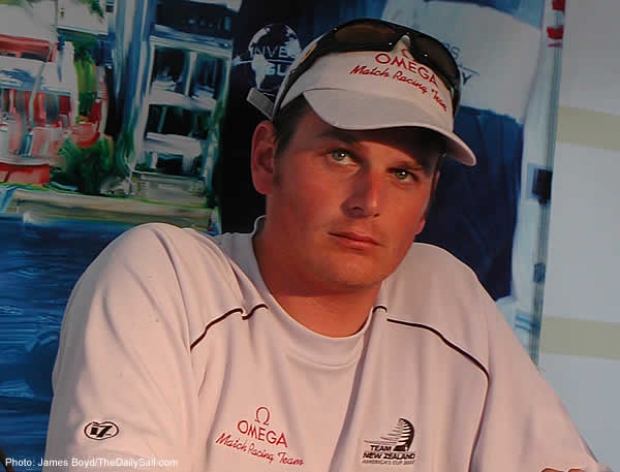
"We identified the fact that we want to have a central person that was responsible for the whole campaign and we talked a lot about potential candidates and the only person that kept dropping out of the hat was Grant with his experience in campaigns and leadership," explains black boat skipper Dean Barker. "We never really had one clear leader in the last campaign. I was in charge of the sailing, Tom [Schnackenberg] was in charge of design and with Ross Blackman heading up the funding side. And it never really gelled as well as we had hoped or thought it would. You always become and expert after the fact. Would it have changed anything last time? Who knows. It certainly has a very good feel about it the way things have been progressing up to this point."
Former Team New Zealand head Tom Schnackenberg is still integral to the design team. "He is really going to focus on what he is best at which is designing and being involved in the design process of America’s Cup boats," says Barker. "He has done it for years and he has had a hell of a lot of success when he focussed on that."
The design team is now being headed by former Wolfson Unit boss Andy Claughton. "I think he was in a way the de facto design co-ordinator last time without really the authority. Tom had a lot of other pulls on him as head of the syndicate which were taking his focus away from the design. So it will be good for Andy to take that role on."
Still puzzling is why Team New Zealand was so flawed. Aside from the team's unparalleled experience designing and engineering ACC boats they also spent considerable time testing their boats NZL81 and 82 out on the Hauraki Gulf. Unfortunately this also seems to be puzzling the technicians at Team New Zealand.
"There were a lot of things which we couldn’t really explain," says Barker. "We obviously had issues with the boat which we have been investigating in the last two or three months. There has been a fairly intensive study going into the engineering and construction of things to see what the problem was, because according to all our calculations there shouldn’t have been a problem.
"The tip cap that broke - we never broke one in all the test sailing we were doing. The design and specs suggested it should have been good enough, but it wasn’t. For me it was incredibly frustrating because you start to lose more and more confidence about what you are doing, because everytime you go into the next race you are wondering - have we seen the end of it or is there something else we are going to have a problem with? It is very hard to remain focussed. We should have won race two and that potentially could have stemmed the flow a little bit, but that is sailing and you have to take your chances when you can."

The dismasting in race four
Aside from some vigorous head scratching over what went wrong with their boats, so Team New Zealand have also carried out a management review and this has resulted in the return to the fold of Kevin Shoebridge. Aside from being involved with New Zealand's America's Cup program since Fremantle in 1986-7, with the exception of this last Cup when he was with OneWorld, Shoebridge has sailed three Whitbreads as Dalton's second-in-command until the last Volvo Ocean Race when he skippered Team Tyco. Within the new structure Shoebridge has the role of Operations Manager coinordinating the different departments within the team.
At present Barker says no one is on a full time salary. "We are on retainers. We have been given the government funding which is to recruit and retain a core group of designers and sailors so the campaign can still go on. Right now the whole focus is on fund raising and to get to the point where we can say we are going to have enough money to challenge."
Having felt the economic benefits of hosting two America's Cups, the New Zealand government were smart enough to come to Team New Zealand's rescue within a matter of days of the last America's Cup competition finishing in March. How many other governments would do this? Team New Zealand have traditionally run highly effective but low budget Cup campaigns but this resulted in an exodus of the countries most talented individuals to foreign campaigns, lured by 'fresh challenge' as well as top dollar wage packets - Russell Coutts and Brad Butterworth being the most high profile examples of this. The New Zealand government's initial funding of, it is believed, 5.6 million NZ$ has been an attempt to stem this tide.
Aside from their internal issues the sole make or break issue dictating the future of Team New Zealand is their funding. Dalton along with Ross Blackman and Tony Thomas have been busy laying siege to the corporate world. If they are able to raise a suitable amount of corporate sponsorship then the New Zealand will stump up addition funding to the tune of 30-35 million NZ$.
"I guess you’d always like more, but we have to be realistic with our funding model," says Barker. "If we could get to 75 million Euros I think that would be as good as we could possibly hope for. We’d like to get to that, but it is incredibly hard to raise that level of funding." While Oracle and Alinghi benefit from the personal fortunes of Larry Ellison and Ernesto Bertarelli, so the Kiwi government looks like it may be Team New Zealand's sugar daddy. Even so, providing value to sponsors given the deficit they have to raise is going to be immensely hard, Barker believes.
While Team New Zealand's recent campaigns have relied on funding from the 'family of five' loyal sponsors, so this time round with the Cup coming to Europe this is certainly going to have to be reappraised. "We have to open up a bit more because it has become a more international event and being in Europe it may not suit some of our existing sponsors to put more mooney in for an event that is not going to be raced in New Zealand. So the funding model for us changes, the companies change and whether we maintain a family of five concept - that is something we have to look closely at as we keep going forward."
Dalton and his team have been speaking to Hasso Plattner's company SAP who part funded their last defence along with a number of other companies but at present none have signed on the dotted line. "The America’s Cup is a long way away and so it is very hard for the companies to focus and say ‘let’s get involved now’ with the America’s Cup three and a half years away still," says Barker.
An addition problem is that winning the America's Cup doesn't get any easier nor does it get any cheaper. "Alinghi did an absolutely brilliant job considering they started relatively late and moved very quickly and designed the winning boat within perhaps six months of having started. They have obviously lifted the bar, which happens every time."
US$ 100 million has been touted around as being the figure which top campaigns such as Prada and Oracle have spent on past challenges. Some are believed to have spent more... Barker says that Team New Zealand's budget for their last defence was just over 80 million NZ$. "So less than half of what Oracle, Prada and probably Alinghi spent."
Looking at the resources Alinghi and Oracle are already putting into their campaigns at this stage, being a new challenger even with Team New Zealand's experience is daunting. "I think they are certainly a long long way ahead of the game at the moment," says Barker of Alinghi and Oracle. "It is a long way to go to sustain it but the advantage for them is that they have the backing to sustain it for four years, because the people cost is the highest. Every time you go sailing you have got to have at least 50 people working, so it will certainly be an expensive campaign. Effectively they have been up and running since late August, before the Moet Cup."
The deadline for Team New Zealand's fund raising is April next year but Barker is vague as to what they must have in place by then. "We know we’re not going to have the whole lot, but it depends on the way we fund the team and which sponsors come on and where we sit at that point will determine it."
Personally, Barker says he remains optimistic. "I think we are in about as good a position as we could hope to be at this point in the campaign given what we’ve been through. I personally believe we are going to be there. We really want to be there and if we don’t challenge this time, then I think New Zealand will drop out of the America’s Cup for a long period of time, if you look at Australia as a model of that. So I think it is important that New Zealand stays in there and I believe that if we can put together as good a team as we are hoping to do then we certainly feel we’ll be competitive."
For Barker, still with the job of skipper and running the sailing team, there is the search for talented individuals to strengthen the afterguard. "We are really looking hard at the afterguard. We want to strengthen that. We had some good guys last time but we need to keep pushing the level higher and higher, so there are a number of guys that are worth looking at at the moment."
At the recent Bermuda Gold Cup, sailing with Barker's new Omega Sailing Team was none other than British Olympic hero Ben Ainslie. "We have been talking to a lot of different people. I have known Ben for quite a while and he agreed to come and sail as a bit of a break from his Finn campaign," says Barker.
A problem identified with the Kiwi defence last time was having a crew that was not fully race ready. "I was very happy with our sailing team," says Barker. "We’d got to a fairly good level, but the unfortunate thing was that we didn’t get the race time to really push things. Going from where we started to where we ended up there was a lot of progress. Anyone who has been through the Louis Vuitton series will have had the hard races and been under the pressure and things. It is a big ask to come through a defender program and be ready race on race one."
A change in format of the Cup schedule next time, with particularly more racing for the defenders, is likely to prevent this re-occurring for Alinghi in 2007.
Next Wednesday's announcement by America's Cup Management of the venue for 2007 will certainly help challengers being able to provide potential sponsors with more finite details of what they require and what they will be able to offer sponsors.
As to a venue Barker says he doesn't mind. "The good thing for us is that the more expensive ones have dropped out of the running. From what we understand ACM are doing everything they can to try and reduce cost, which is very important because unless they do it is going to make it very hard for new teams to get into the America’s Cup. If you talk to Dennis or any of the other guys who have been funding teams commercially. He doesn’t even think he is going to get there." Mind you, this is not the first occasion Conner has said this in the past.
Aside from the Wednesday's announcement of the venue details are expected to be announced about amendments to the America's Cup Class rule. "There are lots of rumours flying around. You don’t want to read too much into it. We are just focussed on looking at our boats and what we have to do to make them more reliable so that we can go and do those regattas next year." Team New Zealand have it in their program to compete in the regattas in Newport and Europe ACM are proposing for 2004.
So how would Barker like to change the boats? "The thing is that they have so much sail area they start to feel fragile when you get up over 25 knots because of just the power. It does get a little bit scarey because you are waiting for things to start popping off and there is so much righting moment… I guess the obvious thing is for the boats to get a bit lighter and maybe to make them good in the lighter air. We’ll see what they do."
There are some interesting rumours flying around about the ACC rule allowing canting keels, but with 20 tonne bulbs to shift around (although bulb weights would reduce if this were the case) we find it hard to believe the rule makers will go down this route. Hopefully all will be revealed on Wednesday.
Even with funding does Team New Zealand have what it takes to go up against the mighty Alinghi and Oracle? Where will the next America's Cup be held? Click here to send us your views.
Most Read
Most Commented
Comments
Businesses

Pro businesses
Editor's choice
Member blogs
-
 Ned Collier Wakefield: MOD70 round BarbadosWell that was intense. 12 hard fought for seconds for the win. In idyllic conditions, Tony Lawsons MOD ...
 -
 Mini Transat leg 2 reportThe second leg of the Mini Transat started on 31st October, just over a month after ...
 -
Leg 1 reportI’ve been working towards the Mini Transat now for three years. In 2013 I was part ...
Business blogs
-
 The Island Sailing Club in Cowes, Isle of Wight, is delighted that Prince Michael of Kent ...
 -
Peta Stuart-Hunt chats with the 25 year-old British solo sailor Lizzy Foreman before she sets sail ...
-
The 2015 Student Yachting World Cup (SYWoC), an ISAF-recognised event hosted and run by students for ...
Editor's Choice
All time favourites...
-
 Three legs down into Ian Walker’s
 -
 Winning all but two races at
 -
 For the first time in its
Latest Comments
Add a comment - Members log in