
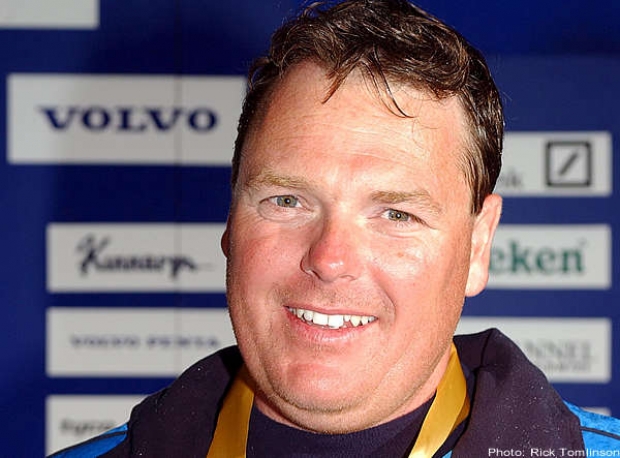
Etchells champ
Saturday September 20th 2003, Author: James Boyd, Location: United Kingdom
After a practice race today, the 2003 Mastercard International Etchells World Championship kicks off tomorrow in Greenwich, Connecticut.
Leading the British entries is current World Champion Stuart Childerley, who with his trusty crewmates Simon Russell and Roger Marino will be attempting to hang on to this title for a third consecutive year.
Following two Olympic campaigns in the Finn (finishing fourth twice) and then an unsuccessful attempt at the Soling - he got silver at the Pre-Olympics, won the World Match Racing Championship but failed on the day to make the section - Childerley became the consumate 'amateur' (under ISAF's classification). Having given up a life on the ocean wave, he rejoined the real world, taking over the family business.
Today aside from racing his Etchell, he is often to be seen at the helm of Mike Slade's Leopard, which he has sailed on recently in both the Rolex Fastnet Race and the Maxi Yacht Rolex Cup in Sardinia.
"It's a bit of a mixture," admits Childerley of his current sailing regime. "It is balancing it with work and family and making sure that what I do do, I enjoy. If you are stretched for time and try and fit it all in you don’t enjoy anything."
Childerley returned to racing back in 1999 when he joined Adrian Stead on board the Barlo Plastics Mumm 36. "I really enjoyed getting back into sailing," he recalls. "That was the first sailing I'd really done for some time."
Since 2000 the Etchell has been his primary focus. "I looked at Etchells and the World Champions were going to be in Lymington in 2000. So I saw that as an opportunity to see what it was like in our own back yard. And I looked at venues for the Worlds over the next four years - quite attractive with New Zealand while the America’s Cup was on, the Greenwich regatta in Connecticut, then Maloolaabaa and then San Francisco - so potentially four years of really good venues and good racing."
Another attraction of the Etchells class is that it attracts top sailors of all ages. At this present Worlds are the likes of Dennis Conner, Peter Isler, Ken Read and Team New Zealand's Cameron Appleton. Childerley says he likes the mix: "It's great. You get really good racing. There are good amateur sailors meeting the pros - it is very similar to the Star like that. The Etchells is relatively cheap. You have limited sails and what you can do with the boat. Our boat for example was built by Bashfords in 1994 and I’ve had good value out of it. It is nice that you can still be competitive in a 9-10 year old boat."
The last two World Championships Childerley won with reasonable margins - 12 points in Lymington, while in Auckland he says "we had one of those weeks where it clicked and whatever we did was right. The one time we had a bad start there was a general recall!"
So will he make it a hat trick? "We realise we've been pretty fortunate to win it twice. We feel comfortable in the boat together still. We’ve done a lot less sailing this year, but collectively we’ve done a wide range of sailing and I think we are expecting the Americans to be very tough to beat in their own backyard."
Conditions-wise a regatta in Connecticut should be a light wind affair. Last week with Hurricane Isabelle romping through they might have had to take a reef... "I think if it was any earlier in September we would be expecting light airs," says Childerley. "We are told to expect a mixed bag, but I expect predominantly 10 knots ish. So it’s going to be be quite good because the series will be below 15 knots most of the time. I see that as a personal challenge. In Lymington we had light and windy races and in New Zealand it was predominantly windy. If we have a predominately light air series it is a good challenge."
Childerley says they have never been slow in light conditions, but admits in Connecticut there will be a lot more people that are competitive in the light. "Potentially it can be a lot, lot harder. You can be racing in the 40s in light-medium airs and you’re not going to go any further forward in the fleet. Whereas in a breeze, there is technique and speed and more opportunities to climb through the fleet. If it is light and shifty, the whole game is a lot more unreliable, less predictable than when there’s breeze. Normally if you get a bad start you can find your way round to get the predictability you can expect. In light airs you can’t do that."
The local sailors in the US east coast fleet will obviously be among the main contenders. Childerley rates Judd Smith, the local Doyle sailmaker.
So what does it take to become Etchells World Champion? "A bit of luck! When we've sailed the Etchells we have been very precise in what we have to do. We have concentrated on keeping the rig set-up very basic. We don’t stray very far away from the North tuning guide. We use North Sails. And then it is just a matter, I think, of sailing the boat.
"A lot of people get in the boat and it is their hobby and they try and find excuses for not winning races in the set-up and things like that. Whereas I feel strongly that it is more about where you sail, how you sail, how the team works, rather than set-up. Set-up is an important fact, but I think it is more important sailing the boat. It is a boat, there is no instrumentation, there is a compass, everyone has got similar sails, we’re not going to be a million miles from each other in speed and it is very easy to be spending the race looking up the rig rather than looking at wind shifts."
On board their fine vessel Childerley helms. Roger Marino in the front looks at the wind up the track and the compass and trims the jib. Between them Simon Russell provides the boat-to-boat input about how they're doing and what is happening locally. "I am able to sail the boat by feel, so I haven’t got my head in the boat too much."
The key is to get adequate sailing time in beforehand. "It is quite noticeable - if we have done enough sailing between us, I have plenty time to look out of the boat and take in all the input they give me and we sail very well. If we haven't done enough sailing I notice it because I find my head is in the boat a bit more and all of a sudden you start to rely on their information and deciphering that information.
"Rather than them just looking at the jib, they are really playing a part and bringing information into the boat which would be impossible if I had to do that all myself - looking at the compass, looking for wind shifts, feeling the speed - you can’t do all that yourself. So you’ve got the tiller in your hand, but you are using your two crewmembers to bring the information in and then we have to make it work between the three of us."
He stresses that on board the atmosphere is very relaxed. "Rog and Fums - I've got them doing what I’d like them to do in the boat. I am sure everyone has different ways of sailing it. But I find it comfortable sailing with them that way."
Prior to the start today the team had done two week long stints in the boat in the UK. "Then we’ve got three or four days before the regatta where we know pretty much what we want to do and how we want to approach that. We’ve got the boat, we know we're fast in most conditions, so it is a case of getting comfortable with the local conditions, any new sails we’re going to use for the regatta and making sure our routine is good."
Their sails are "bog standard". "I have been temped to make a few alterations, but I haven’t done as yet because I don't want to over complicate it. If I start to change luff curves and things I am turning quite an enjoyable hobby into a complex enjoyable hobby and if it doesn’t go right you start getting twitchy about this, that and other. So you’ve got to keep it as simple as possible," he says.
Their 1994 Bashford boat still has its original keel and its original mast. "We’ve put on the North Australia kit - a PC main, a GM or DC jib and I use the standard bi-radial running spinnaker."
Outside of the Etchell, Childerley says his Olympic career is over. "What I have found on reflection is that if you have the experience of a 30 year old and the ability to be able to put the commitment into a campaign as you would as an 18 year old - that is the perfect balance. But as you get older it all becomes more complex with wives, girlfriends, kids and your commitment gets diluted. And as it becomes diluted, you can’t put in 100% commitment that is required."
Childerley is married to wife Lisa and has children Ben and Abigail. "Last year was the first regatta we did when we took the kids and it was bucket and spade and all the rest of it. It was a very strange sensation of going to a regatta with kids and not being able to have that singleminded approach to a regatta."
Business-wise he sold the family business, JPM Aggregates, last year and worked for the new owners for eight months. Following two months off he is now a Regional Manager for Tarmac, working out of their office in Sevenoaks.
"It is a challenge for me. I came from sailing full time to gradually working into the family business, growing that and selling it and then working in a larger business. I left school at 16 with no real qualifications, but I’ve got drive and the ability to listen. I got the opportunity to join Tarmac, but if my reputation disappeared, with my background and (lack of) qualifications I wouldn’t have that opportunity again. Now I can work in a PLC and it will be a challenge to see how far I can get in that."
Having a full time job not involved in yachting allows him to maintain his amateur status. "There is no pressure on me to do anything that I don't want to do," he says. "It is really nice that I can just go and get really involved but there’s no ties. I have a limited ability to take time off now - even less now that I am working for a large company - so you pick and choose the events you really want to do."
The constraints of maintaining his amateur status are that he can't be paid or take financial reward for sailing. "I think anything other than out of pocket expenses you start to get into a grey area. So I did the Volvo stuff last year [with old Olympic mate Jez Fanstone on News Corp] all off my own back and I just got stuck in there because there was an opportunity to do it."
Going forward he says he wouldn't go 'pro' as a sailor but might consider some other role, possibly a managerial one, within the sport. "What I have found with the business is that the management side of it is intriguing. And given the opportunity I wouldn't mind getting involved in a campaign more on the management side of things."
GBR Challenge? "I have enjoyed being on the periphery and seeing what going on from an outsider’s point of view. I think I could bring a different perspective to it. I have a background in management. It’s having an unbiased view and trying to manage all the elements and not having it pulled off course by personal agendas. That is what I enjoy in business. There is not a lot of customer contact - it is all about managing and making sure we meet budgets and pulling it all together."
Fingers crossed for this week...

Most Read
Most Commented
Comments
Businesses
Pro businesses
-
Italy
-
Italy
-
France
-
United Kingdom
Editor's choice
Member blogs
-
 Ned Collier Wakefield: MOD70 round BarbadosWell that was intense. 12 hard fought for seconds for the win. In idyllic conditions, Tony Lawsons MOD ...
 -
 Mini Transat leg 2 reportThe second leg of the Mini Transat started on 31st October, just over a month after ...
 -
Leg 1 reportI’ve been working towards the Mini Transat now for three years. In 2013 I was part ...
Business blogs
-
 The Island Sailing Club in Cowes, Isle of Wight, is delighted that Prince Michael of Kent ...
 -
Peta Stuart-Hunt chats with the 25 year-old British solo sailor Lizzy Foreman before she sets sail ...
-
The 2015 Student Yachting World Cup (SYWoC), an ISAF-recognised event hosted and run by students for ...
Editor's Choice
All time favourites...
-
 Three legs down into Ian Walker’s
 -
 Winning all but two races at
 -
 For the first time in its
Latest Comments
Add a comment - Members log in