
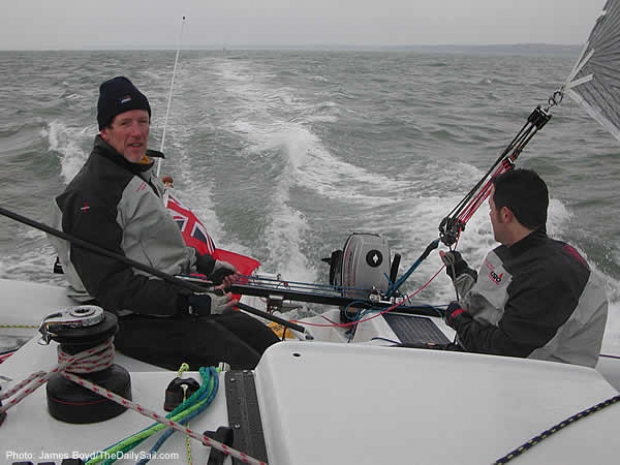
Ian Loffhagen at the helm - the wake gives some indication of the speed potential
Fastest 27 footer in the country
Wednesday December 3rd 2003, Author: James Boyd, Location: United Kingdom
While 60ft trimarans and the giant G-class multihulls have plenty of space dedicated to them in these pages, what fails to get a great deal of coverage both here and elsewhere in the yachting press are the antics of smaller racing multihulls in the 25-40ft size range.
Through the endeavours of the Multihull Offshore Cruising and Racing Association (MOCRA) and in particular the Royal Southampton Yacht Club, a growing fleet of multihulls of this size regularly congregate in the Solent, most recently in the RSYC's Winter Series.
One of the newest boats in this fleet is Sheik Yerbouti, an F25C ('C' for 'carbon' rather than 'cruising') trimaran named after a Frank Zappa album and owned by Ian Loffhagen, Deputy Racing Manager to Janet Grosvenor at the RORC.
With dreams of buying one of these boats once thedailysail has become profitable enough to put food on our plates and our children in shoes, we jumped at the chance to go for a burn up around Southampton Water on board this nimble 27 footer (despite its name the F25 is 26ft 11in long).
Loffhagen describes himself as a Merlin Rocket sailor, but prior to acquiring the F25 this year, owned an F27 trimaran. These boats, designed by Kiwi architect Ian Farrier and built mostly by Corsair Marine in California have accommodation good enough to camp on but are primarily fast (and we MEAN fast) racer cruisers. Such is their performance that for many years Flying Dutchman Gold medallist Rodney Pattisson was the UK importer.
A unique Farrier feature is a simple but much tested (and patented) system for folding in the floats, thereby allowing the boat to fit into a marine berth at monohull rates or to be legally towed. Removing a single pin, the inboard end of beams rise up and the float folds snugly in alongside the centre hull.
In fact the F25 wasn't built by Corsair, but by a group of owners who had some knocked up in kit form by MPG Marine in the USA. Sheik Yerbouti was moulded in 1994 but sat unfinished in a barn outside Seattle until being imported into the UK and launched by Loffhagen the night before this year's Round the Island Race.
Dimensions-wise she is similar to the original F27 with a beam of around 19ft, however compared to her predecessor, the F25 is built entirely in carbon fibre with a balsa core and has a taller carbon fibre rotating wing mast. Significantly for a multihull where weight is even more crucial to performance than it is with a monohull, the F25 weighs a mere 880kg compared to 1,500kg for an F27.
It has a straightforward up and down daggerboard and Loffhagen says that the rudder is non-standard. "Originally the boat had a kick-up rudder but it was rubbish. This is an after market rudder, which is also carbon. It cost an arm and a leg, but it is lovely. It is like an International 14 rudder."
Skeik Yerbouti's sails were made by Randy Smyth and her wardrobe comprises a fully battened main, fully battened jib, another smaller jib, two asymmetrics and a Screecher. Loffhagen explains that the latter is similar to a Code 0, with the tack attaching to the end of the bowsprit. "We don’t use that for handicap racing, because it hurts the rating too much, but it is a great sail for the Scottish Peaks or something like that."
Loffhagen is currently getting to grips with his new toy and for the recent races in the Royal Southampton's Winter Series has had Maiden II co-skipper Helena Darvelid helping him out. While they have won almost all their races on line honours, they are now getting to the stage where they are occasionally winning on handicap too.
Aside from the RYSC events, Sheik Yerbouti next year will race in the Round the Island next year and possibly some of the RORC racing when Loffhagen's work commitments allow, although he says he has yet to grips with her offshore. "I would look at the weather carefully before doing any of the RORC series. The F27 was a great sea boat but this is like changing from a Volvo estate to a Lotus Elise and I want to be convinced of its seagoing capability before I get myself in a pickle. It is so much more of a race horse."
The Scottish Peaks Race, which unlike the Three Peaks Race still allows multihulls to enter (and is likely to stay this way since the organiser has the larger F36 trimaran), is also in the schedule as Loffhagen twice won it in his F27. "I quite like those combination sailing and fell running events, not that I run... However you are allowed to row. We could row the F27 at 5 knots, with carbon oars and sliding seats - the whole business."
Aside from this there is also a possibility that next year's Skandia Cowes Week may see a multihull class. If this comes to pass, then the class would almost certainly have both length and rating limits. Racing would probably be held under the MOCRA Rating Rule, a fairly basic rule based on weight, length and sail area, with tweaks for prop type, rotating masts, carbon, etc.
"It is getting pretty good now," says Loffhagen of the racing for his type of boat. "We are getting a dozen boats out on a Sunday morning. People are upgrading. Brian Haynes, he had the F28 Carbon Tiger and he is getting a new F33 in this month..."
So are monohull sailors missing out? "Absolutely," continues Loffhagen. "A lot of dissatisfied monohull sailors are sailing sports boats now. I understand that. But it is just so good sailing so fast. Compared to plugging along at 7-8 knots maximum, you can have a boat that only needs three of you, so you don't need a big crew and you can sail at 20 knots plus."
They say that multihull racing isn't as good as monohull racing... "I think inshore it is getting there," counters Loffhagen. "Offshore we have some work to do to get to a critical mass. When we do get that there are people ripe for conversion. At the moment there aren’t enough boats racing. I have talked to several people, many who have gone the asymmetric route who are keen. The most important thing we can do is to go and sail alongside them and they can see how much fun we are having. There is no point in us going off in a corner and doing our own events."
In the past there have been dominant classes in this size of multihull such as the 26ft Firebird catamaran and before that the 24ft Strider catamaran and the F27's original competitor, the 25ft Dragonfly trimaran from Denmark, which famously beat the stalwart 50ft ocean racing monohull Quailo of Wight upwind in a North Sea gale during the 1985 two handed Round Britain and Ireland Race.
Today there is no one dominant design in this size of multihull and regularly racing in the Royal Southampton YC events are Dragonfly 800s, 920s, F27s, F25s, F24s and the Darren Newton-designed Dazcat, Mike Butterfield’s larger catamaran Dazzler. "There is also a chap called Ben Goodland who bought an old Strider and has souped that up and has done well," says Loffhagen. "He is in the market for a F31 or a Dragonfly 920. Pete Newman (the sailmaker who used to work with Graham Goff), he’s had an F27. He’s a very good sailor, very competitive and has just bought an F31. So it is pretty optimistic at the moment."
Traditionally a criticism of multihulls is that they don't go to weather. 60ft tris have rather disproved this - these days they point as high as an equivalent monohull and sail upwind at up to 18 knots. "Tris definitely go upwind," says Loffhagen. "You can point as high as a monohull, but it pays to foot slightly more and increase boat speed because the VMG is better. So upwind we're sailing at 12 knots slightly cracked off," although he admits they don't have instruments at the moment. They are waiting to fit some instruments from TackTick, who are currently developing a system of measuring mast rotation by comparing the difference between two fluxgate compasses - one on the boat and the other on the mast. Loffhagen guestimates that their optimum is to sail upwind at 50deg off true.
Downwind and reaching is really where the boat comes into its own. "Downwind we are learning to sail it hotter and hotter and hotter. You have to get the apparent forward of the beam, so we are sailing some crazy angles, but it is really fun. It is very hard work downwind - the reverse of conventional thinking. You are looking forward to the beat for a rest because you are working really hard to keep the boat hotted up downwind. You are always trimming, trying to ride the apparent down, coming back up to collect. I did Key West on an F28 a couple of years ago and we were beating everyone by working hard downwind. We were trying to get every little gust and wave and it does pay on these boats. It was like when I used to sail a Merlin and we used to be rude about GP14s: it didn’t matter how hard you hiked it made no difference. It is similar between a multi and a mono - the more you put in you just get disproportionate gains back."
Loffhagen says he clocked 22 knots top speed in his F27. On his new machine he thinks it capable of approaching 30 knots. This certainly makes it among the fastest boats of its size in the country. Tornado guru Reg White has been campaigning a suped up Firebird catamaran in recent years which is one of the few boats in the fleet to be able to challenge the F25.
"It is as fast as a Firebird, depending upon the conditions," says Loffhagen. "In some conditions the Firebird is faster. It has no wieght, so in a chop where you have more waves then the bigger boats will beat us because they will carry their way more, whereas we will be stopped by the waves."
A downside of such a machine is cost. Loffhagen reckons Shiek Yerbouti has cost him around £70,000, which in monohull terms could buy you a Mumm 30. "You have to think of it as money per knot rather than length. To go at these speeds in a mono you would need a Volvo 60."
The final gripe about it being a multihull is of course the potential for capsize or pitchpoling. Loffhagen says that he doesn't worry too much about this. "The Farrier design is quite conservative. There is a lot of buoyancy in the bows and when you start to bury a float as you start to get overpressed, you reef and you come more upright and you go just as fast, if not quicker. The danger is obviously pitchpoling, but I haven’t sailed it offshore in big waves yet. In flat water I am not at all worried about it. We ride shotgun on the sheet all the time. I have always got the traveller within reach and we don’t have knots in spinnaker sheets and we never cleat spinnaker sheets." Saying this Farriers have been known to capsize.
Multihulls can be ugly in the extreme, but with her 60ft tri hull shape and nicely profiled cabin top, we find the F25 good looking - maybe it is personal taste.
Looking around the boat and the cockpit appears quite small, but Loffhagen points out the standard crew is three and he often races just two up. Using the tramps spanning the divide between the floats and the main hull it would be possible to take around six sailing in relative comfort.
As a sailing experience the F25 is not dissimilar to a high performance skiff or a Tornado Sport. Alarming for the uninitated is how fragile the boat seems, the acceleration that is capable of throwing you off balance - gusts are translated directly into speed rather than heel - and the rapid decceleration when you punch into a wave. It is this that makes for the uncomfortable motion/lively ride depending upon your viewpoint. This is one boat in particular where you have to place faith in engineering - the boat is carbon and should be able to withstand a pounding.
We sailed the boat in moderate (not enough) breeze in flat water, so we are not in a position to say what it is like in a chop. The moment of sheer joy, when it all felt like it came together was when we popped the kite up sailing back up Southampton water en route back to the main haven for boats of this sort at Southampton's Saxon Wharf up the Itchen River - the kite was lifting the bows up and it felt like the boat could be pushed.
Down below it is pretty pokey and Loffhagen says that as a rule he doesn't sleep on board. There are narrow quarter berths either side, and a reasonably large bunk forward, which they use for sail stowage. Other stowage is to be found in the middle compartment in the floats.
The rig is fairly conventional for a boat of this sort. There is a bowsprit for the kites. The mast rotates with an aft-facing spanner and there is a single set of diamonds. The mainsail is a state of the art Smyth square-topped affair. Perhaps most unusual is the lack of a boom (the F25 is the only Farrier tri not to have one). "It makes gybing pretty straightforward," says Loffhagen. "The boat goes pretty well without one and we have got the traveller as far aft as we can. You tend to crank the main right in and ease the traveller."
Loffhagen says he was also considering fitting a mechanism to cant the rig, but hasn't because of time and cost and he is uncertain of how it would be rated. At present there is precious little rigging. The shrouds and forestay fix to the mast at one point and there are no backstays. The Vectran/Spectra shrouds are lashed to the floats via a neat purpose-built eye that Loffhagen says originated from Canada.
While many view this corner of the market as the lunatic fringe - the boats can capsize, don't go to windward, they behave strangely compared to monohulls, have a horrible motion and are frequently sailed by eccentric wierdos, so the belief goes - there is no denying they are very very fast and extremely exhilarating to sail and for anyone who enjoys such things, there is the more esoteric pleasure of sailing a very high performance craft that harnesses wind power to the maximum efficency.

Most Read
Most Commented
Comments
Businesses

Pro businesses
-
France
-
Netherlands
-
Italy
-
United Kingdom
Editor's choice
Member blogs
-
 Ned Collier Wakefield: MOD70 round BarbadosWell that was intense. 12 hard fought for seconds for the win. In idyllic conditions, Tony Lawsons MOD ...
 -
 Mini Transat leg 2 reportThe second leg of the Mini Transat started on 31st October, just over a month after ...
 -
Leg 1 reportI’ve been working towards the Mini Transat now for three years. In 2013 I was part ...
Business blogs
-
 The Island Sailing Club in Cowes, Isle of Wight, is delighted that Prince Michael of Kent ...
 -
Peta Stuart-Hunt chats with the 25 year-old British solo sailor Lizzy Foreman before she sets sail ...
-
The 2015 Student Yachting World Cup (SYWoC), an ISAF-recognised event hosted and run by students for ...
Editor's Choice
All time favourites...
-
 Three legs down into Ian Walker’s
 -
 Winning all but two races at
 -
 For the first time in its
Latest Comments
Add a comment - Members log in