
The black art
Thursday April 25th 2002, Author: James Boyd, Location: United Kingdom
An interesting aspect of Clark's approach is that they did not become completely bound up in computer-based design. "We did a lot of hand shaping where we got the plane out and even did that in the tank itself. The hands on feel part is what is missing in the virtual world".
A certain amount of experimentation and following hunches went on too, a process which Clark compares to Fleming discovering penicillin. "We tried some radical ideas. I don't like the expression no stone unturned, but its not far off. It's been reasonably structured".
It seems this task involved considerable time management on his part. "It is very easy to get completely side tracked into developing the best block. At the end of the day the boat has to go through the water fast." He gives the examples of some of the decisions they had to make such as a winch system which is 100kg heavier but 200% faster - which do you go for? "Fortunately we've got some good lateral-thinking people and innovatively thinking people. But you want to encourage it without it getting out of hand". One gets the impression he has thoroughly enjoyed the whole 'experiment'.
Using all these techniques the design team started to identify the trends which make America's Cup boats go fast and those which don't. "There were a couple of things, but we can't tell you what they are," says Clark. "70% of times they run along the lines that the CFD pointed out".
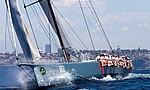
A number of boffins were brought in to work on the computational fluid dynamics (CFD) to establish how to make GBR70 slippery through the water. Principle CFD work was carried out by Steven Fiddes, formerly of Bristol University using some software which he originally developed with Geoff Willis when they were working on Peter de Savary's short lived Blue Arrow campaign and which has subsequently gone on tobe used for testing the aerodynamics on Formula 1 racing cars. SP Technologies worked on the Finite Element Analysis to develop the structure for GBR70.
While some yacht designers will have you believe they have all the answers, Clark admits there are some areas of yacht design which remain a black art. "The interesting thing about this is it is not completely knowable. It is not divide this number by this and you end up with a result. There are elements which are unquantfiable. That is why it is as much a case of art as it is science".
Ultimately the choice over which hull would become the new GBR70 was relatively easy. "We had two or three models which were significantly better in the tanks and in the VPPs and we chose one of those," says Clark.
At this point in the article it would be nice to go into the nuts and bolts of what Clark and his team discovered and what they put into practice in their design of GBR70. After a mute response to my questioning Clark warms up. "It is fairly conventional, but not conventional," he says cryptically of GBR70. "The most obvious thing is the knuckle bow, the new boats follow that thing. You can see GBR70 has a similar bow treatment. This increases the waterline length and it gives you some direct benefits there.
"It is quite clear that the rule forces you down towards a heavier displacement boat with more length and more sail area," Clark continues adding that because they are displacement boats and don't have to plane they can be at the heavier end of the rule. "Sail area and length minus the displacement - it is a balance between those things. You can add displacement or take away length. The boats are pretty powerful so you can have less than the maximum sail area". The rule limits ACC boats to 25 tonnes and Clark believes most around between 24 and 25 tonnes.
Continued on page 3...

Most Read
Most Commented
Comments
Businesses
Pro businesses
Editor's choice
Member blogs
-
 Ned Collier Wakefield: MOD70 round BarbadosWell that was intense. 12 hard fought for seconds for the win. In idyllic conditions, Tony Lawsons MOD ...
 -
 Mini Transat leg 2 reportThe second leg of the Mini Transat started on 31st October, just over a month after ...
 -
Leg 1 reportI’ve been working towards the Mini Transat now for three years. In 2013 I was part ...
Business blogs
-
 The Island Sailing Club in Cowes, Isle of Wight, is delighted that Prince Michael of Kent ...
 -
Peta Stuart-Hunt chats with the 25 year-old British solo sailor Lizzy Foreman before she sets sail ...
-
The 2015 Student Yachting World Cup (SYWoC), an ISAF-recognised event hosted and run by students for ...
Editor's Choice
All time favourites...
-
 Three legs down into Ian Walker’s
 -
 Winning all but two races at
 -
 For the first time in its
Latest Comments
Add a comment - Members log in