
Stressed out
Monday May 24th 2004, Author: Peter Bentley, Location: United Kingdom
Surprising as it may sound in this day-and-age of high-tech composites, finite element design and computer simulation, yacht designers and builders still have remarkably little information about the real-life loads on their creations. With the exception of the odd load-sense pin, those of us out sailing have virtually no idea what is happening to the structure of our hulls and rigs as we push ever harder into more extreme conditions.
All that is set to change thanks to a relatively new British company that has finally perfected a lightweight and comparatively low cost system for measuring loads in composite structures. Right now, the Insensys fibre optic strain measurement system is fitted to a number of high profile projects including Mirabella, Ellen’s new Castorama B&Q, Yves Parlier’s radical new 60ft catamaran Médiatis Région Aquitaine and even a humble Oyster 72. Where these high profile projects tread today, it seems more down to earth designs will follow tomorrow.
Based in Fareham and shortly moving to Hamble, British start-up, Insensys has developed what was hitherto a lab technology into a thoroughly workable product. Currently, the biggest market for the system is in monitoring the blades of wind turbine generators but the marine industry has played a key part in development and will continue to feature in the companies’ plans.
As CEO, Martin Jones, himself a keen International 14 sailor points out, the marine market will never make anyone a fortune but it does as he so nicely puts it, “stress us from a R&D point of view - it’s a good platform for us to try thing out.”
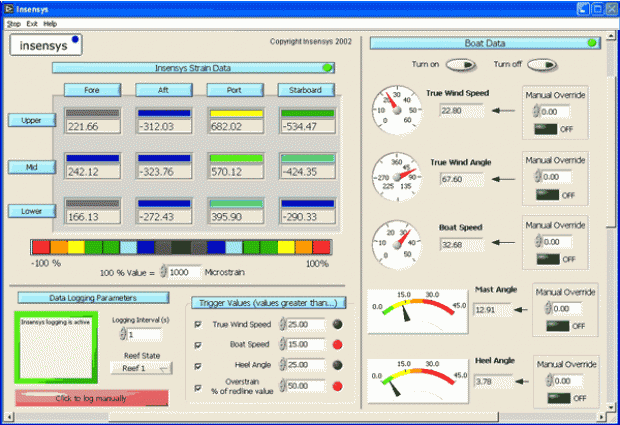
The Insensys system is based around fibre optic cables that are bonded into composite structures. Via a very clever combination of optics and electronics these fibres are able to measure strain (and thus load) deep within the laminate of almost any structural component.Hulls, rigs and rudders are amongst the first to get the Insensys treatment, but there is no reason why rigging, battens and sails should not also ultimately benefit.
Below: rosette patch

The Technology
Insensys use a system of fibre optic cables to measure the strain in specific locations throughout the structure. Most people are familiar with the concept of fibre optic cables being used to transmit light in communications networks, and this is indeed one of their functions the Insensys system.
The first of several clever twists comes with the fact that in this system, the fibre optic cables do more than just transmit signals. They also perform the strain measurement. In order to do this, a small device called a diffraction grating is engraved into the fibre optic cable using a laser. A diffraction grating is a clever little device that, in essence, consists of an array of very fine optical slots each a very precise and very tiny distance apart. When broad-spectrum light is directed through the diffraction grating, light that is the same wavelength as the slots are wide, is reflected back along the fibre optic cable. The other wavelengths simply pass through.
So, with zero strain, the wavelength of the reflected light will be precisely related to the original dimensions of the diffraction grating. If the diffraction grating is stretched or compressed, the distance between the slots will change and thus the wavelength of the reflected light will change in direct proportion. Hey presto, we have a simple and reliable method of measuring strain.
Once the fibres with their diffraction gratings are either incorporated in the composite lay-up at the manufacturing stage or bonded on afterwards, a very simple and robust method of determining the load on each and every part of the rig and hull structure is produced.
If only it were that easy. Even with just a single grating on the fibre, a light source and light detector are required. And of course, the electronics to analyse and output the signal in a useable form.
Insensys have gone much further than this. By designing and producing some very sophisticated detectors and the necessary electronics to control them, they are currently able to put as many as 100 diffraction gratings onto a single fibre. Light is pulsed into the fibre in a very precisely controlled way and by measuring not only the wavelength of the reflected light but the time it takes to return, it is possible to determine the individual strain in each and every on of those 100 sensors. A single fibre is thus able to measure the loads in a huge number of different places. In the future, Jones sees the potential to put as many as 500 sensors on a single fibre.
When you bear in mind that light travels at 300,000Km per second it soon becomes clear that some pretty precise timing is required to differentiate between strain sensors that may only be a few metres apart. There are competitive systems in the industrial market but they use an older and much simpler technology requiring different sizes for each diffraction grating, distinguishing between each by the fundamentally different wavelength of light reflected. The Insensys system has the great advantage that all the diffraction gratings can be identical and thus manufactured at a lower cost.
Another area in which Insensys appear to have a huge advantage is the electronics required to process all this information. While commercial competitors have their electronics housed in industrial-standard 19in rack units, Insensys have developed their own waterproof carbon fibre-encased unit, barely bigger than a large paperback book. Its size and weight would not be out of place on even a quite small racing yacht.
Below: Nick Harper mid-way through the installation on board Yves Parlier's cat

Applications
On the face of it, the most obvious application for the Insensys system is load monitoring and warning the crew of potential overloads in the structure. On boats like Mirabella or Médiatis Région Aquitaine, the likes of which have never been seen before, this is indeed a vital function.
Though structural monitoring is clearly an important role for the systems currently installed, Jones sees this as just one of the many potential applications of the system. In the longer term, data gathered by the systems on these boats will allow the designers to push nearer the limits with subsequent commissions.
Imagine if you will, the lot of the America’s Cup structural engineer. We know for a fact that the loads on these boats sometimes exceed the strength of the structure (proof if any were needed comes in the form that at least two have suffered very public hull-failure). In order to make sure the boats do not break, the majority are marginally over built and thus heavier than they need to be. Armed with the knowledge of what the loads really are in boat number one, the lessons learned could well save vital kilos off the second design.
Similarly, setting up rigs remains as much an art as a science. Even on the most high-tech boats the best way to check that the rig is straight is to lie on the deck and squint up it. Imagine now if you will being able to simply plug in the Insensys box and tweak the diamonds until you knew it was straight. That day is not very far away.
From here it is but a small step to use the data to set up a particular mast bend to suit the luff curve of the sail and the wind conditions of the day. Add in the ability to measure the shape of the battens in a fully battened and direct read-out of the sail shape become a very real possibility.
This ability to read the shape of almost any component on the boat while at the same time knowing the precise loading offers almost limitless possibilities. Properly applied the Insensys system has to potential to transform our structural knowledge of yachts and their systems in much the same way as GPS transformed the way we think about navigation.
Glossary
Fibre optic cable: A thin (0.008mm) unbroken strand of high quality glass that transmits light in a very controlled way. The fibre optic is usually coated with a protective plastic layer and a Kevlar/plastic sheath.
Modulus: The physical property of any given material that determines how much its stretches or compresses under load. If we know any two values from stress, strain or modulus we can calculate the third.
Strain: The relationship between the original (unloaded) length of a structural member and its longer or shorter length when loaded.
Stress: The load per unit areas of material.
Most Read
Most Commented
Comments
Businesses

Pro businesses
-
-
Italy
-
United Kingdom
-
United Kingdom
Editor's choice
Member blogs
-
 Ned Collier Wakefield: MOD70 round BarbadosWell that was intense. 12 hard fought for seconds for the win. In idyllic conditions, Tony Lawsons MOD ...
 -
 Mini Transat leg 2 reportThe second leg of the Mini Transat started on 31st October, just over a month after ...
 -
Leg 1 reportI’ve been working towards the Mini Transat now for three years. In 2013 I was part ...
Business blogs
-
 The Island Sailing Club in Cowes, Isle of Wight, is delighted that Prince Michael of Kent ...
 -
Peta Stuart-Hunt chats with the 25 year-old British solo sailor Lizzy Foreman before she sets sail ...
-
The 2015 Student Yachting World Cup (SYWoC), an ISAF-recognised event hosted and run by students for ...
Editor's Choice
All time favourites...
-
 Three legs down into Ian Walker’s
 -
 Winning all but two races at
 -
 For the first time in its
Latest Comments
Add a comment - Members log in