
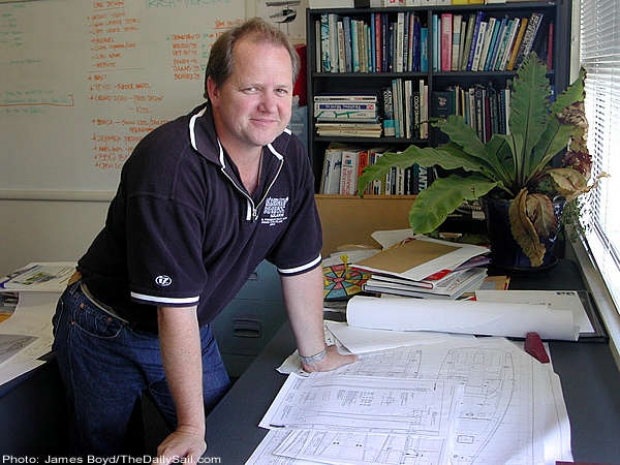
Brett Bakewell-White on yacht design
Thursday March 20th 2003, Author: James Boyd, Location: Australasia
Brett Bakewell-White is not a firm of solicitors as I first imagined, but a wry humoured Auckland- based yacht designer whose firm is just hitting the big time.
After training as an architect Bakewell-White got involved working as a draughtsman alongside Laurie Davidson on the KZ7 campaign in 1986 and subsequently spent nine and a half years working with the eminent designer, latterly running his office in NZ when Davidson moved to the States. "I did an apprenticeship with Laurie which was a great way to learn," says Bakewell-White when The Daily Sail visits his office just off Halsey St. "I learned a lots of things you'd never learn about of a book or at school. It was a great grounding."
In 1994 he decided to go it alone opening his own design house. "I thought I was just going to go out and become a famous yacht designer and it was all going to work really easily! But then I found it was somewhat harder than that"
It is only now, almost a decade on, that Bakewell-White is finally getting to the position he envisaged, with commissions now coming in from all over the world and in particular Europe - a hard market for a NZ-based yacht designer to crack - for everything from power catamarans to racing skiffs, although racing boats are his speciality.
Part of the legacy of working with Davidson was sailing a relatively ancient Davidson 55 called Starlight Express and undertaking all manner of modifications to her. "We’ve put a new bottom on it, we’ve put several new rigs in it, it’s on its fourth keel, four rudders and we’ve redone the entire internal structure so she really is like grandad's axe [replace the head, replace the handle, replace the head, you get the picture...]. She’s done six Kenwood Cups, seven Hobart and is probably new Zealand’s most travelled ocean racing yachts and one of the most successful too."
It's latest owner, Stewart Thwaites, was new to yachting when he bought Starlight Express. Despite this he has launched himself in at the deep end and has already sailed three Sydney-Hobart races. "He’s got the bug for the Sydney-Hobart race and he won it this year on IRC." Now Thwaites wants to win it on elapsed time and so Bakewell-White has his first maxi boat commission (besides it seems all self-respecting designers have them at the moment...)
The new boat is an IRC maxi designed to the maximum limit under IRC of 1.6 (although this has just been marginally increased). 30m long and skinny she is built in carbon/Nomex construction with minimal interior in the centre of the boat. "There’s a nice galley and head and it’s got a little area to sit around and drink rum, but otherwise it’s pipecots."
Instead of the going for the present trend of having a swing keel, the keel is fixed - although it has a trim tab - and the boat will instead carry 5 tonnes of water ballast. "It was designed before this current frenzy for swing keel boats," says the designer. "I also don’t think a canting keel boat is suitable for Sydney-Hobart smashing upwind in 40 knots of air. The speeds of this thing are incredible. We’re expecting in excess of 12 knots upwind. Two sail reaching in 25 knots of air doing 24 knots. The loads are scary. The mast compression on an ACC boat is about 60 tonnes. On this it is about 80 tonnes. It is right on the limit of available gear in terms of winches and blocks."
Because of the loads a lot of hydraulics are being used: backstay, outhaul, vang, cunningham, downhaul on the staysail, jib and Code 0, genoa car in and out and up and down (like an AC boat) and the trim tab. in the cockpit there will be five coffee grinders.

The current benchmark for such a beast is Neville Crichton's Alfa Romeo and Bakewell-White is confident that his creation should show the latest Hobart winner a clean pair of heels: "We are longer and narrower and lighter and faster and deeper although the rig is about the same size."
Construction started in August at a new boat building facility that the owner set-up especially for the occasion but which will now is being turned into a going concern specialising in the construction of race boats. Central to this was them striking lucky in being able to get Paul Hakes to do the construction. During his 12 years at Cooksons Hakes built Larry Ellison's Sayonara and Steve Fossett's PlayStation as well as Chris Dickson's TAG Heuer AC boat. The deal came along at a time when Hakes and his build team found themselves unemployed following the plug being pulled on the illbruck America's Cup program.
Aside from the maxi they’ve finished two Farr MRX match racing boats, as well as the new bow for Prada and a lot of work for Le Defi Areva during the Louis Vuitton Cup.
When the maxi is launched in June-July, she will be sailed with 26 crew inshore and 16-18 offshore. The owner has his core group from Starlight Express, but for major races Team New Zealand pretender helmsman Cameron Appleton and his match race crew are expected to be on board.
Other work ( click here to see the full list)
Bohica is a very high performance 8.3m sports boat designed and built for Rodney Keenen and Phil Houghton of the Doyle loft in Auckland. On one day at Hamilton Island Race Week she beat all the boats on elapsed time with the exception of five maxis and Starlight Express.
To date she has sailed with 18ft skiff style racks but Bakewell-White is currently modifying her to lose the racks and have a swing keel.
The Foundation 36 was the one design built for the inaugural World Championship of match racing in Perth. Peter Milner Yachts, the builder in Perth, also sold a cruiser-racer version of which around 24 have been built. One is now in Scotland.

Recently Bakewell-Clark won a design competition run by the national authority, Yachting New Zealand, for a new 40ft one design keelboat (see above).
"The idea of it is to boost keelboat sailing which has been gradually falling away in New Zealand over the last 10 years.," says Bakewell-White. "There are very few race boats been built for local owners that have stayed and our fleet is getting pretty tired. It was a way of encouraging owners into a race boat that was capable of racing overseas, but also provided the ability to go cruising. One of the handicaps we have here is that we have fantastic cruising grounds so it is very difficult to talk an owner into building a pure race boat because everyone wants to go cruising.
"The other thing is we don't a have a lot of really wealthy people in New Zealand. Your average boat owner has got a family and the only way he’s going to get to spend 500k on a boat is to get the family's approval. So it is a racer cruiser 85% racer, 15% cruiser and it’s got enough inside to be comfortable for a week or two weeks cruising. But primarily it is a race boat, but simple to sail - no runners, swept-back spreaders, carbon rig, non-overlapping headsail."
Construction is to start imminently at the new Hakes Marine company in Wellington.
Interestingly the boat isn't built to a handicap rule. "Our philosophy on ratings is that first we want to design a good fast boat. It is our belief that rating rules come and go and they change but a good boat is always a good boat. So first and foremast it is a nice fun boat to sail. It performs well and doesn't have any vices. And it had to be capable of going offshore so that moderates the design so it is a relatively conservative boat."
In New Zealand most boats race under a simplified version of IMS called ORC Club, although boats usually have to race under IRC when they go to Australia. "In actual fact the boat has a reasonable rating under both systems and we know it is a quick boat."
In NZ Bakewell-White says they have around 230 ORC Club measured boats and roughly 3 IRC and 3 IMS...
Also starting construction at Lloyd Stephenson Boatbuilders is a carbon/Nomex Transpac 52 for an American owner.

Aside from this they have 68ft pocket maxi El Toro (above), launched last August. "Outside of an AC boat she is currently the fastest boat in New Zealand," says Bakewell-White. "She was built in carbon foam, by her ambitious owner Dutch immigrant, Tony Ruiterman. I think she's the 25th boat he has built. Tony's a dairy farmer, but he enjoys building boats and then he just sells them. He doesn’t do it for money. I think the longest he has owned a boat for is three years." El Toro has a lifting keel, a carbon rig, retracting bowsprit, and is based on the dimensions of a V60 rig, and as the owner bought much of illbruck's old sail wardrobe. She is, of course, for sale...
Bakewell-White is also looking at a proposal for a new maxZ86 with a swing keel and all manner of lifting and turning foils. What would he and his team really like to design? No hesitation: "A 60ft trimaran..."
The Minis
Bakewell-White has also been responsible for the Minis of Chris Sayer and Liz Wardley. Originally they designed an Open 50 for Sayer, but this had to be put on the back burner when Sayer was unable to raise sponsorship for the project.
"I spent fair amount of time talking to him about how he likes to sail the boat and we discussed my thoughts on singlehanded sailing and the sort of boats the French guys had been using and footage I’d seen of people sailing Minis and Open boats. And our philosophies seemed to agree. I think Chris was a bit surprised. I think he thought we might produce a skinny boat, but the reality is that the Open style rule drives you towards these great wide aircraft carrier type boats. You don’t have a choice. I set out to do something more elegant. These boats were like trying to smash a walnut with a sledge hammer.. But the reality is horsepower is king and the 10deg limit on the static heel drives you towards big wide form stable boats."
Instead they tackled the Mini. Having sailed Navman in the 1999 Mini Transat Sayer had a lot of input into the design. "Chris put together some data on the course and a weather model and we modelled his original boat and then we came up with four new designs of varying styles that we felt were worth pursuing and ran those through a reasonably sophisticated VPP programme, down the course using the weather model."
One boat was clearly better than the others with the forecast weather but another was better all round. "One of the dangers of working with a weather model is that the average is seldom what you see. So there was a dangerous of running with the design that was best for that weather model. So we concentrated on those two designs and we looked at the differences between them and why we thought one was better all round than the other and why the other boat was specifically better in the race and we came up with another boat that was a hybrid design between the two and that finished the course within 20 minutes of the best of the first group and was also a good all round boat, so that was the boat which was built in the end."
They then carried out some tank tests to establish the best balance between righting moment/form stability and drag and on the foils. Structural work on the boat was carried out by Team New Zealand's Andrew Kensington formerly of High Modulus while rig development was handled by Chris Mitchell who has worked on all Team New Zealand's rig development since NZL20.
One of the radical ideas they tried was a 600mm long forward facing strut used effectively to pole out the top of the forestay. Bakewell-White says that under the Mini rules you have rectangles to fill forward and aft of the mast. A mainsail with a large roach does the job, but the forward area is bisected by the forestay. "So we looked at poking it out to take up a bit more of that rectangle, but there are all sorts of other aerodynamic benefits from doing that.
"Most rigs – and they found this from America’s Cup testing - the point with the highest drag is where the forestay meets the mast and the sails come together very closely. S by projecting that out forward of the mast and allowing the strut to pivot in all directions you can control the distance between the two sails with your forestay/runner tension. You can allow it to fall to leeward and open the slot out or by tensioning it on more you can pull it up to windward. And we are also flying fractional spinnakers off the end of that strut and that allows, if you ease the runners off when you’re heading downwind, the genniker to rotate around to windward on the end of the strut as the forestay goes slack." He adds: "It took a lot of messing around to get it right. Unfortunately we ended up losing the rig before we had it fully sorted out."
They are able to fly both masthead and fractional kites on a single halyard - a tweaker pulls the halyard into the mast when fractional kites are used.
Equally unusual is the boat's forward raked canting keel. The advantage of this is that the top of the keel foil and the 16:1 tackle to cant it doesn't invade the already cramped accommodation. However it also allowed the keel to be canted using the primary winches and without having to leave the helm.
Hydrodynamically loads on a forward raked keel are quite different. "Normally an aircraft wing that isn’t swept or swept aft, the tip carries the biggest load. If you rack it forward the other way the keel root carries the biggest load and the advantage of that is that you get rid of some of the issues of tip loss. The problem is that when a normal wing stalls it normally stalls from the tip and then gradually stalls all the way along so you get a gradual loss of lift. When a forward raked foil stalls it tends to be catastrophic, the entire thing lets go and that’s largely why you don’t see it on airplanes, because the critical time is when you’re normally pretty close to the ground…"
However Bakewell-White points out that on a canting keel the keel strut is not there to provide lift. In fact its only function is to attach keel bulb to boat which has lead him to another concept: "I spent quite a lot of time trying to do an Open boat without a keel and came up with a couple of ideas that worked, because the keel is just wetted surface - it’s just drag. But the problem is being able to make it come back upright from upside down. Maybe I’ll work on that a bit harder."
Bakewell-White dismisses the obvious argument - that the forward facing keel will shovel up all manner of flotsam. "It doesn’t make any difference. You’ve got to have a rake aft of more than 30degrees before you shed anything off a foil anyway, so that is not really an issue."
Interestingly he says that the Mini that Sayer lost last year was carbon and Kevlar construction. "Chris decided to run with Kevlar/carbon because it was tougher in case he ran into something. There was a small weight penalty, but it was considerably more expensive to go to Kevlar. So when he lost the boat, and the keel got torn out of the bottom the Kevlar didn’t help him at all. So this time he’s building in carbon and will take the weight saving – and it’s a whole bunch cheaper!"
The second boat is also marginally different in order not to be so on the edge in terms of its measurement. "We had it pretty fine in terms of freeboard measurements and internal volume. We’ve just decided we can live with slightly more safety margin. So we increased the freeboard by a few mills. The cabin got 100mm longer because Chris couldn’t quite reach the jammers from the helm before, but essentially it is the same boat."
Generally he holds that most Open-style monohulls are far too complicated. "The important thing is that you’ve got to make it relatively easy to sail and a tolerant boat. It’s all very well to have a boat that is 1 or 2% faster, but if you can’t extract it out easily then generally you are probably worse off because most boats when you are getting to the front end of things with a high performance race yacht, tend to be fairly tweakly and if you don’t sail them at 100% they don’t perform particularly well. They tend to have a fairly narrow groove whereas if you just back off slightly then you end up with a more tolerant boat that will achieve 90 or 95% of its performance most of the time whereas a boat that is fully whipped as a race boat that is not being sailed at 100% its performance tends to drop away pretty rapidly."
This he says refers to the whole boat, giving sail handling systems as an example. "I sat and watched videos of guys racing Minis and there was the start to one race and the breeze started to back, and one guy got a lead of a couple of hundred metres and so he decided it was time to put up his genniker. So for 20 minutes the thing was thrashing and slapping and carrying on and by the time he got the genniker set he was just about last. So if you can set the boat up so it is easy to operate then you make it much easier on the crew, so you don’t get tired so quickly and you’d be prepared to make sail changes. If you could save 10 or 15 minutes on genniker sets - that’s far more useful to you than getting a fraction of a percent out of the boat by tweaking the design or having a foil that is supposedly better."
Tomorrow we speak to 23 year old former Amer Sports Too bowman Liz Wardley about her Mini campaign
Most Read
Most Commented
Comments
Businesses


Pro businesses
-
Italy
-
United Kingdom
-
France
-
Editor's choice
Member blogs
-
 Ned Collier Wakefield: MOD70 round BarbadosWell that was intense. 12 hard fought for seconds for the win. In idyllic conditions, Tony Lawsons MOD ...
 -
 Mini Transat leg 2 reportThe second leg of the Mini Transat started on 31st October, just over a month after ...
 -
Leg 1 reportI’ve been working towards the Mini Transat now for three years. In 2013 I was part ...
Business blogs
-
 The Island Sailing Club in Cowes, Isle of Wight, is delighted that Prince Michael of Kent ...
 -
Peta Stuart-Hunt chats with the 25 year-old British solo sailor Lizzy Foreman before she sets sail ...
-
The 2015 Student Yachting World Cup (SYWoC), an ISAF-recognised event hosted and run by students for ...
Editor's Choice
All time favourites...
-
 Three legs down into Ian Walker’s
 -
 Winning all but two races at
 -
 For the first time in its
Latest Comments
Add a comment - Members log in