
The perfect plan
Monday February 12th 2001, Author: Ed Gorman, Location: United Kingdom
 Ellen MacArthur's historic performance in the Vendee Globe was, like all great competitive sailing enterprises, a team effort. It was no fluke, rather the result of careful and clever preparation combined with inspirational natural talent.
In the very early days - a mere four years ago - when Ellen first began working with her shore manager Mark Turner, it was all about their combined determination as they sought to get her started in the Mini class.
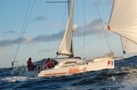
While Ellen lived like a destitute in a portacabin in Hamble, she and Mark sent out hundreds of sponsorship proposals and made scores of presentations. Almost all were unsuccessful, but through stubbornness and persistence they just managed to get her away in the Mini series of the summer of 1997. Racing Le Poisson, she scored two eighth places in the Mini-Fastnet and the Trans-Gascoigne and was 17th in the Mini-Transat itself - a race Mark himself finished in fifth position.
That was the beginning, but there was no certainty that Ellen was on an irreversible upward path. The key decision was what to do next. MacArthur, still just 22, wanted to try and cobble together an Around Alone campaign for 1998, perhaps chartering an old boat. But Mark believed she should go for the less exciting but more attainable 4,000-mile Route du Rhum from St Malo to Guadeloupe.
The big breakthrough was the decision by Sir Geoffrey Mulcahy, the chairman of Kingfisher, and his board, to sponsor Ellen in that race. The idea was that if she did well, the company would consider backing her for a Vendee Globe campaign.
Mark and Ellen got hold of Pete Goss's Open 50 Aqua Quorum for the Route du Rhum and, despite its lack of roller-reefing, Ellen surpassed even her own expectations, winning the Open 50 class and beating several of the Open 60s to finish an extraordinary fifth overall in the monohull fleet.
Her campaign received a certain amount of publicity in Britain but it took off in France where the far more educated public (in sailing terms), took the young English girl to their hearts. With stores and businesses to promote on the continent, Sir Geoff and Kingfisher who were suitably impressed, spotted an opportunity and wrote the cheque shortly afterwards.
It was proper funding too - something like £4 million - which gave Ellen and Mark the money they needed to commission and build a boat and campaign it and her up to the Vendee start. From then on Mark's own experience in sailing and his familiarity with the professional end of the sport in France came into its own as he and Ellen came up with one good decision after another.
They recognised early on that her ambition was nowhere near matched by her experience, so they sent her to school. She raced in various classes including Figaros, Laser 5000s and in Open 60s with Yves Parlier. All the time she was learning and absorbing more and more information, technique and experience.
On the weather routing side, they employed the top French navigator and meteorologist, Jean-Yves Bernot, who talked Ellen through an entire virtual round-the-world race conducted in real time. This was an invaluable exercise which has produced excellent results both in the Vendee and last summer's single-handed transatlantic race.
The boat and the design of it were areas where Mark was again masterful. Instead of going the same route as almost everyone else to the Finot-Conq partnership, Mark recognised he had an unusual skipper on his hands and he looked for an imaginative design response. He and Ellen elected for a team - now the norm in America's Cup syndicates - but one which combined a far wider range of input than one single design office could normally be expected to supply.
There was Rob Humphreys who had not designed an Open 60 before but came with a proven track record in racing keelboats; Merfyn Owen a designer who had been Mike Golding's shore manager and had overseen the construction of the Finot-designed Team Group 4 and knew exactly what had gone into that; Giovanni Belgrano from SP Technologies who brought structural expertise and finally Alain Gautier who supplied a wealth of experience from the racing end.
Together they produced a custom-built and minutely thought-out boat for Ellen. Kingfisher was intentionally slightly less powerful but more manageable than the Finot and Marc Lombard boats and included a range of unique features - the cockpit pedestal for example - designed to help Ellen sail it to its full potential. The boat was intended to be quick upwind, which has turned out to be a shrewd choice, and it has excellent reliability in all its systems - every detail was thought through and if there was any doubt, the kit chosen was on the robust side.
Electing to have Kingfisher built in New Zealand was yet another far-sighted decision, mainly because it required Ellen to sail it home again. She did the first bit, to Cape Horn, back at school with three experienced sailors on board and the second bit on her own. More experience gained and thousands of miles under Kingfisher's keel.
Looking back on all this, and when you combine it with Ellen's unmatched determination and competitiveness, it's not hard to see how the results have come her way.
Most Read
Most Commented
Comments
Businesses
Pro businesses
-
United Kingdom
-
France
-
United Kingdom
-
United Kingdom
Editor's choice
Member blogs
-
 Ned Collier Wakefield: MOD70 round BarbadosWell that was intense. 12 hard fought for seconds for the win. In idyllic conditions, Tony Lawsons MOD ...
 -
 Mini Transat leg 2 reportThe second leg of the Mini Transat started on 31st October, just over a month after ...
 -
Leg 1 reportI’ve been working towards the Mini Transat now for three years. In 2013 I was part ...
Business blogs
-
 The Island Sailing Club in Cowes, Isle of Wight, is delighted that Prince Michael of Kent ...
 -
Peta Stuart-Hunt chats with the 25 year-old British solo sailor Lizzy Foreman before she sets sail ...
-
The 2015 Student Yachting World Cup (SYWoC), an ISAF-recognised event hosted and run by students for ...
Editor's Choice
All time favourites...
-
 Three legs down into Ian Walker’s
 -
 Winning all but two races at
 -
 For the first time in its
Latest Comments
Add a comment - Members log in