
Full Circle for UK big boat racing?
Monday June 4th 2001, Author: Peter Bentley, Location: United Kingdom
 In the years since I last raced from Portsmouth, I have been involved in coaching and writing about one design racing, much of it in the Olympic classes. While I could not honestly say that watching the racing has always been fun, at least most of the time it was possible to work out who was winning. Handicap racing is however another matter and even to the trained eye, it was all but impossible to determine which boat was in which division out in Hayling Bay, never mind who was winning. All I could work out on the water was that each boat had finished when the jib came down and the sandwiches appeared in the cockpit.
It seems those sailing aboard this melee of boats had very little more idea of what was going on until they stepped ashore. One or two crews with a sharp navigator and a keen eye for the boats in front and behind were able to make educated guesses as the their whereabouts in the fleet - but no more. And so far as I could tell, nobody really cared. A huge variety of disparate boats seemed to be racing under a roughly equitable system and there were few, if any, complaints about the fairness of the racing. For the crews it makes good racing. For anyone else it is the anthesis of a spectator friendly event.
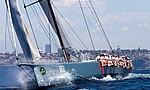
The IRC divisions, supposedly for the massed ranks of the cruiser racer fleet, were as you might expect populated with a rag-tag and bobtail of boats representing every design genre from the overweight old Swans to the latest lightweight fliers. All it seems had a chance of winning if sailed well. The really big question it seemed to me was what were boats like Nokia Communicator doing in amongst the Beneteaus and X-Boats? The answer in the Case of Nokia was clear for all to see. She was winning.
The point is this: IRM has not yet taken off. For sure there were two divisions of IRM boats at the event but in reality the majority were waifs and strays from the one design classes with IC45s taking the top two places. The simple fact as born out by this event is that the majority of owners would rather take their chance with the vagaries of the secret IRC rating system than an even bigger chance with an as yet unproved rule.
So what does the RORC have to do to ensure the success of IRM? Nobody would argue that the boats are not pretty close to the mark for an exciting yet sensible type-form. The cost of commissioning a designer and having a boat built is either pretty sensible or unrealistically extravagant depending on your viewpoint. The stumbling block must be the old problem of nobody wanting to commit until a fleet is established and a few owners buy boats.
Which takes us neatly back to where we came in. Stephen Jones, the ever thoughtful designer of Smiffy, scruffy as ever in the beer-tent after racing offered the best suggestion yet of how the RORC might just kick-start the IRM into the role for which it was intended. His plan, easy in the definition, harder in the execution, is simply for the RORC to think up an event so exciting as to be irresistible to the rest of the world to replace the Admiral’s Cup and race it under IRM handicap. Is it too much to hope that they can kill two birds with one stone?
Most Read
Most Commented
Comments
Businesses
Pro businesses
-
United Kingdom
-
Italy
-
-
Netherlands
Editor's choice
Member blogs
-
 Ned Collier Wakefield: MOD70 round BarbadosWell that was intense. 12 hard fought for seconds for the win. In idyllic conditions, Tony Lawsons MOD ...
 -
 Mini Transat leg 2 reportThe second leg of the Mini Transat started on 31st October, just over a month after ...
 -
Leg 1 reportI’ve been working towards the Mini Transat now for three years. In 2013 I was part ...
Business blogs
-
 The Island Sailing Club in Cowes, Isle of Wight, is delighted that Prince Michael of Kent ...
 -
Peta Stuart-Hunt chats with the 25 year-old British solo sailor Lizzy Foreman before she sets sail ...
-
The 2015 Student Yachting World Cup (SYWoC), an ISAF-recognised event hosted and run by students for ...
Editor's Choice
All time favourites...
-
 Three legs down into Ian Walker’s
 -
 Winning all but two races at
 -
 For the first time in its
Latest Comments
Add a comment - Members log in