
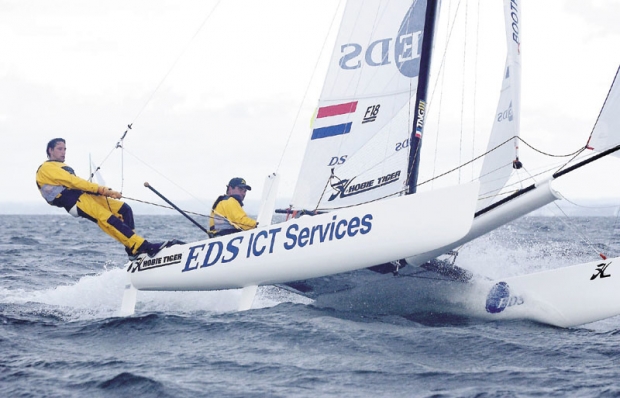
Olympic Tornado duo Mitch Booth and Herbert Dercksen kick butt on a Hobie Tiger
The right Formula
Wednesday July 16th 2003, Author: James Boyd, Location: France
One class that is distinctly on the ascent at the moment is the Formula 18 catamaran. Fleet numbers are swelling all around the world and last year it received ISAF recognition - possibly the fastest this has ever happened in a class' history.
Formula 18 as a rule was originally conceived by French Tornado guru and designer Yves Loday. In the mid-1990s the new fad in cat sailing was spinnakers and all manner of production boats were having the necessary tackle retrofitted from the Tornado to the Hurricane, to the larger Prindles.
Seeing this trend Loday got in early and wrote a rule specifically for three sail catamarans to which most major performance cat builders now work. The rules govern length, beam (8ft 6in), weight (180kg), sail area (main 17sqm, jib 4.15sqm, spinnaker 21sqm) and importantly carbon fibre is banned from both the rig and the hulls to prevent escalating costs. At present for example you can buy a Nacra in the UK for £9,750 including VAT, delivery and tuning, around the same price as a Hobie Tiger.
There are many additional rules governing rig geometry, bowsprit length, but one in particular relates sail area to crew weight.
The above figures are for those with a crew weight of 150kg or more. Crews with an all-up weight of 140kg or less are obliged to use a 19sqm spinnaker and a 3.8m jib, while crews of 140-150kg, use the bigger sails but must sail with correctors equating to 50% for every kilo they are less than 150kg (hence a crew with a combined weight of 142kg would carry 4kg in lead). The result is that F18s are suitable for a variety of crew sizes and weights, don't cost the earth given the performance they offer and due to their conservative minimum weight restriction can be built robustly.
"It has taken off at a pace," claims Don Findlay, the Nacra agent in the UK and Chairman of the F18 UK Class Association. "In the UK we will have an increase this year from 50 to 80 paid-up members and that progress is being made throughout the world.
"The success is due to the fact that eight different manufacturers are pushing the same class, whereas if you look at dinghies or catamarans previously each manufacturer was pushing their own class."
The three main manufacturers in the class, in Europe at least, are the American heavyweights Hobie and Nacra while the French Cirrus cats are a close third. At the Worlds last week the Gold fleet included 23 Hobie Tigers, 15 Nacra F18s, 12 Cirrus, two Hawks and one Diam, while the Silver fleet comprised 18 Tigers, 13 Nacras, six Cirrus, four Hawks, three Dutch-built Hunters, three Mattias from Italy, three Mysteres and one French Alado.
Newcomers into the F18 tend to be those coming from other older cat fleets such as the Dart 18, Hobie 16 and Hobie 18, while interestingly there is only a tiny crossover from monohull sailors into the class.
When we visited the F18 Worlds in Belgium the general impression we got was that the racing was top level as was the social scene, where in the evenings competitors could ply themselves with free Stella and Hoegaarden or even, if really desperate, Campari.
What was particularly impressive was the calibre of some of the entries. This included many of the top Tornado Olympians such as Mitch Booth and Darren Bundock to A-Class World Champion Glen Ashby. Aside from this some unexpected figures included Italian ex-Prada crewman Stefano Rizzi who also sailed with Grant Dalton on The Race and in the Volvo Ocean Race, French Around Alone skipper Thierry Dubois and former Dutch Whitbread skipper and transatlantic beach cat sailor Hans Bouscholte.
Aside from this the bulk of the fleet were good national sailors mainly from France, the UK, Belgium, Holland, Germany and Italy, but with others from Russia, Poland, Australia, South Africa. "It is very nice for club sailors to see how they compare with the experts," says Don Findlay.
At the class meeting that took place at the Worlds their policy on entry to the World Championship was being discussed. Should they keep the present format - where anyone could turn up and after qualifying races, the fleet would be divided into gold and silver fleets or should the culling take place in national qualifiers? British opinion favoured the former.
In terms of events, the 2004 World championship is to be held in Tuscany, while back in the UK the Nationals will be over the Bank Holiday weekend at the end of August, at a joint event alongside the Spitfire, Hobie 16s, Inter 20 and Prindle/Nacra Nationals.
Slightly unusual, perhaps because it is relatively young still is that on the one hand the F18 is nominally a development class, but on the other all the boats being sailed are standard production cats. Thus the class in theory is leaving themselves open to someone stepping in with a well-designed one-off that takes the rule to its limit and could conceivably blow the competition away.
At present people are playing with peripherals such as block systems for downhauls and outhauls. Most mains have gone from being Mylar to Pentax and jibs are going the same way, while kites are going from being built in nylon to impregnated silicone.
Last year's principle development was spinnaker chutes into which the kites are dropped and from which they are hoisted. There seemed to be great variation in systems (see photos below), some using hoops with a sack attached, some using rig fibreglass tubes of differing diameters. In the UK Graham Eeles makes the glassfibre variety while Mark Quaile makes the hoop/bag. Sails can be supplied by the boat distributers, but many owners fit sails from other lofts. Aside from this we didn't get the impression a great deal of tickering or development goes on.
Aside from being blisteringly quick, there seems to be little speed differential between the different latest models, such the Tiger, Nacra and Cirrus, so the racing is tight.
"There's not too much difference in speed," Darren Bundock confirmed to us at the Worlds. "It is a very good class, the Formula 18 concept. There are five or so different types here and they are all completely different looking boats and you get to the top mark and there are five different brands there. So the concept and rules works very well with the all-up weight of 180kg, and the sail sizes, which are obviously the critical factors in making a catamaran go fast."
At the Worlds Bundock was being sponsored by Hobie to sail their Hobie Tiger as were several other top sailors taking part.
The exciting part is that the F18 seems to be showing no sign of plateauing out, which can only be a good thing for cat sailing around the world.
All F18s now have self tacking jib that under class rules must roller furl

Different types of spinnaker chutes - below, the hoop and back

...and the fibreglass tube

Below: the French Cirrus. One of these won the F18 Worlds sailed by the Boulogne brothers

See detailed photos of the unusual hull shape of the Mattia Dynacat 18 on the following two pages

Most Read
Most Commented
Comments
Businesses

Pro businesses
-
-
Italy
-
Italy
-
United Kingdom
Editor's choice
Member blogs
-
 Ned Collier Wakefield: MOD70 round BarbadosWell that was intense. 12 hard fought for seconds for the win. In idyllic conditions, Tony Lawsons MOD ...
 -
 Mini Transat leg 2 reportThe second leg of the Mini Transat started on 31st October, just over a month after ...
 -
Leg 1 reportI’ve been working towards the Mini Transat now for three years. In 2013 I was part ...
Business blogs
-
 The Island Sailing Club in Cowes, Isle of Wight, is delighted that Prince Michael of Kent ...
 -
Peta Stuart-Hunt chats with the 25 year-old British solo sailor Lizzy Foreman before she sets sail ...
-
The 2015 Student Yachting World Cup (SYWoC), an ISAF-recognised event hosted and run by students for ...
Editor's Choice
All time favourites...
-
 Three legs down into Ian Walker’s
 -
 Winning all but two races at
 -
 For the first time in its
Latest Comments
Add a comment - Members log in