
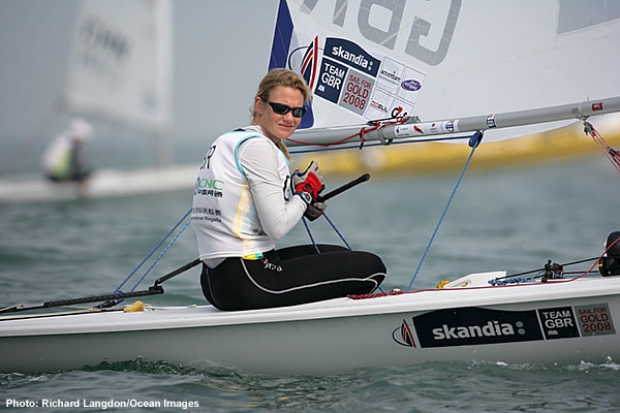
Team GBR's surprise medallist
Wednesday August 30th 2006, Author: James Boyd, Location: United Kingdom
Aside from Ben Ainslie's unprecidented string of bullets in the Finn, the other surprise result for Skandia Team GBR at the Qingdao Olympic test event has been that of British Laser Radial sailor Penny Clark. Currently ranked 34th in the world, Clark went into today's medal race with the knowledge that she would be on the podium whatever the outcome.
"Paige [Railey] is untouchable at the top of the leaderboard, but I’m within four points of second and fourth is pretty much out of reach," Clark told us prior to today's race "So going into the medal race I’m pretty much guaranteed a medal which is really pleasing."
Clark is a product of the RYA's nurturing Youth Squad. Growing out of that in the mid-1990s she moved into the Europe. Clark says she only managed a couple of years in the Europe while she was going through university and was contemplating her Olympic pretentions up until a poor result (a 30th place) at the Worlds in San Francisco in 1997 made her think again. At this time, it should be remembered, she was up against Shirley Robertson who was receiving most of the RYA muscle, ultimately bringing home a Europe Gold medal from Sydney. If your name wasn't Shirley Robertson and you were a British Europe sailor with a keen desire to go to the Games, this was not a good time.
Instead Clark ducked out of her Olympic pretentions and chose to pursue a career in the Royal Navy where she is currently an Engineer Officer based out of HMS Salton in Gosport. It wasn't until the Europe was replaced with the Laser Radial as the women's singlehander for this Olympic cycle that Clark was enticed back. Her first international Olympic classes event was the Princess Sofia Trophy in Palma last year where she scored a promising 7th. Her results after this were lacklustre, but then at this point Clark was not sailing full time.
Unlike the rest of the Team GBR's Olympic squad Clark is in the unique position of having a job to go back after the Olympics if she makes it there. "This year the Royal Navy have been pretty flexible, and they have allowing me time off to do the events and key training with the arrangement that if I start to produce some results at the end of the year then they’d look into giving me a full two years off," she explains. "Fortunately getting bronze at the Europeans was the ticket to that. So they have now agreed to give me two years leave and keep my job open at the end of it and allow me to go full time sailing - which is fantastic."
After a series of mid-fleet placings earlier this year at Princess Sofia and Hyeres suddenly Clark came third at the Laser Radial Europeans and followed this up with a second place at Holland Regatta. So what has made the difference? "I did a little bit last year and worked as hard as I could over the winter," says Clark. "And it has been a case of getting some race experience in and getting a full racing season under my belt that has finally allowed me to come through and start producing the results. I hope that transitioning now to being a full time sailor, I’ll be able to start converting the silvers and bronzes into the right colour."

Clark's training has been with Laser guru Ian Clingan who coaches the Skandia Team GBR Laser Radial squad. "It has been fantastic because there has been six of the girls in the squad all working together," enthuses Clark. "We have all got our own strengths and weaknesses - I think we’ve got at least one person in any given conditions, who is within the top 10 in the world. It is fantastic to train in a squad that is that strong. My intention is to keep training with that squad over the next 12 months to two years to make sure I have the best chance at the Games."
Part of the reason for Clark's success in Qingdao is that she admits her strength is in light wind sailing - both the Europeans and this week's test event have been held in such conditions. Downwind in 18-20 knots plus, she says, she still needs to work on. While being a light wind specialist may provide her with good results in Qingdao it should be remembered that next year's ISAF multiple World Championship in Cascais is likely to be in substantially more breeze and so is unlikely to be indicative of what will go on at the Games themselves come 2008.
Qingdao is also highly tidal and Clark says she has felt at home with this - based in Lee-on-Solent, her regular training ground is the Solent.
In the light winds knowing the intricacies of the current is as important as knowing what the wind might do. "It varies from day to day," says Clark of the Fushan Bay current. "If it is in a certain direction it can be a normal day’s sailing. But once you get the current coming across the course that throws a few extra factors into the racing. I definitely think that having been sailing on the Solent for the last few years that’s helped me quite a lot with that."
More races have been stopped this week due to the tide that the lack of wind and this is why over eight days they only just managed to squeeze 10 races in. "If we miss the slot where the tide is at its slackest then we have a real problem getting over the tide in the light winds. We’ve lost a couple of races due to not getting to the windward mark in time or not being able to get over the start line. So it has played a major factor here."
The range in Qingdao is over 2m and on some courses the water has been moving at more than 2 knots. "When you are only sailing in 6 knots of breeze in a Radial that’s pretty challenging!" says Clark.
While the degree of research Skandia Team GBR puts into aspect like this is top secret, one can imagie that they have carried out their own survey in addition to pouring over the available data from the locals. "The Chinese are pretty strict on what you can and can’t do," continues Clark. "So throughout the event there has been no use of GPS or anything like that to try and make any tidal surveys that you’d normally do during an event. So from that point of view it has been really interesting - it has been down to the competitors to make their own observations as they sail around the course and figure out what is going on out there."
One aspect of racing in Qingdao that the Solent doesn't offer on so regular a basis has been the fog. "At the beginning of the event it was fairly clear skies but still predominantly light winds. The last couple of days the fog has come in and visibility has typically been down to half a mile, so we can just about see the windward mark and that’s about it. So pretty interesting racing!" Clark says.
Despite the fog, light wind and strong tide, Clark says the races they have got in have not been lotteries. "I would say that all 10 of our races have been fair, viable races. They have all been in less than 10 knots of breeze but they have all been fair. Certainly I came out here expecting a large proportion of those races to be a little bit of a lottery. So I have been quite surprised at how far the racing it."
To get around these issues the race organisers have been setting very short courses. "We haven’t had a single leg longer than a nautical mile. So that is a lot smaller than normal and that is purely for the allowance of the tide," she says. "Either upwind or downwind suddenly starts taking a lot longer. Other than that it has been pretty good racing out here."
As for the new Olympic format where racing in each class culminates in a double scoring Medal Race for the top 10, Clark says this hasn't made as much difference as having only one discard. "You’ve had to sail really conservatively all the way through the main part of the event with the aim of getting to the Medal Race in as good a shape as possible. This time it has worked out quite nicely that the three medallist have put themselves into the best positions so now it is just colours between bronze and silver that are yet to be decided. Generally I think it is a pretty good format: to get the medal race in there from a spectators’ point of view. Most of us competitors are pretty much enjoying it and relishing the challenges it is going to throw up with that final one race."
Clark says she sailed in the medal race at Holland Regatta and went into it in second position and came out in silver.
Aside from Clark's showing in Qingdao, the other surprise in the Radial class has been the return to form of American starlette and race favourite Paige Railey. "Paige has sailed a very good event, very consistent all week, which has been pretty impressive after the Worlds in LA, for her to pick herself and have such a good series," says Clark.
This is Clark's first time to Qingdao and she says she is impressed with the facilities the Chinese organisers have set up. "From a shoreside point of view it is a fantastic venue. The Chinese have done a really really good job with the marina, the shore facilities and launching facilities. Obviously it is going to be predominantly a light wind venue out here but they seem to be putting everything in place to maximise the racing opportunity. And they understand the tide and when it is good to race. So come 2008 I think it will be a really good event which might surprise a few people. I think a few people have been expecting it to turn into a lottery."
From here Clark gets to have some time off before the next big fixture - the Sail For Gold regatta in Weymouth in October. This is followed by three Laser Radial qualifier events to determine who gets to go to the Worlds next year in Cascais. At present it is uncertain how many Laser Radial spots will be available per country for this but they are hoping for six so that all of the Skandia Team GBR squad get the opportunity to go.
Most Read
Most Commented
Comments
Businesses

Pro businesses
-
-
United Kingdom
-
Italy
-
France
Editor's choice
Member blogs
-
 Ned Collier Wakefield: MOD70 round BarbadosWell that was intense. 12 hard fought for seconds for the win. In idyllic conditions, Tony Lawsons MOD ...
-
 Mini Transat leg 2 reportThe second leg of the Mini Transat started on 31st October, just over a month after ...
-
Leg 1 reportI’ve been working towards the Mini Transat now for three years. In 2013 I was part ...
Business blogs
-
 The Island Sailing Club in Cowes, Isle of Wight, is delighted that Prince Michael of Kent ...
-
Peta Stuart-Hunt chats with the 25 year-old British solo sailor Lizzy Foreman before she sets sail ...
-
The 2015 Student Yachting World Cup (SYWoC), an ISAF-recognised event hosted and run by students for ...
Editor's Choice
All time favourites...
-
 Three legs down into Ian Walker’s
-
 Winning all but two races at
-
 For the first time in its
Latest Comments
Add a comment - Members log in