
Handicap racing
Thursday January 10th 2008, Author: Toby Heppell, Location: United Kingdom
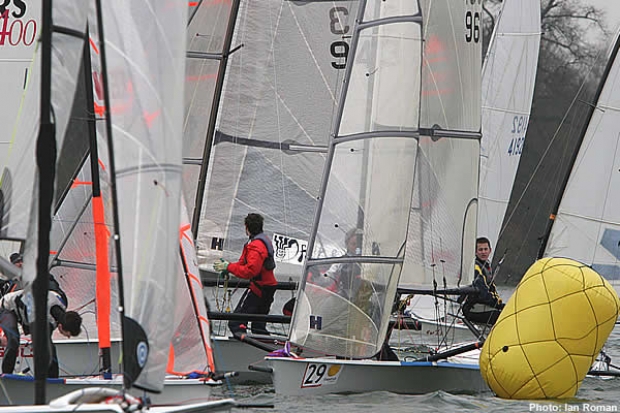
During the winter in the UK a large number of handicap and pursuit races take place throughout the country and are entered on a massive scale. Two of the best known, the Bloody Mary and the Tiger Trophy, both regularly see 100-200 boats competing from a wide variety of classes. The biggest events often attract a number of top names and there is a great deal of prestige attached to winning. But how does one go about taking victory in odd weather, in the middle of winter, on inland venues sailing to handicaps?
Perhaps the first and most obvious point to note is there is a massive difference in technique between an event such as the Tiger Trophy where sailing takes place in an all in handicap format – albeit split into a fast and slow start – and the Bloody Mary where racing takes place in a pursuit race format. Many principles are the same, but some are exasperated by the variation in formats.
Pre-Event:
Preparation before any big handicap event can start well before race start, even before travelling to the venue. The one thing that can arguably play the biggest part in the results are the conditions at the venue. Having an accurate forecast is vital as it enables competitors to start making some realistic goals and also start preparing your race strategy.
The handicap system in the UK is Portsmouth Yardstick (PY), where clubs return their race results and handicaps are created adjusted accordingly. As these handicaps are an average of race results throughout the year, there will always be some classes that sail faster than their given handicap in certain conditions, as multiple Bloody Mary winner, Chips Howarth explains: “The modern classes, such as the 49er and the International 14 with the T-foil, are going to stand a great chance of winning as soon as they are planing upwind as then the PY system is not good enough. The speed differential between going slowly and at full chat is huge in those boats. It is almost like you need to have a graded PY system that once it is over about 12 knots they get more heavily penalised. The reality, though, is we are not able to have such a complex system so those boats have a huge advantage above that wind strength.”

Above: An International 14 in top end conditions.
Of course sailing a boat that over-performs in windier weather is always going to have its disadvantages, the flipside being as soon as it is not windy enough for these boats to be powered up they tend to be extremely slow. With this in mind then, what is the best boat for handicap events and pursuits? “I suppose if you really want to win you need to have different boat options and check the forecast before you go,” confides Howarth. “I think in light winds a Merlin Rocket is probably pretty hard to beat as they have gone through a huge amount of development and yet their handicap never seems to be corrected. In medium conditions, about 11-20 knots, an International 14 or 49er is going to do well and anything over 20 knots you would have to say a Fireball.”

Above: A Merlin Rocket showing pace downwind.
Of course there are only a tiny number of sailors in the country who own, let alone are competitive enough in, this wide variety of classes, so this is generally not an option. However for those pitching up at these events, it does give a reasonable idea of what kind of chance they stand. Essentially, the rule of thumb is the bigger the sails - and so usually the faster the boat - the better chance there is of winning as sailing in dirty air is less of an issue. “I would say the faster the better,” confirms Howarth. “In general I would say the faster boats win pursuit or handicap races. I think if you did an average over so many years of racing it is reasonably clear that faster boats have generally won.”
Pursuit Racing:
Pursuit racing can be one of the most exciting forms of handicap racing with all the classes, theoretically vying for the lead in the closing minutes of the race. Of course the finish is rarely like this with the race more often than not being decided in the last few minutes between one of a handful of boats. Still, it offers an instant idea of who has won and also provides a great spectacle.
Winning or losing a pursuit race is, in many ways a lot more out of the competitors’ control than handicap racing. Firstly the rolling start times means changes in wind direction and strength can have a dramatic effect on the results. “In terms of the wind it is a bit of a leap of faith to be honest,” explains Laser Radial sailor and Grafham Grand Prix runner up, Jon Emmett. “Often you find the best wind is around midday and so the class that starts around midday will always tend to have a bit of an advantage. It is like the traditional Wednesday evening pursuit races at a variety of home clubs – in those you want to be one of the first to hit the water before all the wind disappears.”
Another major factor on one’s performance in a pursuit race can also be the size of the fleet. “I think you are already materially prejudiced if you are in a popular class,” comments Emmett. “That is the main issue with pursuit racing for me: if you are in a big fleet it is going to be harder to get a good start and that makes life more difficult for you from the off. Someone with only one or two boats in his class just does not have that problem. Also when you have a large fleet of Toppers, for example, they will sail a much further distance and slow each other down a lot more on the first lap because they are all fighting with each other that much more.”
Clearly having the run of the whole start-line and the course early on is bound to provide an advantage straight from the outset. However, it is not quite as simple as the smaller the fleet, the better you do. “I remember a few years ago being at the Bloody Mary and the 420 fleet was massive,” recalls Howarth. “What it is good for, is when you have a big fleet like the 420s – which are just big enough so other boats cannot simply sail through their wind shadow – if you are winning your class, the rest of your fleet is acting as a blocker and stopping anyone overtaking you,”

Above: 420s, notoriously slow in light air.
With all of this in mind it is easy to think there is no point in turning up to an event if the forecast is not right for you. Again, this is not always the case. “There are definitely days when you turn up and you think it is not my weather,” Howarth confirms. “I first won the Bloody Mary back in 1990 in a GP14 in very light winds of around ten knots. I remember Steve Irish came second or third in a 420. They are notoriously slow in light winds but he just sailed well, kept his nose out of trouble and managed to sort of sail round the big rafts.”
Handicap Racing:
To some extent handicap racing requires a great deal more active tactics than pursuit racing. The main difficulty here, as is typical of fleet racing, is always going to be in the earliest part of the race. One of the greatest difficulties will almost certainly be the start with a 100 or more boats vyin for positions. But there are added complications as well the sheer numbers.
Principally most will be looking out for the boats that are likely to cause them the most bother immediately after the start gun – for example boats with large sail areas or boats that are particularly fast. “If it is an all-in handicap start the most important thing to look for is a clear wind lane where we are going to avoid the boats that will cause wind shadow problems,” explains Grafham Grand Prix runner up and B14 sailor, Mark Barnes. This is the case even in a relatively quick boat such as the B14. “We have a small rig relative to some boats, which works very efficiently, but it does mean we can have a lot of problems with the likes of 49ers and RS800s, so we have to be wary of where they are.”

Above: The B14 is increasingly being seen as a light wind boat.
While getting off the start line is always going to be tough, the hardest part of the race probably comes in the first few minutes of the first upwind leg. Here, the difference between having undisturbed air and sailing in dirty air can often be the difference between winning and losing. “Compared to class racing, again, the most important thing for us is to look for wind lanes,” continues Barnes. “What we tend to do is keep a good view of what is coming up behind, people we potentially out-performed up the first beat and slower boats that we are hoping to catch. We try to stay inside the extreme areas and so downwind we will often put in seven or eight gybes. Sometimes if we feel threatened by someone we will gybe into a position where they will be forced to gybe away and then we gybe back and take the route that we wanted to take.”
This tactic of keeping clear air at almost any cost is a well established one in big handicap races and such is the nature of this type of racing means the class of boat one sails is less important than in a pursuit. “Even in a really uncompetitive boat in the worst conditions if you are very slick and stay out of trouble it is amazing how well you can do,” comments Howarth.

Although to a large degree results in these races will always be dictated by the weather and class of boat, handicap racing can still be a great deal of fun. For most the major UK events are just a great way to blow off the winter cobwebs and enjoy a catch-up with friends you have not seen since the previous summer. However, actually setting out to win or do well at a big handicap event can be a very rewarding challenge. Few would argue that seeing 200 boats of all different classes behind you for even the briefest of moments is extremely exhilarating. Just remember keep your nose clean and your wind clear and you stand as good a chance of victory as anyone, with the possible exception of that chap with the Merlin, the International 14 and the Fireball.
Events:
Bloody Mary - 12 Jan - Pursuit Race - Queen Mary SC
Steve Nicholson Memorial Trophy - 26-27 Jan - Handicap in three fleets Northampton SC
Tiger Trophy - 2-3 Feb - Handicap in two fleets - Rutland SC
Hoo Freezer - 9 March - Handicap in three fleets - Hoo Ness YC
Most Read
Most Commented
Comments
Businesses

Pro businesses
Editor's choice
Member blogs
-
 Ned Collier Wakefield: MOD70 round BarbadosWell that was intense. 12 hard fought for seconds for the win. In idyllic conditions, Tony Lawsons MOD ...
 -
 Mini Transat leg 2 reportThe second leg of the Mini Transat started on 31st October, just over a month after ...
 -
Leg 1 reportI’ve been working towards the Mini Transat now for three years. In 2013 I was part ...
Business blogs
-
 The Island Sailing Club in Cowes, Isle of Wight, is delighted that Prince Michael of Kent ...
 -
Peta Stuart-Hunt chats with the 25 year-old British solo sailor Lizzy Foreman before she sets sail ...
-
The 2015 Student Yachting World Cup (SYWoC), an ISAF-recognised event hosted and run by students for ...
Editor's Choice
All time favourites...
-
 Three legs down into Ian Walker’s
 -
 Winning all but two races at
 -
 For the first time in its
Latest Comments
Add a comment - Members log in