
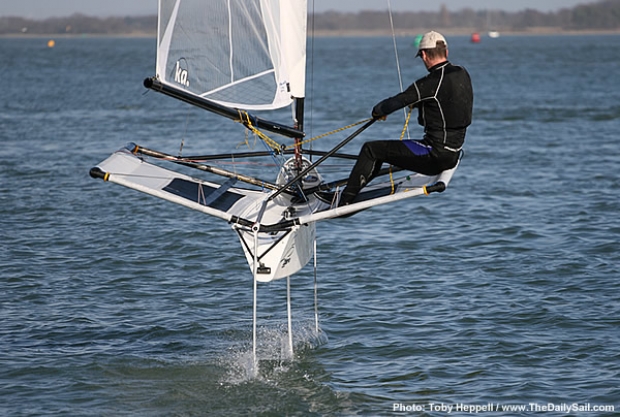
Flying higher, sailing faster
Thursday February 28th 2008, Author: Toby Heppell, Location: United Kingdom
It is a busy time for Moth European and ex-World Champion Simon Payne. His new Prowler Zero arrived from Australia at the end of last week, just in time to be picked up and taken straight to Parkstone Yacht Club for the first UK International Moth Open Meeting of the season. He will put in a few hours on the water this week before taking the boat to the Dinghy Exhibition where he is to give a talk on foiling.
We caught up with Payne early this week sitting next to his new baby in Hayling Island Sailing Club boat park, awaiting our arrival and looking apprehensively out on a glassy, calm sea. As we approach him, Payne is looking every bit the modern, more serious Moth sailor with a Fastacraft t-shirt and Ka Sails hat. A significant change from the days when an epoxy covered event t-shirt and dirty jeans were the telltale signs of a top development class sailor.
In fact Payne does not just look more serious about his mothing these days, he is considerably more professional across the board. “A few years ago I was considering giving up sailing and concentrating on the day job,” he explains to is as we sit in the bar waiting for the wind. “Now it is the opposite way around.” The top Moth sailor explains how he has recently given up his job at Musto and is in the process of starting up his own company. This is all in the hope of having a bit more control over his work/life balance or as he puts it: “I was sick and tired of sitting on the motorway everyday.”

With work/life balance now firmly focussing on the life element Paye is able to not only sail on the weekends but also hit the water during the week. This extra on-the-water time is supplemented by time down at the gym, although he does not seem to be the most enthusiastic gym user and holds a special hatred for the rowing machine in particular. “I guess I always feel a bit angry that I have put all that effort in but have not gone anywhere,” he quips. In addition to this gym-time and sailing-time Payne has recently joined the blogging world, amusing readers with his observations of gym life and inspiring jealousy with his weekly sails.
Of course much of this ‘new life’ comes about from a desire to win back the world championship title - which he won in 2006 but lost again in 2007 - when the event comes to Weymouth this year. Payne admits he was probably not fit enough or well prepared enough for the event in Italy last year. He adds that as much as anything he felt psychologically as though he was struggling, a feeling which can only get worse as a championship progresses.
It is certainly interesting to note the more professional attitude throughout the Moth fleet as a whole. Last season Rohan Veal was the talk of the Moth world with his new job for Bladerider International and with a full time coach. Perhaps unsurprisingly for some Veal won the worlds by a country mile in Italy and one has to wonder if Payne is, in part reacting to this. “If you want to win, you have to have a lifestyle that allows you to sail weekends and during the week these days,” Payne retorts. Unfortunately Veal has confirmed on his blog this week he will not be attending the World Championships in Weymouth this year and indeed is retiring from Moth sailing all together for the time being. Payne seems disappointed by this news and we feel he was looking forward to heading out once again against the big competition from the southern hemisphere.
As previously mentioned, last year at the Moth World Championship Veal cruised to victory in his Bladerider Moth and it seemed as though the rest of the fleet had a great deal of catching up to do. To this end we were very excited about seeing Payne’s new Fastacraft boat which he had been out to Australia to sail last month, before it was bought back to the UK.
At first glance there is little change in this boat compared to his old one. In fact it looks almost identical to the Fastacraft boat Payne had at the Worlds last year. However he explains that creating a worlds winning boat is “as much about restricting development to within practical limits as anything else.”
However, this new craft does hold a few interesting changes from the old boat and some outright innovations. Sitting over most of the centreboard case is a black carbon box a little under a foot long and two inches wide. Payne explains: “The F Box [Fastacraft’s name for the mechanism] lets you cant the main foil forwards by one degree or backwards by two degrees from neutral.” Given the asymmetric nature of the foils it is not hard to see the benefit of this. “As the boat goes faster the foils create more lift so in the windy weather you are constantly having to sail with a bit of flap up which creates drag.” In theory, then, this box should allow the sailor to cant the foil back in windy weather, creating less drag and allow it to be pushed forward in the light winds enabling the boat to foil earlier.

The effectiveness or otherwise of this box is still to be seen, but Payne seems mostly convinced by it and we also note that it looks reasonably easy to remove if it is causing problems. The F-Box is an optional extra on the new Fastacraft and so far only Payne in the UK and Scott Babbage in Australia are using them.
The F-Box is certainly the biggest innovation on Payne’s new boat, but elsewhere there have been other changes. There is a new, flap-less rudder, similar to the Bladerider, where the rudder pin cants to change the angle of attack of the whole rudder. This is clearly the way everyone is heading and the Bladerider design has certainly led the field in proving the change to be fast and effective.

Elsewhere there are a number of tiny differences that add up to an extremely sorted boat. The wand mechanism on the bow has two bearings on it, allowing the wand to be bolted extremely tightly onto the bow, without creating too much friction for the system to work effectively. Also on the bow, 100mm has been taken out of the stem. “With the boat spending so much time in the air there is little need for it now. Plus taking 100 mm off reduces windage and means the boat can be lighter,” Payne explains.

When we press Payne on the overall weight of this hull he reveals this is where its second secret lies. “I was kindly given some really high grade carbon by Advanced Composites,” he explains. This means the boat was built exceptionally light and, presumably, for a fraction of the cost with the very expensive carbon coming free. “It is about the same as all the other boats in the middle but the ends are very light. It is
right on the limit, but there is no reason it shouldn’t be just as strong as all the others,” he says with an air of optimism. The new boat is just over the 8 kg mark, without the rig, probably as light as we are likely to see in the next few years.
Obviously getting a boat from Australia one day and competing the next is far from ideal and Payne did have a few teething problems at the open meeting last weekend. Specifically his control wand was a little too flexible and was pushing underneath the boat, disturbing the water around his foils. “It was a lot like driving a car with slick tyres on ice,” Payne said of the first day. A bit of tank testing in the bath and he was up at the front of the fleet the next day, winning the final race - a promising performance.
A glance out of the bar window revealed a very light breeze filling in on the water. The anemometer in the club announced a steady six knot breeze and Payne announced it was time to hit the water. A short while later he was cranking the main foil forwards into the light wind setting, threading his sail onto his mast - a Ka MSL10B designed for lighter sailors or heavy winds (though he is also trialing a new Fastacraft sail) and it was into the water.
We stood for a while watching Payne foiling around in what was probably a solid eight knots by now. It is hard to make any real judgements without other boats there for comparison. He certainly seemed to be quick onto the foils in the light winds and the boat was shifting, but whether that is the mark of a world champion, a super quick boat or both remains to be seen.
More photos on the following page...

Most Read
Most Commented
Comments
Businesses

Pro businesses
-
-
-
Italy
-
United Kingdom
Editor's choice
Member blogs
-
 Ned Collier Wakefield: MOD70 round BarbadosWell that was intense. 12 hard fought for seconds for the win. In idyllic conditions, Tony Lawsons MOD ...
 -
 Mini Transat leg 2 reportThe second leg of the Mini Transat started on 31st October, just over a month after ...
 -
Leg 1 reportI’ve been working towards the Mini Transat now for three years. In 2013 I was part ...
Business blogs
-
 The Island Sailing Club in Cowes, Isle of Wight, is delighted that Prince Michael of Kent ...
 -
Peta Stuart-Hunt chats with the 25 year-old British solo sailor Lizzy Foreman before she sets sail ...
-
The 2015 Student Yachting World Cup (SYWoC), an ISAF-recognised event hosted and run by students for ...
Editor's Choice
All time favourites...
-
 Three legs down into Ian Walker’s
 -
 Winning all but two races at
 -
 For the first time in its
Latest Comments
Add a comment - Members log in