
200% stiffer?
Thursday March 20th 2008, Author: Toby Heppell, Location: United Kingdom
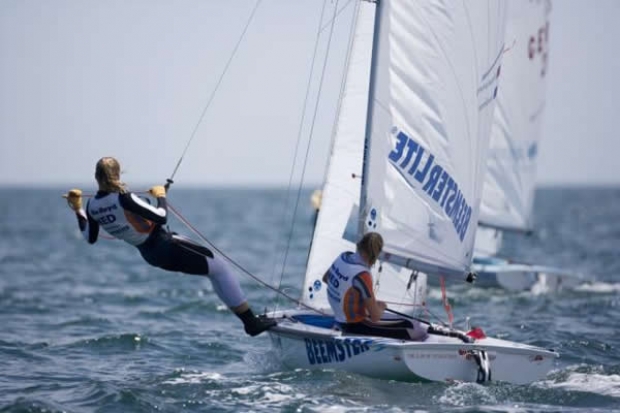
This week at the Princess Sofia Trophy in Palma, Dutch three time 470 Women’s World Champions, Marcelien De Koning and Lobke Berkhout, are sailing a brand new 470, as are team-mates Sven and Calle Coster. Given this is an Olympic year this is hardly surprising. The new boat is referred to in a recent Dutch Sailing Federation Press Release as the ‘DSM 470’.
According to the Dutch Sailing Federation this new 470 is actually similar to a Nautivela hull, coming from a mould made at that factory. “It is a Nautivela-certified mould. It is a certified hull,” comments the Federation’s Simon Keijzer. “It comes from an existing mould and it was used to build the boat at a certified and licensed builder.” However, the boat is still new and original in that DSM – more on them later – were brought in to improve the manufacturing process. “DSM is a building team. So basically the boat was built at the location of Nautivela and has been developed in cooperation between DSM and Nautivela and of course the Olympic teams that are to sail with it,” explains Krystal Van Haaren, Marketing Communications Manager at DSM Composite Resins.
So exactly who are DSM? “DSM stands for Dutch State Mines as they used to be a coal mining company,” Keijzer comments. “That was many years ago now and they evolved into being a company that very much specialised in chemical solutions, fibres, ropes and materials. So DSM produce an awful lot of stuff: the ropes we use, the sails we use, the resin for the moulds and the fibre to build it is all from their factory. So without them then we would not be able to make the boat.” In fact DSM is a giant company that works with a significant portion of the European boatbuilding industry. The company also backs the Dutch Olympic Committee and the Olympic 470 teams individually.

‘New’ is perhaps an interesting concept in terms of this specific design. Certainly it is not the same as other Nautivela hulls that have recently been sold, although the shape is exactly the same. “The Nautivela mould was the basic shape used for the boat and it has not been changed,” confirms Van Haaren.
So while the shape is the same, obviously the new aspect of the DSM 470 is its engineering and construction. DSM claims their new boat is stiffer and lighter than anything that has gone before it. In fact DSM suggests that through improvements they have made, the boat is 125% more rigid, 200% stronger and 2.5% lighter - a significant gain in anyone’s books. Of course this is taking the company’s word for it and short of doing ones own flex tests on the boat it is hard to know how true this might be. Certainly as most will appreciate there is often a significant difference between what can be expected by a material and what may actually be achieved once a hull has been built and being used. It reamins to be seen exactly how much stiffer this new boat may be in pratice - we suspect less than 200% - but certainly, where stiffness is concered, any increase is a good increase.
Such a percentage increase in things such as the stiffness of a hull is clearly going to be hard to achieve, particularly in a boat as refined as a 470. So how did DSM and Nautivela manage it? “We used a special combination of glass fiber from the Euroresins Distribution Group together with a specially developed resin which was then added to build up the Polyester laminate,” explains Van Haaren. “We then used a new way of laying up and this is what makes the hull very stiff and strong. The important thing is the resin and the way the layers are made up.”
In addition a new gelcoat was used which is the part of the process responsible for weight saving. The gelcoat is called Neogel Eco and contains 25% less styrene content than conventional gelcoat formulations. “The gelcoat is an interesting product as it has very low chemical emissions in the workshop environment and is therefore cleaner and safer to work with. It is also very good from a sustainability background,” states Van Haaren, adding that this also increases yield as the styrene evaporation is reduced, leading to less material usage.

Interestingly, although the boat has been developed alongside the Dutch 470 sailors and Dutch Sailing Federation, using advances by a Dutch Company – DSM – the boat is available for purchase by anyone. “The development and the materials have been made by DSM but in cooperation with Nautivela so anybody can buy it,” continues Van Haaren. “They can make exactly the same boat for you or other Olympic teams. Of course the thing is other teams will not switch this close to the Olympics, so I do not see that as a problem for the Dutch Olympic sailors. It is open for everybody.”
Van Haaren is right in her assumption that there is little chance teams heading for Qingdao will go to go out and buy a new boat with so little time left until the games themselves. “If you change one thing then you have to change everything else as well. If the boat is stiffer then you might use a different rig tension which might mean a different rig and different sails etc,” Keijzer explains.
De Koning, Berkhout and the Costers, however, have been sailing with a prototype version of this hull for the last 12 months and have also been involved with the boat from early in the project. In fact as well as the boat being a product of Nautivela and DSM it is also a product of the Dutch 470 sailors and coaches such as Jacco Koops,the Dutch 470 Coach, and Australian Daniel Smith his assistant coach, whose specialty is materials, gear, rigs and boats etc.
With all this new technology the Dutch team are obviously hoping the boat will have a significantly increased performance, specifically in China where stiffness in the choppy waters may well be a significant benefit. Obviously seeing as the boat is so new it is difficult realistically to make any statement on this relative to other 470s or even the standard Nautivela 470s. However, it is being used in Palma this week by both the female and male Dutch 470 teams and at the time of going to press both were in third position overall. Given these are highly experienced teams this does not necessarily show an increased speed advantage, but clearly the boat is not slow either. The new hull was also used at the Sydney International Regatta late last year where the Dutch male and female teams sailing it were third and an uncharacteristically low 16th respectively.
However, at the moment there is definitely one shining endorsement of the Nautivela/DSM boat. “The girls have decided that they would like to use it at the Olympics, but the boys are still thinking about it,” explains Keijzer. But while Sven and Calle Coster are still making up their minds, De Koning and Berkhout’s seal of approval is significant and would probably be enough for most.
Most Read
Most Commented
Comments
Businesses

Pro businesses
-
Netherlands
-
United Kingdom
-
-
France
Editor's choice
Member blogs
-
 Ned Collier Wakefield: MOD70 round BarbadosWell that was intense. 12 hard fought for seconds for the win. In idyllic conditions, Tony Lawsons MOD ...
 -
 Mini Transat leg 2 reportThe second leg of the Mini Transat started on 31st October, just over a month after ...
 -
Leg 1 reportI’ve been working towards the Mini Transat now for three years. In 2013 I was part ...
Business blogs
-
 The Island Sailing Club in Cowes, Isle of Wight, is delighted that Prince Michael of Kent ...
 -
Peta Stuart-Hunt chats with the 25 year-old British solo sailor Lizzy Foreman before she sets sail ...
-
The 2015 Student Yachting World Cup (SYWoC), an ISAF-recognised event hosted and run by students for ...
Editor's Choice
All time favourites...
-
 Three legs down into Ian Walker’s
 -
 Winning all but two races at
 -
 For the first time in its
Latest Comments
Add a comment - Members log in