
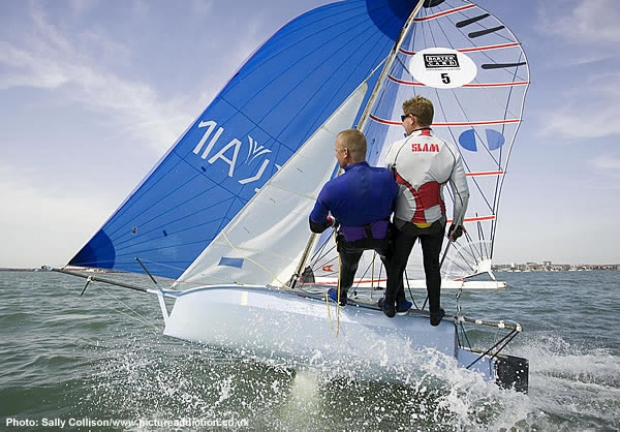
Developing dinghies
Friday April 4th 2008, Author: Toby Heppell, Location: United Kingdom
While the 12ft Skiff class has long been popular in Australia, the spiritual home of Skiff sailing and New Zealand, recently a small fleet of boats has been brought to the UK hoping to build a genuine class here.
Being a, more or less, unlimited development class, changes are always underway, making the 12 footers one of the most exciting classes to watch from a technical standpointThe class’ premier event down under is the annual 12ft Skiff Interdominions – a competition between the Australian 12s and the New Zealanders – which took place recently in Auckland. This event provided an opportunity to see what the latest thinking is in terms of development.
Long time New Zealand 12 sailor, Tim Bartlett describes the latest offerings at the latest event: “There have been a couple of new boats in 2007, one of which belongs to a guy called Hamish Hey who is our current National Champion. I guess you would say it is much more like the 14ft Skiffs in that its sides are much squarer or more upright. To get the width that the boats need, he has had to add carbon racks.” . Most 12ft Skiffs do not use racks, instead favouring a hull that flares dramatically above the waterline to provide the leverage required to manage the huge rig.
Bartlett himself also has a fairly recent boat which has some interesting quirks. “Our boat is pretty original too. It was designed by a guy called Dan Leach in Christchurch and it was an R-Class hull originally which is a 12’9” design that he shortened. The chine is flat and probably about 70mm wide and is angled down by about 20 degrees at the stern and goes down to nothing at the bow. It also rotates to horizontal.” The idea behind this, Bartlett explains, is that as water does not travel straight down the centreline, but moves outward as well, this encourages the chine to generate lift. This, in turn, means you can make the boat narrower. Evidently, although the design has been going quickly, the narrow nature of the boat means that it is extremely unstable.
There are a fairly limited number of 12ft Skiff builders and this makes it difficult for boats to be exported overseas. However at the Interdominions this year two representatives from the UK fleet - UK Class Chairman Alan Atterbury and his crew Bob Clements - flew out to Auckland firstly to compete in the event but also to hunt for some new boats to bring back.

Above: Two of the newley imported UK 12ft Skiffs.
“We went over to New Zealand to do the Interdominions at Christmas and while we were over there it seemed to make sense to buy some more boats and ship them back,” explains Atterbury. “So while we were organising our trip we basically organised the purchase of these three boats from New Zealand and having finished the competition we put them in the container.” With the 12ft skiff being an all-but-unlimited development class every boat comes with a surprising amount of kit. Atterbury continues: “It is amazing how quickly a 40ft container fills up with three 12s. There are three hulls, one trailer, six bow sprits, 12 masts and 36 sails.”
Being a relatively small class, even in the southern hemisphere, the hull developments over the last year have really only been limited to the two designs [what designs????] Bartlett previously mentioned. He points out the major speed differences do not seem to be coming as much from the hulls as they are from the rigs, where more design tweaking is taking place. This being the most active area of development, it is perhaps of little surprise that many of the top boats have three or four rigs. “Most people out there these days have got three different masts and most of them will have a number four main which they hang off the smallest mast,” explains Barlett. “Typically people are sailing around with about an 8.5m, a 7.5m and a 6m mast or something around that. The number four mains can go up to anything around 30 knots and are only really bought out in very, very big winds.”
Although as Bartlett points out there is some consensus on a general sizes of the rigs being used, there are some who go for something a little bit different. “One of the heaviest crews [at the Interdominions] had a zero rig which was nine metres tall,” comments Atterbury. “In fact the newest boat we bought back from New Zealand has an A-Class [catamaran] mast on it. That is a nine metre over-rotating wingmast.”
Recently we have seen the 18ft Skiffs in Australia heading towards more and more square-top rigs, with the newest generation of mainsails actually extending diagonally upwards away from the mast. This square-top route is something we are seeing more and more in a wide variety of development classes and sure enough this is also the case in the 12s. “The bigger mains have had the really large roaches for a few years now,” Bartlett comments. “The latest generations are going down the square top route, which is obviously very popular on other boats around the world. Basically those sails have a very straight leech so the sail comes straight off the head of the mast, goes straight across and straight down. A number of people are also putting a bit of a hollow in that leech to try and encourage the head to twist off very quickly. Also with that it seems to require less vang tension to keep the leech tight.”

Development in rigs, however, is far from limited strictly to mainsail shape with a number of other bits of equipment evolving over the years. “Moving to carbon masts a while ago was a biggie but what you see now is the masts just getting smaller and lighter,” Bartlett continues “Our mast is a 50mm diameter high modulus carbon tube. I can’t remember what it weighs but it is getting to the stage where you can’t use wire shrouds anymore as it weighs more than the mast. The top guys are all switching to PBO rigging at the moment and that is probably something we will see filter down over the next year or so.”
With all this talk of high modulus carbon masts and PBO rigging the cost of this equipment is getting extremely expensive,especially given that most teams have at least four sets of sails/rigs. Bartlett confirms that 12 sailing can indeed be a pricey business. “It will cost you probably NZL$40,000 (around £15,300) for a new one with all the rigs and that sort of thing. You can buy a good secondhand one for about NZL$15,000 (around £5700). We feel for the amount of boat you are getting this probably a decent price, however, it is still a lot of money for a 12ft boat.”
Clearly the price of the boats along with the skill required to sail them are the limiting factors when it comes to numbers on the water. According to Bartlett this is indeed the case and adds that since so few new boats are built the fleet tend to be protective of any secondhand boats when they do appear on the market. “If we know one is coming up for sale we tend to find someone to buy it so it does not disappear and sit in a shed. When the boats cost as much as they do new, they are hard to replace,” he says.

Perhaps because the class is still trying to get a foothold in the UK, the fleet here is a little less precious about their boats. In fact at the moment finding a buyer seems to be the primary problem. “Bob and myself bought all three boats together just to make life a bit easy,” says Atterbury of his new imports. “If you try and get together different buyers then it is simply not going to work. So we just put the money in and have done that. The reality is Bob and I will keep one of them, one of them is lined up to be sold and there is one more currently available. Which boat will go to whom is still up for some discussion.”
Even if all the boats were to be sold in the UK it would still make for a relatively small fleet and the slow take-up seems to be something that is annoying Atterbury at present. “We get the sense that a lot of people are holding back on a ‘wait and see’ basis, which is a little frustrating,” he admits. “If we ever want to invite the Aussies and New Zealanders here [for an event] we need decent competition in the UK. While we have people already that compete, I think there is an opportunity for people that might be looking from the wings from other classes to come in now.”
However, the lack of numbers is not just something the UK 12ft Skiff class has to deal with. Small fleet numbers is also a problem in New Zealand, though Bartlett believes the problem is to some extent symptomatic of their sailing culture. “Down here you don’t find people racing Olympic classes on a week-to-week basis, so you will not find people sailing a 470 every week for example,” he explains. “There is the occasional Laser sailor and also some Tornados, but that is it more or less. For the most part there are only a handful of guys and come the Olympic year they step out of the other classes and go overseas to get some training in their Olympic classes and that leaves a gap.”
Recent developments may also be causing problems for home fleets such as the 12s. “In the last few years something else that has affected us is the amount of money being paid to pros overseas,” Bartlett adds. “You get people that are die-hard skiffies that end up earning their money overseas because they can get paid a lot more doing it there. There are loads of guys that are involved in [America’s] Cup campaigns or the Volvo [Ocean Race] and so we lose them. That just leaves the old buggers like myself back here to hold the fort, hoping they will come back one day with a load of dollars in their pockets, buy a skiff and bolster the numbers a bit.”

In the UK at least, the class is making a great deal of effort to increase their public image. There are a number of things that have been done that we feel will benefit the class greatly. Firstly Batercard came on board as a class sponsor last year and look set to remain for the foreseeable future. Secondly the fleet has, to some extent joined with the UK 18ft Skiff class. “We are going to sail with the 18s as much as we can,” Atterbury confirms. “Obviously they are more established and they have certain events that we are not a part of. We intend to do others but because of the 18s’ European commitments it is a little more difficult to slot into those but there is a joint event approaching in Rutland on 27 April.”
With such a push behind the UK fleet and such an impressive boat it is hard to imagine the class not getting a respectable size fleet together over here eventually. Currently the hope is that the Australians and the New Zealanders will come to the UK in 2010 to compete in a Tri-Nation Regatta. However, with the classes down-under looking financially strapped and the UK class still in a fledgling state there is a long way to go to bring this to fruition.
Most Read
Most Commented
Comments
Businesses

Pro businesses
Editor's choice
Member blogs
-
 Ned Collier Wakefield: MOD70 round BarbadosWell that was intense. 12 hard fought for seconds for the win. In idyllic conditions, Tony Lawsons MOD ...
 -
 Mini Transat leg 2 reportThe second leg of the Mini Transat started on 31st October, just over a month after ...
 -
Leg 1 reportI’ve been working towards the Mini Transat now for three years. In 2013 I was part ...
Business blogs
-
 The Island Sailing Club in Cowes, Isle of Wight, is delighted that Prince Michael of Kent ...
 -
Peta Stuart-Hunt chats with the 25 year-old British solo sailor Lizzy Foreman before she sets sail ...
-
The 2015 Student Yachting World Cup (SYWoC), an ISAF-recognised event hosted and run by students for ...
Editor's Choice
All time favourites...
-
 Three legs down into Ian Walker’s
 -
 Winning all but two races at
 -
 For the first time in its
Latest Comments
Add a comment - Members log in