
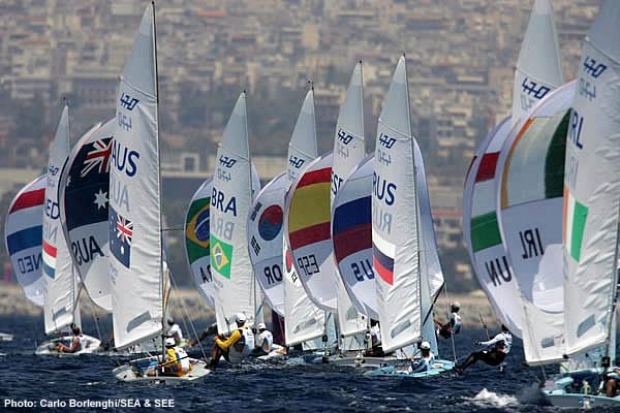
Top of the tree
Wednesday July 30th 2008, Author: Toby Heppell, Location: United Kingdom
For Olympic sailors the focus of the Games is always their own medal prospects and, although nations make every effort to ensure competitors feel part of a team, during the regatta racing is the spotlight and interest is always on the individual crews. However, another one of the most important outcomes from the Games is that of the top national team.
Being top national team at the Olympics is an important one for a variety of different reasons. In real terms it means a significantly better chance of securing major sponsors, enabling more sailors to receive more money, increasing strength of depth in sailors and certainly helping to increase medal prospects for the future. Particularly for smaller countries where overall medal tallies are likely to be fairly low, relatively medal rich sports such as sailing – though not as medal rich as swimming or athletics - can make a major impact. This means a good set of sailing results can account for a significant percentage of a nationalities’ overall medal haul and boost home awareness of the sport.
So which nations are most likely to come out on top in 2008?

Above: Ben Ainslie
Britain:
Medal Prospects - 8
For two consecutive Olympic regattas, Skandia Team GBR has been the dominant nation in sailing. In Sydney they stole the title of top team winning three Gold and two Silver medals. They followed this impressive set of results with two Gold, one Silver and two Bronze medals in Athens, 2004. Clearly then they have been a force to be reckoned with in recent years and to some extent have proved that success breeds success. The team has taken a cautious attitude to their Olympic predictions always ensuring they beat their targets and in doing so have never promised more then they can deliver, making them a firm financial investment. Interestingly the team have always worked on the basis that how ever many medal prospects you have, you can assume to achieve roughly half that number, so their goal for 2008 is - a what might seem conservative - four medals of any colour.
Of course the position of top sailing team has not gone unnoticed by other sailing nations and their spot at the top of the tree is far from guaranteed for team GBR. In recent years we have seen a number of national teams emulating the Skandia Team GBR model or employing a marginally different but broadly similar professional approach. Skandia Team GBR Olympic Director, Stephen Park, does not begrudge this reaction to the Team GBR system and has commented on several occasions he would do exactly the same were he in the position of many of the other nations.

Australia
Medal Prospects - 7
Australia is arguably one of the biggest success stories of the last four years or so. The team went into the Athens Olympics as one of the highest ranked teams in the world only to walk away from the event with no medals whatsoever. This unfortunate hiccup followed an extremely successful Sydney Olympics where Australia was the second best nation to Team GBR. To some extent the up and down nature of results is still prevalent in the Australian team as they failed to take home any medals once again at the 2006 Olympic Test Event - effectively the pre-pre-Olympics - at the 2008 sailing venue, Qingdao.
However, over the course of the last two years the Australian Sailing Team has been run by a new director in the shape of Michael Jones (above) and a number of the younger Australian sailors have been coming to the fore. This has resulted in an impressive turn-around by the Australians, achieving four medals at the 2007 pre-Olympics. They also managed to finish as second best team to Skandia Team GBR at the combined Olympic Classes World Championships in Cascais, Portugal last year. The final culmination of this has seen Australia top the ISAF team rankings – though it must be noted they also had this accolade before their disastrous Athens performance.
So Australia has certainly upped its game particularly in the way their squad is managed, with more of a team approach recently – mirroring that of Skandia Team GBR - and this seems to be at least partly responsible for the recent up-turn in their results.
The Australians new team approach to Olympic competition has helped significantly with training, but also in the age old issue of raising sponsorship money. Primarily this has come from a more corporate approach to sponsorship, again echoing the set-up of Skandia Team GBR. “Effectively we set up as a semi-autonomous body within Yachting Australia. We also said that we should go out as a corporate body to seek more funding and sponsorship than just through the Australian sports commission, who were the primary funding agency at the top of the team," Michael Jones explained to TheDailySail earlier this year.

Above: Spain's Martinez and Fernandez.
Spain
Medal Prospects - 5
Another team with the potential to make it big in China are the Spanish. This team are to some extent the opposite of the Australians in that they had a very poor 2000 Olympics, walking away without a single medal but came back in 2004 finishing up the second best nation with three medals to their name.
Unlike the Australians, the Spanish have been more consistent in their rise up the Olympic sailing ladder. They will be attending the Olympics this time around with a number of their old guard meaning they might be more likely to make an impact in the light conditions at Qingdao where experience, patience and a cool head will certainly pay off.
Despite the differences between Australia and the Spanish there are also some similarities. Both teams have taken a serious look at Skandia Team GBR and adjusted their programme accordingly. Recently the Real Federacion Espanola de Vela (the Spanish Sailing Federation) has required their Olympic team to live in the same place, Salazar, Madrid. This has been done primarily in an attempt to centralise their Olympic sailing programme and provide more of a team environment. Interestingly although Weymouth is undoubtedly the home of Olympic sailing in the UK and many of Skandia Team GBR live either there or close by there is no requirement for them to live there. This in effect means the Spanish have taken a much more firm line and it will be interesting to see how their new approach pays off in China.
USA
Medal Prospects - 5
In terms of overall medals the USA has the greatest number in Olympic Sailing history, though Britain is ahead in the total number of Gold medals. In the past the US has always been a great presence in the sailing world and 2008 looks set to be no different.
Certainly the US will pose perhaps their biggest threat in the Laser Radial class where they boast two of the best Radial sailors in the world, with Anna Tunnicliffe being selected to represent the country at the Games, following their first past the post Olympic selection trial. In addition they have strong contenders in the Star in the shape of John Dane and Austin Sperry, a class the US has traditionally performed well in.
The way in which the US goes about their selection series is perhaps one of the reasons they can be such a threat at the Games. In theory selecting representatives based on a single selection regatta could well be an unsatisfactory system, not allowing sailors to peak at the correct time. However, it definitely ensures the best pressure sailors are selected for the job.
With sailing being much more of a corinthian affair in the US than in many other countries, funding still remains one of the big issues within the sport. Many of their sailors rely on personal sponsorship from close friends and families to be able to compete on the Olympic circuit. This means it is significantly harder to be a full time sailor in the US than most of the other top sailing nations. In addition to this, with the States being so big, the cost of sailing there is increased due to teams having to travel great distances to race against one another.

Above: Lijia Xu.
China
Medal Prospects - 2+
Although by no means an established sailing nation on the Olympic scene, the Chinese have been dramatically improving their lot over the last couple of years. A clear determination to achieve on their home waters in Qingdao has seen the team taking some impressive results as resources are poured into their programme. Back in 2000 when China was looking to get selected as the 2008 Olympic venue, the government initiated a project under the code name ‘project 119.’ The project was dreamed up to help China rise to the top of the medal table, ahead of their closest rival, the USA. To do this the Chinese poured money into five ‘medal rich’ sports of which sailing was one. The name ‘project 119’ refers to the 119 medals available across the five sports (sailing, athletics, canoe/kayaking, rowing and swimming).
At the 2006 Test Event, China walked away as the fourth best nation despite rarely being considered as a big sailing nation or major threat. However, Skandia Team GBR Olympic Director Stephen Park considers the 2008 host nation to be a real contender. “I have no doubt the Chinese will have a few surprises. It is in the public domain that they have 900 Olympic class sailors, when you look at it from that angle then you have got to say that is an impressively big investment,” he commented recently.
Certainly 900 Olympic sailors is a huge resource for their selectors to draw from and it is well documented a strong home teams often translates into medals at the Games. Of all the Chinese sailors to keep an eye on, Lijia Xu is perhaps top of that list. Xu was the first Chinese sailor to win an Olympic class world championship back in 2006 at the Laser Radial Worlds. Certainly she represents the best chance China has of medalling in sailing at the Olympics.
In reality the Chinese have been characteristically secretive in their build up to the Olympics and though many people refer to them as a possible top nation it is very difficult to tell just how strong they might be. We know they have 900 full time sailors. We also know they have been training hard in Qingdao and many are light wind specialists. Realistically Xu and the Yngling team of Song Xiaqun, Yu Yanli and Li Xiaoni are the biggest medal prospects we have seen, but who knows how many others are waiting in the wings?
Of course there are many other nations that stand a chance of topping the medal tree. The Dutch and the Germans have both had radical overhauls to their approach, similar to those undergone in Spain and Australia. In fact the number of teams that represent a threat could well be the biggest threat in and of itself, as Park notes: “I think we stand a good chance of seeing 20 countries winning one of the 33 medals where it used to be 13 or 14.” If one thing is for sure, then now there are more countries than ever vying for that top spot, which can only be a good thing for the sport. With many nations now continuing to up their game who knows what 2012 could hold?
Most Read
Most Commented
Comments
Businesses

Pro businesses
Editor's choice
Member blogs
-
 Ned Collier Wakefield: MOD70 round BarbadosWell that was intense. 12 hard fought for seconds for the win. In idyllic conditions, Tony Lawsons MOD ...
 -
 Mini Transat leg 2 reportThe second leg of the Mini Transat started on 31st October, just over a month after ...
 -
Leg 1 reportI’ve been working towards the Mini Transat now for three years. In 2013 I was part ...
Business blogs
-
 The Island Sailing Club in Cowes, Isle of Wight, is delighted that Prince Michael of Kent ...
 -
Peta Stuart-Hunt chats with the 25 year-old British solo sailor Lizzy Foreman before she sets sail ...
-
The 2015 Student Yachting World Cup (SYWoC), an ISAF-recognised event hosted and run by students for ...
Editor's Choice
All time favourites...
-
 Three legs down into Ian Walker’s
 -
 Winning all but two races at
 -
 For the first time in its
Latest Comments
Add a comment - Members log in