
Meet the US Paralympic team
Friday September 5th 2008, Author: Marlieke de Lange Eaton, Location: United Kingdom
The US Paralympic Sailing Team has spent countless hours on and off the water competing, training and campaigning for this pinnacle event: the 2008 Paralympic Games in Qingdao, China. Held in the same venue as the Olympic Sailing Regatta last month, the Paralympic Regatta has attracted an unprecedented 80 elite athletes from 26 countries. Starting Monday, September 8, eleven races are scheduled for each event over five days. Medals will be awarded on the final day of racing, Saturday, September 13.
The US Paralympic Sailing Team is made up of six world-class athletes in three events selected for the 2008 Paralympic Regatta: Nick Scandone and Maureen McKinnon-Tucker in the new double-handed SKUD-18; Rick Doerr, Tim Angle and Bill Donohue in the triple-handed Sonar; and John Ruf in the single-handed 2.4 mR. They all bring different skill-sets, experiences and abilities, but they all share the same drive to win.
Head Coach Betsy Alison said the athletes’ biggest strengths are their positive attitudes and willingness to get the job done on the water. "We have a strong and unified team here in Qingdao, ready to get started in the Games," said Alison. "It has been a long, hard road to get here for each of these sailors and we're now on to the final act.
"Each of these athletes has trained extensively for these Games," said Alison. "I know that each one of them is ready to get underway and has worked tirelessly to put their best efforts forward on the race course."
SKUD-18
Skipper Scandone, 42, and crew McKinnon-Tucker, 43, are among the favorites to capture a gold medal in their class. After joining forces last year, the unstoppable team won the 2007 US Paralympic Team Trials and US Sailing's 2008 Rolex Miami OCR by wide margins.
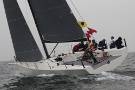
The SKUD-18 is an 18-foot lead-assisted skiff with a center-lined seat, a big, asymmetrical spinnaker and a bulb keel. According to the International Foundation for Disabled Sailing (IFDS), a SKUD-18 team must include one female and one person deemed a Functional Classification System (FCS) 1, or severely disabled. Since adding this new class, IFDS President Serge Jorgensen is pleased with the results. "We have found that participation, interest and competition have all increased, as well as opportunities for athletes that would not otherwise fit into one of the other two classes," he said.
This event marks another debut: Not only is it the first Paralympic Games for Scandone, who was named the 2005 US Sailing Rolex Yachtsman of the Year, but McKinnon-Tucker will be the first woman to represent the United States in sailing at the Paralympic Games.
Sonar:
Over the last two years, Skipper Doerr, 47, and his crew, Angle, 30, and Donohue, 56, have brought home gold medals from major events including the IFDS World Championship, US Sailing's US Disabled Sailing Championship for the Independence Cup, and the C. Thomas Clagett Jr. Memorial Regatta just last month.
Doerr, Angle and Donohue each has a long history with the sport, before and after they became disabled, and each brings their own strengths and experiences to the team. In addition to their impressive on-the-water results, the team was named US Sailing's 2007 Paralympian Team of the Year for outstanding performance and achievement. In 2007, Doerr was named the US Olympic Committee's Paralympic Athlete of the Year for sailing.
The triple-handed Sonar is a keelboat with a versatile, crew-friendly design that is accommodating to athletes with physical disabilities. This event has the longest history in the Games (since 1996) and traditionally has some of the longest running rivalries. "It is not rare to see all boats finishing within seconds of each other after racing for an hour or more," said Jorgensen.
2.4 mR:
Ruf, 40, grew up sailing across the country, but his first single-handed foray in the 2.4 mR was at the 2000 US Paralympic Team Trials. He quickly adjusted from having a crew to relying on himself, and he poured his characteristic enthusiasm and tenacity into this new boat. His hard work paid off in 2007 when he won the US Paralympic Team Trials in the 2.4 mR and the following year, he finished second at the C. Thomas Clagett Jr. Memorial Regatta.
The 2.4mR is commonly raced by able-bodied and disabled sailors alike. Weighing almost 500 pounds and with only eight inches of freeboard, the boats can be challenging yet rewarding.
These athletes earned spots on the US Paralympic Sailing Team after winning the US Paralympic Team Trials – Sailing last October in Rhode Island. Coordinated by US Sailing and six host organizations, the winner-takes-all regatta determined which sailors will represent the United States at the 2008 Olympic and Paralympic Games.
"It is the highest honor that our athletes can have in their athletic careers - to represent the United States in an event of this magnitude," said Alison. "It is an honor and a responsibility that all are willing and able to carry forward as ambassadors of sport. They will all do their best on the water and on land to make their country and each other proud."
In addition to Alison, the U.S. Paralympic Sailing Team is supported by a talented group in Qingdao, including Team Leader Sarah Hawkins, Coaches Marko Dahlberg and Michael Pinckney, Performance Enhancement Team Dr. Anne Allen and Athletic Trainer David Ray and Personal Care Attendant Vincent Scandone.
From the US they will also receive guidance on rules from Dave Perry and weather and conditions from Team Weather Forecaster Jennifer Lilly.
Sailing was first introduced to the Paralympic Games in 1996 as a demonstration sport, and as a result of its success, later became a medal sport for the 2000 Paralympic Games in Sydney.
Most Read
Most Commented
Comments
Businesses
Pro businesses
-
Netherlands
-
United Kingdom
-
France
-
Editor's choice
Member blogs
-
 Ned Collier Wakefield: MOD70 round BarbadosWell that was intense. 12 hard fought for seconds for the win. In idyllic conditions, Tony Lawsons MOD ...
 -
 Mini Transat leg 2 reportThe second leg of the Mini Transat started on 31st October, just over a month after ...
 -
Leg 1 reportI’ve been working towards the Mini Transat now for three years. In 2013 I was part ...
Business blogs
-
 The Island Sailing Club in Cowes, Isle of Wight, is delighted that Prince Michael of Kent ...
 -
Peta Stuart-Hunt chats with the 25 year-old British solo sailor Lizzy Foreman before she sets sail ...
-
The 2015 Student Yachting World Cup (SYWoC), an ISAF-recognised event hosted and run by students for ...
Editor's Choice
All time favourites...
-
 Three legs down into Ian Walker’s
 -
 Winning all but two races at
 -
 For the first time in its
Latest Comments
Add a comment - Members log in