
Fitness first
Wednesday June 25th 2008, Author: Toby Heppell, Location: United Kingdom
This is due to be my last Moth blog before the World Championships take place in just over one week from now in Weymouth. You can see previous entries
here and
here.
Before I bought my boat I began to scour the internet for advice on foiling and one of the first things I read was a beginner’s guide on the UK Moth site. The piece, written by Simon Payne and Adam May, contains several bits of advice and starts with these two points.
1. Get down the gym. You may think you are God’s gift to sailing but if you aren't fit (and most of you aren't) you won’t do it. More embarrassingly you will probably throw up in the rescue boat which isn't good for the class image. More seriously these are hi performance pieces of kit and you don't want to hurt yourself. If it’s too much to go to the gym then go running, or sail like hell, but do something.
2. Invest some time understanding how your boat works. When you are sailing, your boat will be constantly "talking" to you. Sending you little messages that you need to react to.......... or else! If you don't speak the boats language then you won’t understand what to do. A good working knowledge will do here.
Stupidly I had taken this advice with a pinch of salt, after all most people want to promote their class as physically challenging and besides I felt I was fairly fit. Perhaps, I had originally thought, there would be a few of the top guys that would be fitter than me but I felt I would be more than able to compete at the level I was at. Suffice to say this was not the case but interestingly it has only come to light recently.
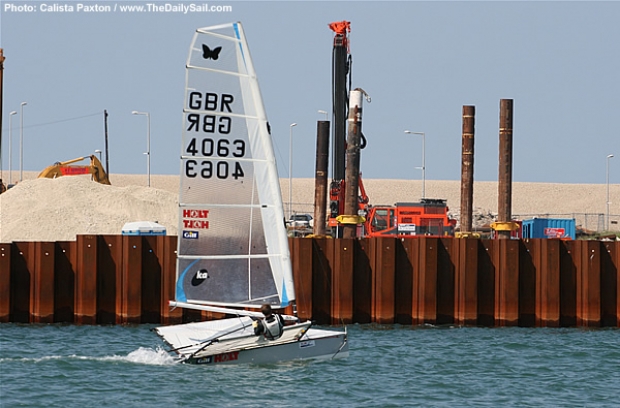
When out and about foiling by myself, fitness has not been a major issue and looking back it is clear to see I was taking it easy. However, a little over two weeks ago I went to the Moth National Championships, hoping to discover roughly what my pace is in the build up to the Worlds. Race one of the event took place in around 15-18 knots and it was soon clear I am hopelessly unfit. Off the startline those around me were quicker to foil, quicker on their foils and able to stay on them for longer. Most of this was simply down to them being able to work harder.
In essence to get the boat onto the foils without sailing some really ridiculous angles it is necessary to work extremely hard. When on the foils the amount of work required to keep the boat hammering along inches above the water is just huge. I was very quickly off the pace and lost track of most of the front end of the fleet by the end of the first beat – not good.
At the end of race one I was absolutely knackered and feeling ill from physical exertion – note to self downing half a bottle of Lucozade in one gulp is not a good solution to this situation. To make matters worse a new mainsheet I had fitted not so long ago had been completely shredded and I was now down to a core that was about 3-4mm thick. To put this in perspective this is the same type of mainsheet rope I had used in the 49er for four years, having only to replace it about once a season.
The wind increased throughout the day and I was simply way off the pace, mostly due to fitness but I am still unhappy with the lift I am getting from my foils. Even in the 18 knots that remained for race two there were times when I had to sit further back than most and wind on a lot of rudder flap to get the nose of the boat in the air. In fact there were times I was foiling upwind with the rear corner of my wingbar hitting the tops of the waves and this bow-up foiling looks and feels wrong. Here again the advice Payne and May wrote is important. Simply, I still do not understand enough how the boat should feel to make the necessary adjustments to my foil system. I am pretty much taking a stab in the dark most times I head out in the hope of finding a suitable setting.

The next thing that came as a shock during the racing was the speed in which the boat needs to be pushed around the course. This is a fairly obvious point but it is easy to slip into the idea that if you are foiling then you are likely to be close to the speed of the top few and so focus remains on getting the boat onto foils as quickly as possible. However, this is simply not the case. To some extent, as in most boats, where upwind is a case of hard work making the major gains downwind seems to be won on who has the biggest cajones (as our Mexican friends might put it). In 18 knots with the fleet hammering around the course the reaches in particular – we were sailing triangle sausage courses – were frightening in the extreme. It feels as though for an entire leg the boat just continues to accelerate until you get to the gybe mark. The temptation to back off is huge and again it is clear I had been doing this when out practicing.
Foiling feels most unnatural in this situation as, while the boat accelerates, you find yourself edging forward to stop the foils breaking the surface of the water. Essentially the faster you go, the more lift is generated and so the higher the boat gets. Also as with many high performance boats you have the ‘zone of death’ to contend with. Essentially between broad and very tight reaching is an area it is all but impossible to sail in. This means you often have to choose between heading high for a wing mark and low of a wing mark and switching half way down the leg.
With a reach almost over you then find yourself hammering along at a very high speed, sitting just forward of the mainsheet bridle with the gybe mark looming. This is where things get really tricky. Obviously the difficulty here is the faster you are going the bigger effect even a small rudder movement has. This is exacerbated by the fact that you have no hull in the water to drag through the gybe. The first few laps of the first day at the nationals I think I swam on most gybes. I would go to make a smooth slow turn and the boat would disappear out from underneath me and start to head off at roughly 90 degrees to its previous direction. This mostly left me in the water where the wing used to be appreciating just how far my boat was able to foil without me in it – I swear it would give a smug wobble before capsizing.
I am fairly proud to say I managed a couple of gybes in lighter weather on the second day of the nationals where the boat was foiling on the way in and through the manoeuvre only to touch down due to me not heading up enough on the new gybe. I have to say though whenever this happens it feels more like luck than judgment.
Again I came back from the event with a list as long as my arm of bits to fix and areas to improve. I seem to be repairing my main foil control rod on a fairly regular basis at the moment and I am now in the process of doing it again. Trampoline lacing eyes are still ripping out occasionally and there are two that need mending again. Most of the work I have to do though is on myself and for the last couple of weeks I have been running as much as possible every day in the hope that I can improve my fitness even marginally before the Worlds start in a little over one week’s time. On the plus side this is about as inspired to go out running as I have ever felt and I do not even need the help of a Rocky theme tune alarm clock, as Alex Adams admitted to having to inspire him in the mornings.
Most Read
Most Commented
Comments
Businesses


Pro businesses
-
-
France
-
-
United Kingdom
Editor's choice
Member blogs
-
 Ned Collier Wakefield: MOD70 round BarbadosWell that was intense. 12 hard fought for seconds for the win. In idyllic conditions, Tony Lawsons MOD ...
 -
 Mini Transat leg 2 reportThe second leg of the Mini Transat started on 31st October, just over a month after ...
 -
Leg 1 reportI’ve been working towards the Mini Transat now for three years. In 2013 I was part ...
Business blogs
-
 The Island Sailing Club in Cowes, Isle of Wight, is delighted that Prince Michael of Kent ...
 -
Peta Stuart-Hunt chats with the 25 year-old British solo sailor Lizzy Foreman before she sets sail ...
-
The 2015 Student Yachting World Cup (SYWoC), an ISAF-recognised event hosted and run by students for ...
Editor's Choice
All time favourites...
-
 Three legs down into Ian Walker’s
 -
 Winning all but two races at
 -
 For the first time in its
Latest Comments
Add a comment - Members log in