
Beauty or the beast?
Wednesday April 30th 2008, Author: Toby Heppell, Location: United Kingdom
There is a fashion in the foiling Moth fleet of late to build ever smaller hulls to reduce windage when airborne. Last year, inspired by Adam May’s then newest, tiny design, we had a half joking conversation about where the trend might end up - a foiler with no actual hull at all….
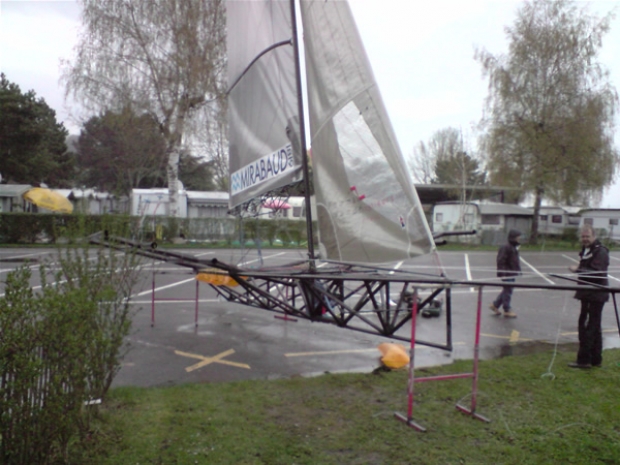
Skip forwards almost exactly a year and Thomas Jundt (he of the Swiss foiling 18ft Skiff fame see previous articles following his progress here and here) sent us a picture of his latest ‘boat.’ We opened the attachment in his e-mail and gasped at what we saw there. Beautiful this boat ain’t. Innovative, however, it is. “The main thing we wanted to do is be much lighter,” Jundt explained to TheDailySail last night. “The biggest gain is when you lift off and in order to lift off we have to be light. So this new project is all about being as light as possible.”
To achieve the weight he wanted, Jundt has stripped the structure of his new boat down the bare essentials, using carbon tube for a ‘frame’. “We got the tubes from C-Tech in New Zealand. They are 45mm diameter, 1.2mm thick carbon tubes.” Using these tubes to build the uncovered frame, Jundt has managed to par down the structure to a mere 35kg. The all-up sailing weight of the boat is around 155kg. Jundt explains that the foils are large to lift such a big boat and as such weigh around 30kg. In addition to the foils there was a great deal of extra structure to be added to their last boat and it ended up at a whopping 220kg. So, with this newest design Jundt has managed to shave almost 30% of the all-up sailing weight compared to his last boat.
Perhaps because Jundt is more engineer than boat-builder or perhaps because the actual hull is less important in foiling boat design, there is one major part of the project that is currently missing: a hull. “At the moment we are not quite sure about what will be the best shape and structure for the hull so we decided to put a small hull on one side and a floatation thing on the other side for the launch,” Jundt explains. “When we went for the first test sail, we were using polystyrene. So we had two polystyrene hulls in order to float and take off, that is why it looks so funny in some of the pictures.”
In essence then, what we have here is a super light structural frame, that has no floatation itself that will one day have a hull attached, but which has already been out for a test sail. Jundt, however, does have some fairly sound reasoning as to why the floating part of the hull has not been built into the frame from the start. “We wanted to have a small hull that manages to go okay at very low speeds, before take-off,” he comments. “I did not want to make the structure attached to the hull and then find out that the hull was not good and have to throw the whole thing out.”
So what we are looking at here is a work still very much in progress with Jundt building experimentation possibilities into the design. The first hull, though, has already been selected and is soon to be attached to the frame and taken out for testing. “The hull we are going to have is going to be the hull of a catamaran. It is 8m long, 50cm wide and about 40cm high and that will attach to the bottom part of the structure,” he explains.
Although Jundt is fairly sure the catamaran hull will go well in a straight line in non-foiling conditions there are other factors he is unsure of. “Theoretically it is perfect to go straight, but we have no idea whether we can sail it yet as it has absolutely no stability. The only stability we have is the foil in the water, as the hull is perfectly round.”
These stability issues are also likely to be a major problem when it comes to manoeuvres. With such a long slim hull tacks are going to be tricky at the best of times, however, another change could well compound this issue: “We thought it would be better for longitudinal stability to put the [main] foil in front of the mast. Of course on the 18 it is behind, so we gained about 80cm in separation,” Jundt continues. “On the old boat we had the best sensation at the very back of the wings, so we have moved the foil forward to allow us to move forward as well. Of course low riding this will add to the difficulty.” This is no major worry, though as the great part of Jundt’s plan is to be able to throw this hull away and add a new one if it proves too difficult to sail.
Interestingly, from a structural point of view there is very little difference between a standard 18ft Skiff and Jundt’s new frame. “The 18ft rig was doing well so we decided to keep that for the new boat. In doing that it gave us the four points that we had to respect: The shrouds, forestay and mast foot. Then we have to have the wings which need structure as well. So it looks like an 18 because I had to take the structure and the wings. An 18 footer is a good shape to take structural loads anyway, it is just a bad shape for light wind performance.”
Of course in other foiling classes the main aim of reducing hull size is not just to improve light wind performance but also to reduce windage. Clearly, with a tube based frame, the same size as an 18ft Skiff, Jundt is a long way from doing this. “I know it is not good for windage, but we are not aiming for a high top speed, we are aiming for a high average speed around a course,” he states. Of course this is not to say Jundt is not mindful of exactly how big a factor windage is and he has already started considering covering the boat, though he maintains weight is the key factor. “We have talked about covering the whole thing with a thin film and then using that as a hull when there is enough wind to fly. That is one of the experiments that we will try.”
The aim for the new boat, in performance terms, is to be as quick as possible in light wind, hence the long, slim hull and to take off as early as possible, hence the focus on weight. Jundt, says they are aiming to lift off in eight to nine knots of breeze downwind, with the big, flat gennaker up and nearer 11 knots upwind. “We are not 100% sure we will be able to take off in those winds - I did not know how to calculate that,” he admits.
Although the original 18ft Skiff rig has been kept, there have been a few changes. Perhaps most obvious is the boom, which is also an all carbon frame. “The boom is very light and very stiff so that we can get enough tension in the leech,” Jundt comments, adding that they have put a bigger square top on the main and stiffened the mast. They have also developed a smaller main, allowing the team to go foiling in winds of over 20 knots where the bigger rig is a bit much to handle and just creates drag.

On the performance side of things Jundt is keen too express again that this is not a boat designed for top speed sailing. Having said this on the test sail, they managed 18 knots on a close reach – the only leg the team could sail due to the main slipping and no leech tension being able to be applied. In the old boat he says they managed to hit 23 knots with a broken foil system so he would hope this new one will be that bit quicker. One day they would like to see 30 knots, but for that sort of high speed run new, smaller foils would need to be added and the boat would need to be optimised in other ways.
Last time we spoke to Jundt, he was still debating as to whether he would be able to build a new boat, due to the cost involved. Currently he has no idea of what it would cost him to build another one from scratch but says in man hours and materials the new frame would cost in the region of £20-25,000. On top of that there would be the rig, the hull, the wings and the foils - so presumably, a fairly hefty sum.
The plan now is to do some experimentation with hulls over the coming weeks before entering the famous annual Bol D’Or on Lake Geneva in the open monohull class. Certainly it will be exciting to watch this boat racing but, we feel, more than anything it raises interesting questions about where foiling might be headed. In particular if Jundt’s hull is detachable and he covers the frame in plastic material he could well only use the ‘hull’ part of the boat for light non-foiling conditions. Certainly this is one boat worth keeping an eye on.
If you have Adobe Acrobat Reader 8, a 3D design model of Jundt's vision can be seen here .
Most Read
Most Commented
Comments
Businesses


Pro businesses
Editor's choice
Member blogs
-
 Ned Collier Wakefield: MOD70 round BarbadosWell that was intense. 12 hard fought for seconds for the win. In idyllic conditions, Tony Lawsons MOD ...
 -
 Mini Transat leg 2 reportThe second leg of the Mini Transat started on 31st October, just over a month after ...
 -
Leg 1 reportI’ve been working towards the Mini Transat now for three years. In 2013 I was part ...
Business blogs
-
 The Island Sailing Club in Cowes, Isle of Wight, is delighted that Prince Michael of Kent ...
 -
Peta Stuart-Hunt chats with the 25 year-old British solo sailor Lizzy Foreman before she sets sail ...
-
The 2015 Student Yachting World Cup (SYWoC), an ISAF-recognised event hosted and run by students for ...
Editor's Choice
All time favourites...
-
 Three legs down into Ian Walker’s
 -
 Winning all but two races at
 -
 For the first time in its
Latest Comments
Add a comment - Members log in