
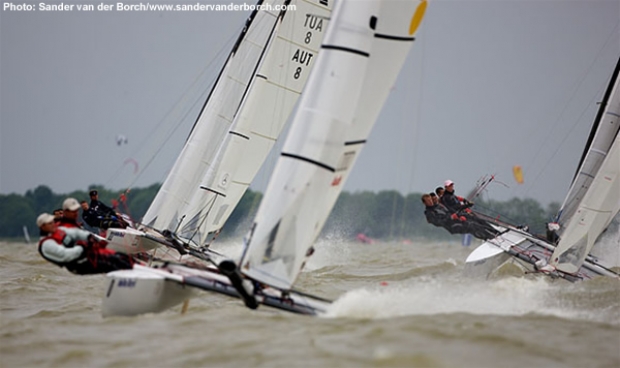
Tornado history
Thursday May 29th 2008, Author: Toby Heppell, Location: United Kingdom
Back in late 1967 the Tornado class was officially born. The boat grew out of the old International Yacht Racing Union (IYRU) B Class Catamaran rule and originally was developed mostly in Brightlingsea by Reg White, Terry Pierce and Rodney March. The boat was quickly accepted by the IYRU as the pick of the bunch at an Olympic Catamaran Trial. Now, over 40 years later, it’s reign may has finally come to an end in its position as the Olympic multihull.
As mentioned the Tornado was born of the B Class Catamaran rule, one of four very rudimentary box rules created by the IYRU in the early 1960s – perhaps the earliest incarnation of what now exist as the Formula 16, 18 and catamaran rules The original B-Class rule specified a boat that was simply 20ft long, 10ft wide and with 235sqft of sail area. Interestingly while the smaller A-Class has survived as the ultimate singlehanded development catamaran and the C-Class the doublehanded equivalent but allowing solid wingsail rigs, the Tornado is the only B-Class boat to have survived thanks to its Olympic history.
An Olympic Trial took place in the autumn of 1967 on the Thames which the B Class catamaran attended in a variety of different forms from many countries. “We all came together at the Isle of Sheppey with the opinion being that whichever boat won the trials would get International status overnight and then be put in for the Olympics,” recalls the first ever Tornado Gold Medallist and builder, Reg White. The Rodney March design, sailed by White and Bob Fisher won the trials by a significant margin and was declared winner of the event. The class swiftly received International status and was officially given its position at the 1976 Olympic Games in Montreal.
Above: Reg White and John Osbourne.
Part of this victory was also a commercial one for White’s Brightlingsea-based company Sailcraft. “I had the rights to sell it for the first year and I think all the sails were made by Hyde at the time. It was like a one design as far as the rig was concerned for the first year,” White recounts.Following this restricted start White continued to sell the most Tornadoes globally for the next three or so years. However, it was not long before other countries were manufacturing their own hulls, leading to a surge of interest from other sail manufacturers. “It was not really until other countries got involved that we got other sail makers making different sails,” White states. “There were very strict sail dimensions and it was only really the luff curve that you could play around with, so they were still fairly similar.”
Of course in those early days, sailing was much less professional and finding time to actually race the boats was always going to be tricky. Reg White recalls how he came to win the first ever Gold Medal in the Olympic catamaran class: “I had been sailing against John Osborne for a number of years in the Tornado. I won the Europeans and he won the Nationals in the same year. Then someone said ‘it’s about time you two get together and go for the Olympics’ - so we did.”
However, with the class being fairly new and very few sailors being able to spend significant time on the water, there was a major problem in finding competition. White continues: “We did not have anyone to tune up against which was when we got my son Robert involved. That is where we did a lot of the technical development. We had all the different sails that you could buy, but it was hard to know if one was better than the other in one condition or another. So we spent a lot of time on the water, tuning and making sure we had the right sails for the right conditions.” White puts his success at the Olympic Games down to these hours on the water and says by the time he got to the Games he felt his team was easily the most technically advanced.
Aside from material improvements in hulls, rigs and blocks, the Tornado remained effectively unchanged from its start in the early 1970s to the Olympic competition in Sydney 2000. Not only this, but it remained one of the highest performance, most spectacular classes as well. So what is the secret of the boats success? “I think they got the fundamentals right in the design. It was the first accepted beach cat that was wider than the usual trailable width,” explains Tornado Olympian Mitch Booth. “I think the basic dimension of a two to one length to width ratio was a great formula. It was quite a powerful boat for the time it was designed and because it has been an Olympic class it has needed to evolve at the highest level - not only the construction of the boat, but the rig and technology and of course the way the boat is sailed.”

Above: Action from the 2000 Sydney Olympics.
Booth also believes a great part of the success of the Tornado is the very fact it has been an Olympic class for so long. “It is where all the top cat sailors have always gone because it is the Olympic boat. Because of this it is sailed at a very efficient level, so it has been shown in a very good light,” he comments. Perhaps this could go some way to explaining why so many sailors stay in the class for so long. The big names at the front of the fleet have often been there for years such as Roman Hagaara and Darren Bundock. Booth himself sailed his first Tornado regatta at the age of ten in 1973.
White, however, is more convinced it is the design that has yet to be beaten. “Several companies have tried to bring out a boat that is better than the Tornado but they have yet to achieve it,” he comments. “I think one of the reasons for that is the boat has now been fine tuned to almost perfection. Looking at classes like the Formula 20 they are a lot narrower than the Tornado, so if you have got any breeze at all then you have just got no hope.”
Modern Era:
By the early 1990s a small group of multihull sailors felt the boat needed updating and gathered with a plan of improving the Tornado. “Reg [White] Yves [Loday] Randy [Smythe] and myself reassessed the Tornado and considered whether we should redo the rig,” continues Mitch Booth. “We looked at the whole possibility of doing a bigger rig, adding another trapeze and then putting a spinnaker on.”
This reassessment produced several different rigs for the Tornado. “A number of people turned up to Florida with whatever rig they thought would do the job,” explains White. “We turned up with a square top mainsail - which is similar to what we have got today - the same jib and a spinnaker. Mitch Booth turned up with a similar mainsail to the one that we had, no spinnaker and a bigger jib.” However, as well as experimenting with new rigs the Tornado fleet also decided to experiment with new course formats - causing some problems. “The courses being used were very short and by the time we had got the kite up and then taken it down again many other boats were almost the same speed that we were,” White recalls.
But at this stage these new developments failed to get off the ground. “The class sort of rejected the whole idea because they did not want change and there was not much pressure to change the whole boat,” says Booth.
Below: Syles and May test out an early Tornado Sport.

Following this the boat continued in its original form for the next Olympic Games in 1996 and the 2000 Olympics, before the issue came to a head once again. “After the Olympics in 2000 we had another big push after the ISAF had re-evaluated the multihull and they said they wanted a boat with a spinnaker and double trapeze,” Booth continues. However, the Tornado class were still not convinced and as the ISAF held an Olympic Equipment Trial to select a new multihull. Two Tornados attended the event, the Tornado in its current state and what was then called the Tornado Sport with a bigger main and spinnaker. “We actually bid against the Tornado class as an alternative Olympic boat,” Booth comments. “We won that bid as the preferred equipment and then ISAF asked if we could re-join the Tornado class as it seemed silly to have two separate boats. So a deal was struck and the Tornado Sport became the Tornado again. That is the short version of what happened.” See a report from 2001 about the change of rues here.
What is most interesting about the change to the new enlarged rig is that the hull, despite being designed in the 1970s to take the load of a smaller rig and single trapeze, never needed to be adapted. “I think, that the boat was able to have the new rig is really a credit to Marstrom,” says Booth. “They have made an excellent product that still remains the highest spec and highest quality beach cat and certainly out of the Olympic class boats it is very high tech. When we put the extra rig size on it, the boat coped very well so there was no problem at all there.”
Here Booth raises another interesting point about the Tornado, that of Marstrom’s building dominance in the class. Rarely has a boat building company been so overwhelmingly in control of the Olympic boats being sailed. “Reg [White] has played with a few hulls. We actually used a Reg boat in the ’92 Olympics, so did Yves Loday, but apart from that they are all Marstroms. I think Reg has had a few since then and I understand that Graham Eeles may have one but it is 99% dominated by Marstrom.”
Unfortunately after over 40 years of competitive racing the future for the Tornado does not look rosy after the multihull event was removed from the Olympics last November. History shows when a class loses its Olympic status sales tend to fall rapidly. Unfortunately the success of the Tornado may also be its undoing. After all those years of competing at the Olympic level the price of a Tornado is now extremely high compared to its immediate competition, such as the ever expanding F18 class. “I think the F18 is the place most of the top sailors will go,” says Booth “It is such a big class it is more interesting for the manufacturers and therefore the professional sailors have a much bigger role to play. I think it will be hard to compete against that. The [Tornado] will survive in its own way and I am sure it will live, but we just don’t know in what form yet.”
Currently there is talk of a number of sailors getting together to produce a Tornado Grand Prix series. However, right now it is nothing more than talk and as Booth says it seems unlikely the pro sailors will go anywhere other than F18 sailing. The only aspect of the Tornado that might save it from an inevitable demise to relative obscurity is the fact that it remains one of the most powerful, refined and high performance 20ft catamarans in existence. Numerous boats are likely to be coming on to the market over the course of this year, particularly post-Beijing and while new Tornados may be expensive, secondhand they represent phenomenal bang for buck.
Most Read
Most Commented
Comments
Businesses

Pro businesses
-
United Kingdom
-
-
-
United Kingdom
Editor's choice
Member blogs
-
 Ned Collier Wakefield: MOD70 round BarbadosWell that was intense. 12 hard fought for seconds for the win. In idyllic conditions, Tony Lawsons MOD ...
 -
 Mini Transat leg 2 reportThe second leg of the Mini Transat started on 31st October, just over a month after ...
 -
Leg 1 reportI’ve been working towards the Mini Transat now for three years. In 2013 I was part ...
Business blogs
-
 The Island Sailing Club in Cowes, Isle of Wight, is delighted that Prince Michael of Kent ...
 -
Peta Stuart-Hunt chats with the 25 year-old British solo sailor Lizzy Foreman before she sets sail ...
-
The 2015 Student Yachting World Cup (SYWoC), an ISAF-recognised event hosted and run by students for ...
Editor's Choice
All time favourites...
-
 Three legs down into Ian Walker’s
 -
 Winning all but two races at
 -
 For the first time in its
Latest Comments
Add a comment - Members log in