
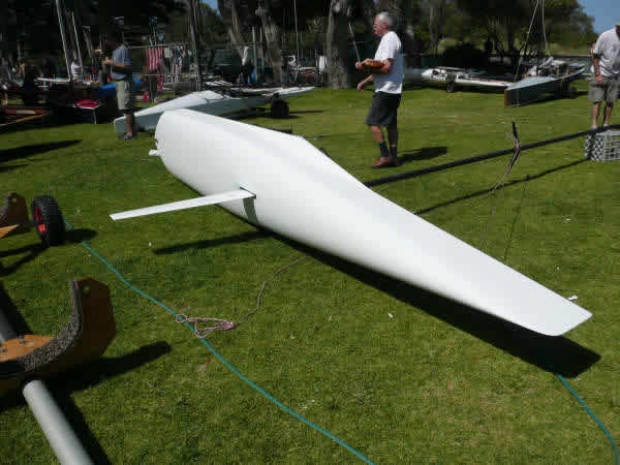
Above: Chris Mass' 'String Theory.'
All but decided
Thursday March 27th 2008, Author: Toby Heppell, Location: United Kingdom
Just before Christmas the International Canoe World Championships took place in Australia. The event was a particularly confusing affair with three different types of the sliding seat International Canoe sailing:
- the standard International Canoe (IC)
- the separate, Asymmetric Canoe (AC), effectively an IC with an asymmetric kite
- the new Development Canoe (DC), built to a new set of rules but without an asymmetric kite
At the Worlds the new DC boats were the clear winners, with Chris Mass’ String Theory taking the title. More critically for the class, a decision was set to be made about the future of the various classes - so what has been decided? “We have had a vote by the members and that now has to go through to the governing body,” explains UK Class Secretary, Andy Biden. “This should just be a rubber stamp, but we know that one or two of them have other ideas. I think the poll came in at something like 79% of the membership said that they would like to go ahead with the DC as the new IC. That was well over the threshold needed.”
So all it requires is for some class procedure to take place for the DC to be adopted as the main rule for the International Canoe class – the DC becoming the new IC. The International Canoe has slowly developed previously and Biden says that generally the class rules have almost always twisted towards what the membership wants. “If someone goes and does something which is proven to be cost efficient or makes the boat easier to sail then we will, to a point, do it. To some extent that is how the DC came about. People were saying the old boats were great upwind but tended to be a little bit pedestrian downwind and they wanted a wilder ride.” Spearheading the development was US dinghy guru and avid Canoe sailor Steve Clark who came up with the parameters for the new rule which looked to be a little bit quicker than a standard IC, though Biden adds there were a number of other class members thinking along the same lines.
The new DC rule is in essence an opening up of the previous class rules. The International Canoe has always been a controlled class and the acceptance of the
International rules in the 70s made the boat a one-design. However, the Development Canoe rule will be a box rule allowing for significant variations. Without repeating both rule sets verbatim it is difficult to accurately set out all the differences between the two classes (the rules in full for the IC and DC can be found here and here). What perhaps speaks most about the difference is to compare the simple measurements as seen below:

|
Length
|
Beam
|
Sail Area
|
|
DC
|
4900-5200mm
|
750-1100mm
|
10m2
|
|
IC
|
5180mm
|
1010mm
|
10m2
|
While the class has chosen – in significant numbers – to go down the development route, it is still hanging on to a traditional element. “At the same time as this we did have a vote on electronics to allow things like GPS, but that was thrown out completely. Of course that is a lesser rule but it does have an effect on the business of sailing,” explains Biden.
It is not just the hull specifications being changed with the Development Canoe though. The International Canoe has always been known to have fantastic upwind speed for a singlehander and this is due, in no small part, to the boats having both a main and a jib. However, in recent years there has been some experimenting, notably by Steve Clark, with single sailed rigs, so with the DC the rules regarding the respective size of the sails has been modified to cover just overall sail area. A single mainsail will make the boat easier to sail but school is out on whether or not this is faster, as Biden says: “We had a few people who put single sails on them and they basically decided if we are going to go development we might as well go that far. In response we took the size restriction off the mainsail to allow that to happen. They have now experimented and so far, of the boats that have come out, half of them have reverted back to main and jibs.”
Below: Clark with a una-rig back in 2005.

With much experimenting still taking place on the rigs and the new DC rule yet to be officially sanctioned there is still much work to do on the designs. However, at the World Championships late last year, Chris Mass with his String Theory Development Canoe dominated the event, winning all but one race. “String Theory is very fine forward and it goes a long way aft before it gets to its maximum beam so it looks like a paper dart,” explains Biden. “Mass seemed to suggest he needed to put a little more buoyancy in the forward section and if he were to build another one that is what he would do. The boat was very, very quick though and he had had it on the water for ten months by the time of the worlds, so had really worked out how to sail it which helps.”

Above: Andy Patterson's una-rig main under a standard IC main.
The one race Mass was not able to win went to another Development Canoe in the form of the Red Barron, a Morrison design, built by Andy Patterson that will be available as an off-the-shelf hull. However Biden notes that this boat had three hours on the water before being containered up to go off to the world championships and could do with being sailed a more.
With this sort of performance so far there is clearly a lot to be gained from moving to a Development Canoe, though at the moment builders seem to be concentrating on a few key areas. Firstly having a fine, or wave piercing, hull seems to be a very popular move and was shown to be very quick on String Theory. Second has more to do with hull strength than shape. “One of the problems with the design is it is a very long and thin boat,” says Biden. “A lot of tortional twist is generated between the mast and the sliding seat. What most people have done [with the DC] is lifted that area to get more of a box beam effect through that section of hull because that’s where all the loads are.”
Of course with the decision all but made and the Development Canoes getting faster all the time there is a question of what happens to all those International Canoes built to the previous rule. Biden comments there will be three options for the Canoe sailors: They can convert their Canoe to have an Asymmetric spinnaker, strip a significant amount of weight out of their boats – and or make some major alterations - and compete as a DC or sail as an International Canoe in a classic division. At first glance it would seem obvious that most would sail in the classic division, however one of the big differences between the DC and the IC is the weight. Simply the original IC carries a lot more weight than is needed these days. Replacing the seat and carriage with a carbon one for example could probably save close to 15-20kg and keep the boat reasonably competitive. Interestingly Biden says that the first draft of the DC rule a measurement error would actually have made the standard Nethercott IC not eligible as a DC, he adds this was quickly rectified when the mistake was realised, however.
So while the DC becomes the new IC, what of the asymmetric-equipped AC? It appears this is going to continue to be a separate class within a class. However recently numbers have been dropping and we wonder how much of an effect the DC is likely have on this branch of the class. Biden expands on this: “Our biggest problem [in the AC class] is we tend to find the guys who have got them tend not to end up doing so much racing, but it is so much fun to punch your way upwind and then turn downwind, put the kite up and cruise along. It is quite interesting that the [AC] guys who went to the worlds and tried the DC designs and were saying it was an unbelievable boat and so much better than the standard IC in terms of sensitivity. They were looking at it saying, ‘yeah you can get a kite on that,’ so I think really the guys who like playing around with kites will keep doing so. Because of this I think eventually the AC will be using the DC rules as well.” We hope if this is the case they do not pass on the chance to call the boat an ACDC!

Above: Clark's 'Wonk' DC.
Although the new Canoe rules are called the Development Canoe there are clearly still clearly going to be restrictions about what can and can’t be done. Principally these involve things like keeping the sliding seat, and its double ended hull and pintail transom - both decisions we applaud, as these are arguably what makes a Canoe, a Canoe. However, there are clearly going to be some arguments in the class further down the line about what should and should not be done. “We have not actually banned hydrofoils but the wording of the rule makes it very difficult to put them on,” warns Biden. “Basically it says the dagger-board has to be able to be lifted above the keel-line. If someone can find a way of doing it that is successful then you can have a hydrofoil. I know some people have been talking about putting them on the end of the sliding seats and so on. However, so far what we have found is the new DC is very quick and keeps accelerating. Most importantly they punch their way through waves which is what we wanted them to do.” Perhaps then in the future the foiling debate might be on the cards for the Canoe fleet and at present that door has not been slammed shut. However, we think it unlikely as it simply does not seem something suited to the Canoe.
The official decision whether to adopt the Development rule is due to be made in April. However, with such a strong following in the class and with so many DCs already out there, it is all but certain the DC is here to stay. With the new Development rule and by the looks of the boats we have seen so far the class has managed to find a way to modernise without losing its key characteristics and this is something we can only applaud.
Most Read
Most Commented
Comments
Businesses

Pro businesses
-
France
-
United Kingdom
-
United Kingdom
-
Editor's choice
Member blogs
-
 Ned Collier Wakefield: MOD70 round BarbadosWell that was intense. 12 hard fought for seconds for the win. In idyllic conditions, Tony Lawsons MOD ...
 -
 Mini Transat leg 2 reportThe second leg of the Mini Transat started on 31st October, just over a month after ...
 -
Leg 1 reportI’ve been working towards the Mini Transat now for three years. In 2013 I was part ...
Business blogs
-
 The Island Sailing Club in Cowes, Isle of Wight, is delighted that Prince Michael of Kent ...
 -
Peta Stuart-Hunt chats with the 25 year-old British solo sailor Lizzy Foreman before she sets sail ...
-
The 2015 Student Yachting World Cup (SYWoC), an ISAF-recognised event hosted and run by students for ...
Editor's Choice
All time favourites...
-
 Three legs down into Ian Walker’s
 -
 Winning all but two races at
 -
 For the first time in its
Latest Comments
Add a comment - Members log in