
Foiler for 2016?
Tuesday June 3rd 2008, Author: Toby Heppell, Location: United Kingdom
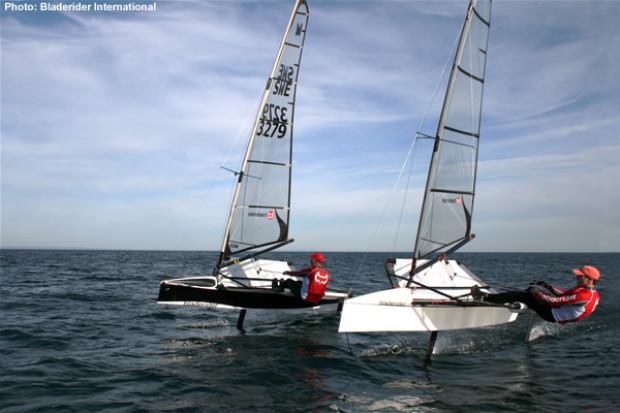
Bladerider International, makers of the Bladerider X8 foiling Moth, yesterday announced the launch of a new product, the Bladerider FX. Made from Fibreglass, as opposed to carbon, and priced significantly lower than any other professionally produced International Moth, the FX could well be the foiling boat for the masses.
It is important to kick off with a few comparisons to get a true idea of exactly what we are dealing with. Firstly and perhaps most importantly there is the issue of price. Currently a Bladerider X8 retails at £9,120 ($17,958 or $18,750 AUS) before tax. The FX is listed as costing a significantly cheaper £6,084 ($11,971 or $12,500 AUS). This puts the boat much more in the realms of availability for most, though once tax, freight and optional extras have been added the price is likely to be significantly more. Secondly there is the issue of weight. The new FX has an all up sailing weight around the 40kg mark, whereas the all-carbon Bladerider X8 is about 32kg, a significant percentage difference. It should also be noted that the X8s are not currently the lightest International Moths on the market with the company having made a decision to beef up their production hulls last year.
When we first heard about some of the details of the Bladerider FX there were obviously a number of questions that popped instantly to mind. Specifically when we saw the FX was to have the same foils and rig as the X8 we wondered how such a significant cost saving had been made by getting rid of 10kg carbon for the X8 hull and replacing it with 15kg of fibreglass for the FX. However, current Moth World Champion and Bladerider head of Sales, Rohan Veal explained the changes go much further: “The wing frame we use on the X8 is bladder moulded and they are really expensive for us to buy,” Veal comments. “We make no money if we sell them separately, as they are very labour intensive. Also our supplier keeps putting up the price on us. On the FX it is a simple tube frame, very similar to what most of the other manufacturers do, which is using straight tube. The difference will be they have moulded corners. [The corner attachments] should be fairly resistant as they will be made from a high density plastic. That is really the component that makes it a lot cheaper. Also there are a few other things; we have shifted the mast and boom production over to China. The gantry on the back will be made from alloy as will the spreaders and they are both significant cost reductions.”
The point that wing bars are expensive on the X8 is certainly one that shows in the Bladerider spare parts price list (found here). When looking at an entire wing assembly, for example, one wing on the X8 costs £1042 whereas on the FX it would be £462, obviously a significant saving.

An immediate concern with the FX is that despite it only costing around £6000 this money is presumably being spent on an uncompetitive boat. In a class such as the foiling Moth where weight is one of the most crucial design aspects, surely having effectively a third as much weight again as all the boats you are racing is going to be extremely slow. Veal does not see it this way though. “Once you get onto the foils it is the same speed,” he explains. “Take-off is a little bit slower but other than that it is more or less the same.” It is difficult, without having sailed or seen the boat, to decide exactly how true this might be. We suspect there will be conditions where the FX is able to match a fully carbon foiling Moth, however, we have reservations about exactly how well one might do over the course of a championship or even a whole race. Of course, so much in the foiling world revolves around boat handling, we suspect an FX could be sailed within sight of the front of the fleet but will struggle to make those all important last few places.
Assuming the boat is not as fast as other International Moths being built there is the question of who might actually buy one. “I think there are a lot of people out there that want to get into [foiling] but do not want to buy a second hand boat,” Veal comments. “There seem to be a lot of people out there that want to buy a new boat. No matter how much we tell them the second hand boats are a good buy and that is a good way to save money, they still say they want to get a new one because they know what they are getting and get a full warranty as well.”
Perhaps this is the case but surely if people were really that keen to get into the foiling Moth fleet they would take the plunge and buy a second hand boat. Or if Bladerider felt second hand boat take-up was weak why not set up a brokerage with a warranty? As it is the FX would appear to be £6000 of uncompetitive boat that will not win you a major regatta just for the peace of mind of buying something new. Sure, it is an entry point foiler and there are probably a fair few sales to be made to those looking for fun over racing and if 1000 were sold it would also make a pretty great one-design foiling class, but to get there you have to sell a thousand first.
However, Bladerider International is the company that mass manufactured a foiling Moth, took it to the World Championships and won, something many doubted they would be able to do. It is not a company that would bring out this boat unless they were absolutely sure there was a spot for it somewhere in the market. Happily, as Veal continues to talk, it soon becomes clear to us where this is. “I think there will be a big youth market. It is at a price where I think parents would be able to buy the boat for their kids,” he explains. “The parents might be worried they will jump around on it and break it and this boat covers that. The boats are unbelievably strong. We were really surprised how strong the impact resistance was when we got the first few samples through.”
This certainly seems like a wise market to go for and the price point looks good. A new 29er before tax is £5293 ($10,417 or $10,848 AUS) and is something parents have show little reluctance to buy throughout the world with the cost split by two sets of parents in some situations. In addition to the cost of the carbon Moths there is also the work that must be done to maintain what are, after all, very fragile sailboats. Not only does this involve the cost of buying materials, it also involves a lot of working with potentially dangerous tools so a stronger fibreglass hull makes a great deal of sense for the youth market.

The youth market is also one the International Moth has struggled with in recent years principally for the above reasons, so this could be a significant gap for the FX to fill. Happily for Bladerider it would also mean getting young people into foiling at an earlier age, making them more likely to stay in the foiling Moth class and presumably loyal to the Bladerider brand. “I guess I think when people get to about 19 they might upgrade to the X8,” Veal confirms. “They might just stay with [the FX] I do not think it is that much slower anyway, especially once you are foiling.”
Perhaps as an example of the youth credentials of the Bladerider FX the first boat to be seen by most will be one heading over to the International Moth World Championships in Weymouth next month and will be sailed by a junior. “We are bringing at least one over and we have one of our junior sailors from Melbourne who will be competing on it - he is representing the boat,” explains Veal. We were hoping that Veal himself would sail the boat at the Worlds but currently this is not to be the case. “I have certainly thought about it, but if I did the event I do not think I would have that much motivation to go and win, just to go and have fun,” he comments. “I have zero training at the moment though and I do not know if I would represent the FX as well as I would like. It is important to me to make sure that our team does well, especially our three juniors and one female. I want to make sure they do well and look after them.”
We think the FX will make a great youth boat and is certainly priced well enough to sell in that market. We also think that for a few it will work as a training foiler but there is one final aspect we are very excited about. Early on in its foiling career the International Moth was proposed by a few fans as a possible Olympic candidate, ourselves included. However, as everyone knows, the ISAF are highly unlikely to take on a development class as an Olympic boat. When the Bladerider came out with the potential to be a one design off-shoot it looked like a serious contender for a while and Bladerider International had a number of talks with ISAF about such a possibility. However, with a remit to include as many countries as possible; a £10,000 single hander that was very fragile did not seem to do it for the ISAF either. Now Bladerider International has brought out a foiling Moth that can be a one design class, is tough, is significantly cheaper and they have proved there is worldwide demand with their X8, could this be a potential Olympic foiler? “That is certainly something we have thought about,” confirms Veal. “Having had long discussion with ISAF about our current boat, the cost aspect is certainly a big issue [for them]. If something like this can’t get into the Olympics for say 2016 then there is something seriously wrong. We are ticking all the boxes here and it is difficult to believe it would not stand a good chance.”
So there you have it - as with many things it is all about how you look at the Bladerider FX. For some it is and will probably always remain a boat that costs £6000 and is not able to compete at the top level of the class it sails in. For others it is an entry point foiler for the youth market and those wishing to have fun. Perhaps in the future it could be the Olympic one-design putting sailing on the map in Olympic terms. Provided the boat is not too much slower than the average Moth (we shall see at the Worlds) we think this is a great concept. For a new boat we can’t think of anything that goes as fast for as little money. Could this be the 21st Century Laser?
Most Read
Most Commented
Comments
Businesses

Pro businesses
Editor's choice
Member blogs
-
 Ned Collier Wakefield: MOD70 round BarbadosWell that was intense. 12 hard fought for seconds for the win. In idyllic conditions, Tony Lawsons MOD ...
 -
 Mini Transat leg 2 reportThe second leg of the Mini Transat started on 31st October, just over a month after ...
 -
Leg 1 reportI’ve been working towards the Mini Transat now for three years. In 2013 I was part ...
Business blogs
-
 The Island Sailing Club in Cowes, Isle of Wight, is delighted that Prince Michael of Kent ...
 -
Peta Stuart-Hunt chats with the 25 year-old British solo sailor Lizzy Foreman before she sets sail ...
-
The 2015 Student Yachting World Cup (SYWoC), an ISAF-recognised event hosted and run by students for ...
Editor's Choice
All time favourites...
-
 Three legs down into Ian Walker’s
 -
 Winning all but two races at
 -
 For the first time in its
Latest Comments
Add a comment - Members log in