
Olympic comment
Tuesday August 12th 2008, Author: James Boyd, Location: United Kingdom
If you wish to express your views on the Olympic Games - email us
here
.
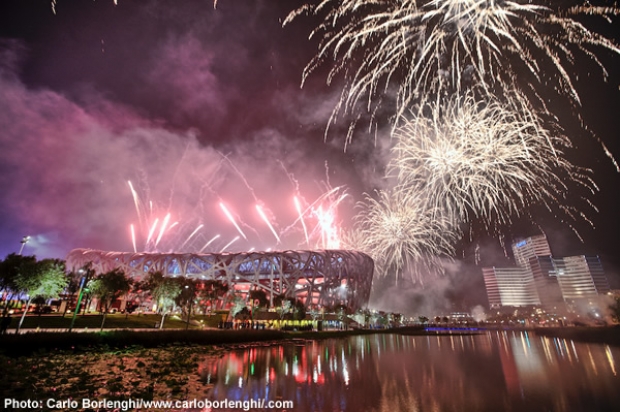
I am not a great fan of pomp and circumstance, but one could not fail to sit watching the opening ceremony of the Olympic games with mouth ajar. Firstly it was held in the incredible 91,000 seater National Stadium (the ‘Birds Nest’) in Beijing, a superb masterpiece of architecture and art fitted with a giant plasma screen encircling the roof aperture. There were the fireworks (guess which country invented gunpowder?) and 2008 drummers, beating hell out of their drums with neon sticks all immaculately in time, as you could see when they switched the lights out so that all you could see were their glowing sticks. There was symbolism such as the giant paper scroll (guess which country invented paper?), and then the giant moving type (guess which country invented printing?), which would have been hard enough to conjure up in CGI, but of course in China was carried out by a highly trained and co-ordinated army of performers. And much, much more… (watch highlights from this here)

(more photos from Carlo Borlenghi on the following pages....)
As we attempted to take all this in, the simultaneous thought went through my mind and those of my fellow Brit co-spectators: what on earth can London do to equal let alone trump this in 2012?
Having come up with booze about 9,000 years ago, the Chinese invented paper, ink and the seismometer, collapsible umbrellas and were drinking tea back in Roman times. While we Anglo-Saxons were wondering around with blond hair firing bows and arrows on behalf of kings who’s names began with the letter E, the Chinese were busy inventing things like paper money, the clockwork mechanism and gunpowder (and from there a wide range of armaments and fireworks). While we were getting our first crop of French guests they had the compass that got their sailors from China as far afield as Africa and Egypt.
Something a little closer to home - did you know that the Chinese were the first (around 1000 years ago) to build their ships with water tight bulkheads, something which didn’t appear in western shipbuilding until the 1800s?
To be fair we Brits have done our fair share to redress this balance, but our creative flare seems to have only kicked in over the last 300 years or so with the rise and fall of the British empire.
Michael Faraday built the first electrical generator, James Watt/Thomas Savery the steam engine, but ‘who was the first’ when it comes to more contemporary technology becomes a topic of heated debatable with Brits claiming to have achieved the first manned flight in an aeroplane, created the first lightbulb, the telephone (Alexander Graham Bell was born in the UK) and radio (technically a Welshman), jet propulsion, photography, etc.
God damn him, the World Wide Web was even created by a Brit, Tim Berners-Lee (admittedly in his bunker at CERN in Switzerland at the time). He has a lot to answer for.
Culturally Brits in their idle moments can claim to have invented many of today’s most international and main stream sports such as football, rugby, cricket and tennis. We can more than hold our own in the fields of art and architecture. When it comes to music we may have the likes of Purcell, Handel, Elgar, the Beatles, Rolling Stones, Led Zeppelin, David Bowie and Robbie Williams, but it was the Chinese who roughly 1000 years earlier recognised the 12 note scale upon which all our contemporary (ie last 500 years) music is based. While the Chinese dealt with the big picture fundamentals eons ago, we have been much better more recently at the detail, such as penicillin, the rubber band, the tin can, perforated toilet paper, the Harrier Jump-Jet or instant Custard.
While China has its own complex form of cuisine, admittedly when it comes to food we suck. The most widely eaten form of food in the UK is curry and specifically Chicken Tikka Masala with its sweet reddish sauce, while this might be followed by battered deep fried fish and chips (wrapped in newspaper of course) although our Sunday roasts with accompanying vegetables could be something to be proud of along with our unique school deserts such as spotted dick and rolly polly pudding, that most non-Anglophiles generally find hideous and repulsive.
Scotland have the kilt, sporran and all the paraphernalia, but traditional English dress is also something of a worry. Effectively there is none. We have Beefeaters, businessmen from 50 years ago in their bowler hats, or from the 19th century with top hats and frock coats, but not really anything approaching traditional dress. Perhaps thankfully we have no equivalent of leiderhosen or the Stetson. As to our folk culture, hopefully all the Morris dancers will be scooped up in a fleet of buses and dropped off in John O’Groats come 2012.
So Britain can generally hold its own in terms of culture even if we are relative upstarts compared to the Chinese, but what is perhaps most worrying is how this might be depicted at our Opening Ceremony in 2012. What are Britain’s most iconic images? A look at the postcards in a London tourist shop would say they were the Queen, a prince with jug ears or more likely his attractive but deceased wife, an English ‘bobby’, a London bus, Buckingham Palace, the Houses of Parliament, Tower Bridge and a punk rocker from 30 years ago. It will be fascinating to see what Sir Keith Mills’ creatives can make of that.
Olympic sailing
While Qingdao has come in for a lot of flack as the sailing venue of the 2008 Games, it has, against all expectations, provided just adequate conditions for racing. To date after four days, there have been the occasional delays, but so far (touch wood) not one race has been dropped in any class and given the forecast it doesn’t look like any will in the short term at least.
This may be the case and the much scorned comments made last year by Qu Chun, the Competition Manager (who argued that it was acceptible for an event where the NoR allowed an overall result to be gleaned even if just one race was sailed) now perhaps forgotten, but it would still be hard to say that the sailing event in any of the classes to date has got the heart pumping. Yes, there have been some good stories - the three bullets by the Chinese lady windsurfer, the zero to hero performance by the Paraguayan Radial sailor as well as the controversy over the Tornado Code 0s and Finn sailors being nailed by Rule 42. When you get to see the boats up close, sailing officionados can appreciate the mark roundings, the starting, the subtleties of light wind technique that the athletes are demonstrating, skills finely honed after years of practice. But at the end of the day any form of sailboat racing held in light winds (with the possible exception of Decision 35 and C-Class catamarans) is pretty tedious - and we're enthusiasts! Practically anything is more exciting on the Olympic agenda than watching a Yngling wallow its way around the race course in 4 knots of breeze. And occasionally when the wind craps out fully it no longer becomes a sport but a lottery. Luckily so far there have been few instances of this, although generally most are expecting a high scoring regatta. The Lasers have been watchable because of their numbers, but conditions off Qingdao have even managed to make 49ers look pedestrian.
At this stage making such comments is a case of flogging a dead horse and we can only hope that Weymouth in four years time delivers conditions that are a little more vigorous (although not to the degree experienced at the recent Moth Worlds).
TV coverage
Our sympathies go out to UK TV commentators Richard Simmonds and Shirley Robertson as they attempt to make a silk purse out of a sow’s ear. It is great that in the UK we can get to see some sailing on the BBC, but clearly the producer and cameramen working on ‘the feed’ from the race course that gets disseminated to broadcasters internationally have little past experience working on sailing events and are often pointing their cameras in the wrong direction or from the wrong perspective. Much of this is certainly due to the constraints placed on the cameramen and directors by the event organisers.
The Olympics is supposed to be one of the pinnacles within our sport with viewing figures genuinely up into the billions, but when it comes to the TV footage being delivered from the sailing event it appears to be little improved since the 1980s. There is precious little use of graphics of the type we have seen during recent America’s Cups which help to give the viewer some indication of the leader upwind or downwind, let alone any graphics depicting the wind speed and direction at the weather mark or leeward gate that could be used to indicate to the viewer where the laylines are and who's doing what and why. The event organisers seem perfectly satisfied to leave non-sailors totally in the dark when it comes to even the basic technicalities of our sport, with Richard and Shirley forced to make valiant efforts to fill in the gaps.
Conversely the on board cameras are excellent, but their output, no matter how crackly, is seen all too rarely.
Given the status of this event in the sailing calendar surely there should be TV crews on each of the five courses delivering live feeds combined with tracking of all the boats/sailboards competing? From a technical standpoint this is all possible. The reason that it doesn’t happen is certainly due to a combination of cost and politics. Getting the TV feeds alone would cost five times as much, but this is stymied from the very outset because broadcasters, such as the BBC, must pay large sums for the TV rights to the Olympics as a whole. As a result while in an ideal world ISAF should be able to stream live feeds from each race course directly from its own website, this is never going to be possible as they are not a TV rights holder. Perhaps the BBC might oblige by streaming from each race course in 2012 for surely by then TV and internet TV will have melded even more than they have today.
James Boyd
Your comments:
Phil Lawrence writes:
The biggest surprise is that after 4 days everything is still on schedule with no races lost, although some races have been sailed in conditions that at best could be described as pretty marginal….
Visibility has also been surprisingly ok, which might be down to turning off the local factories (have they done this in Qingdao?)
You have to feel sorry for the competitors who must be completely stressed out racing in such unpredictable and difficult conditions. It just looks a complete horror show watching the TV feed over my cornflakes – so god only knows what is like actually in the boat! If these conditions continue we will be watching the medal races from behind the sofa!
It’s obviously going to be a high scoring affair with some of the favourites taking a mighty fall as they run out of discards – Hopefully our GBR guys can keep on knocking in counters to stay in the game until the final shoot out – But so far so good! (I hope I don’t curse them by writing that!)
As for CodeZeroGate - It’s a nice piece of out of the box thinking and has been judged legal by the jury so moaning isn’t going to change it. It’s still a big gamble, as it won’t pay if they do race in decent breeze or have races where the tide is against on the downwind legs - For those of you with an anorak and 30 minutes to spare all the technical questions to the organisation are listed on the ISAF micro site – Some unhappy sailors there….
Chris Gould writes:
Made the mistake of watching the ladies' windsurfing yesterday. To make good TV, you definitely need some wind!!
On the subject of Tornado Code 0s Donald Lawson writes:
Hey, I think it is fine. I dont see why the other sailors didnt explore this kind of fix for the light winds. Mitch is very intelligent and knows what he is doing. Even if they dont use the sail, he has wasted a lot of peoples time and focus which will help him in the next weeks racing. Roman is more upset because his huge light wind advantage is at stake here, if the US and Dutch use these sails, you are talking about an huge upwind advantage but just as important a huge downwind disadvantage for those two teams. Fun to me that the Aussies are now building their own version. A code 0 doesnt have to be perfect to work well, it just has to help get the extra wind up top undercontrol.
If you wish to express your views on the Olympic Games - email us here .
Most Read
Most Commented
Comments
Businesses

Pro businesses
-
Italy
-
-
United Kingdom
-
Editor's choice
Member blogs
-
 Ned Collier Wakefield: MOD70 round BarbadosWell that was intense. 12 hard fought for seconds for the win. In idyllic conditions, Tony Lawsons MOD ...
 -
 Mini Transat leg 2 reportThe second leg of the Mini Transat started on 31st October, just over a month after ...
 -
Leg 1 reportI’ve been working towards the Mini Transat now for three years. In 2013 I was part ...
Business blogs
-
 The Island Sailing Club in Cowes, Isle of Wight, is delighted that Prince Michael of Kent ...
 -
Peta Stuart-Hunt chats with the 25 year-old British solo sailor Lizzy Foreman before she sets sail ...
-
The 2015 Student Yachting World Cup (SYWoC), an ISAF-recognised event hosted and run by students for ...
Editor's Choice
All time favourites...
-
 Three legs down into Ian Walker’s
 -
 Winning all but two races at
 -
 For the first time in its
Latest Comments
Add a comment - Members log in